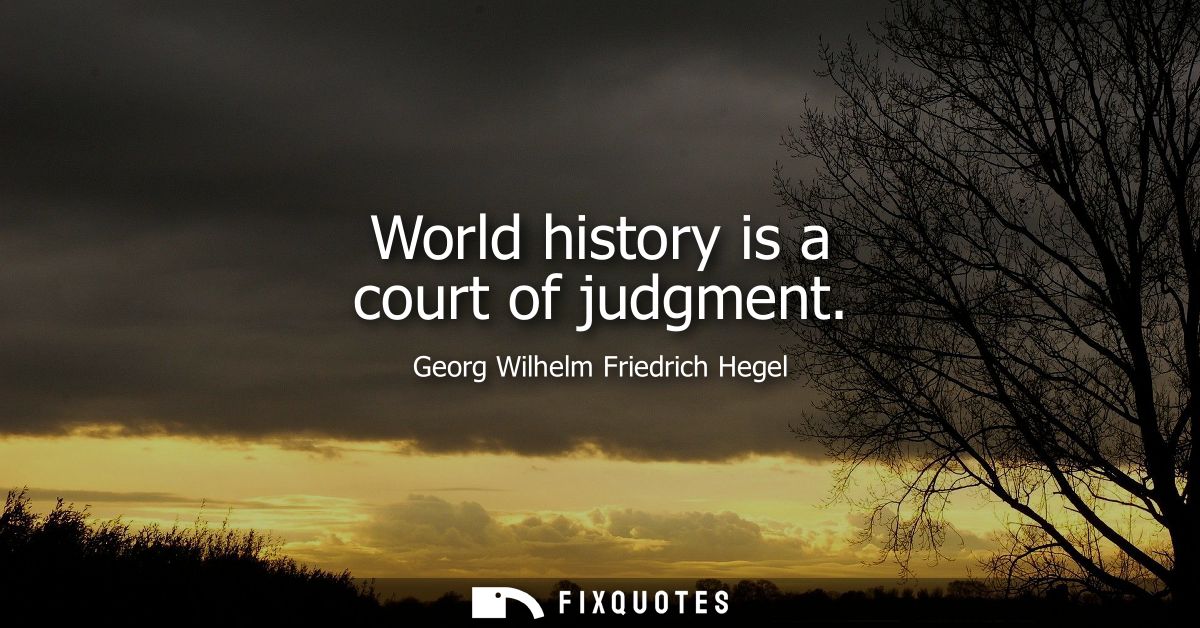
"World history is a court of judgment"
About this Quote
History, for Hegel, isn’t a scrapbook of tragedies and triumphs; it’s a tribunal. “World history is a court of judgment” carries the chill of inevitability: nations, institutions, even ideals enter the dock, and the verdict arrives not through moral sermons but through outcomes. What survives and expands appears “rational”; what collapses is treated as having failed history’s test.
The line works because it smuggles a radical claim into legal imagery. A court implies procedure, evidence, and a finality that feels objective. Hegel borrows that authority to make his philosophy of history feel less like speculation and more like a sentence handed down. The subtext is bracingly unsentimental. Individuals and peoples may believe they’re acting from piety, ambition, or patriotism, but they’re also instruments of what Hegel calls the “World Spirit,” pushed along by conflicts that reveal, retroactively, a larger logic. It’s cynicism with a metaphysical alibi: the world’s suffering becomes intelligible as the price of progress.
Context matters: Hegel is writing in the shadow of the French Revolution and the Napoleonic wars, when the old European order looked both exhausted and violently replaceable. “Judgment” here echoes the revolutionary idea that history can condemn regimes, but Hegel sharpens it: history doesn’t merely judge; it is judgment. That’s why the phrase still needles modern readers. It legitimizes power by treating victory as proof, and it dares you to ask whether “progress” is a moral horizon or just the story winners tell with philosophical polish.
The line works because it smuggles a radical claim into legal imagery. A court implies procedure, evidence, and a finality that feels objective. Hegel borrows that authority to make his philosophy of history feel less like speculation and more like a sentence handed down. The subtext is bracingly unsentimental. Individuals and peoples may believe they’re acting from piety, ambition, or patriotism, but they’re also instruments of what Hegel calls the “World Spirit,” pushed along by conflicts that reveal, retroactively, a larger logic. It’s cynicism with a metaphysical alibi: the world’s suffering becomes intelligible as the price of progress.
Context matters: Hegel is writing in the shadow of the French Revolution and the Napoleonic wars, when the old European order looked both exhausted and violently replaceable. “Judgment” here echoes the revolutionary idea that history can condemn regimes, but Hegel sharpens it: history doesn’t merely judge; it is judgment. That’s why the phrase still needles modern readers. It legitimizes power by treating victory as proof, and it dares you to ask whether “progress” is a moral horizon or just the story winners tell with philosophical polish.
Quote Details
| Topic | Wisdom |
|---|---|
| Source | Later attribution: Comparison among Ehsan Sehgal, World, and Western Philoso... (2024) modern compilationID: XrUnEQAAQBAJ
Evidence:
ChatGPT Reviewed in Detail : 1. " World history is a court of judgment . " - Georg Wilhelm Friedrich Hegel Hegel's quote expresses his philosophical view of history as a process of unfolding reason and ethical development . In his ... |
| Cite |
Citation Formats
APA Style (7th ed.)
Hegel, Georg Wilhelm Friedrich. (2026, March 31). World history is a court of judgment. FixQuotes. https://fixquotes.com/quotes/world-history-is-a-court-of-judgment-28517/
Chicago Style
Hegel, Georg Wilhelm Friedrich. "World history is a court of judgment." FixQuotes. March 31, 2026. https://fixquotes.com/quotes/world-history-is-a-court-of-judgment-28517/.
MLA Style (9th ed.)
"World history is a court of judgment." FixQuotes, 31 Mar. 2026, https://fixquotes.com/quotes/world-history-is-a-court-of-judgment-28517/. Accessed 2 Apr. 2026.
More Quotes by Georg
Add to List