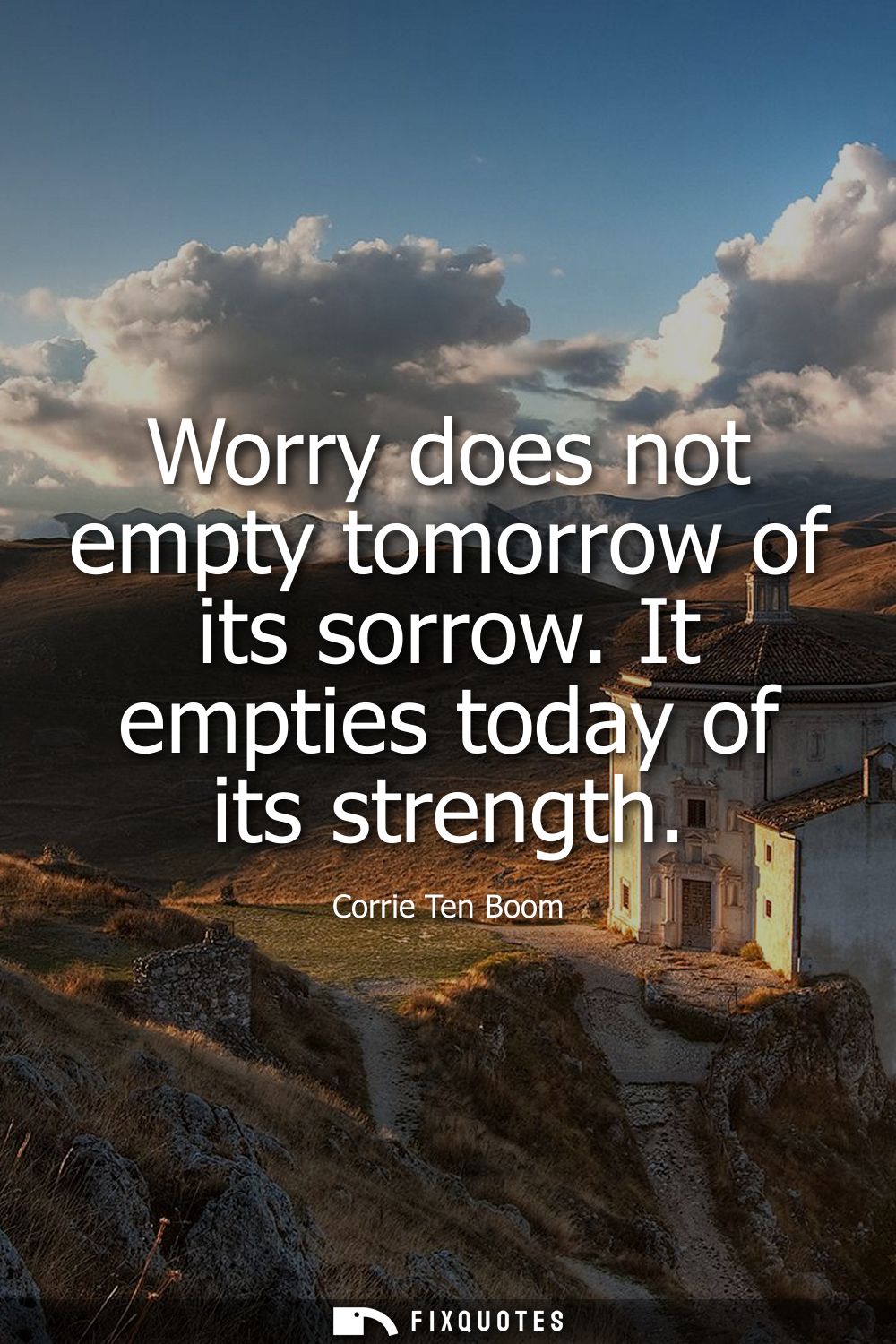
"Worry does not empty tomorrow of its sorrow. It empties today of its strength"
About this Quote
Worry is framed here not as a private feeling but as a thief with impeccable timing: it can’t rewrite what’s coming, but it can sabotage what you still have. Corrie ten Boom’s sentence works because it refuses the comforting fantasy that anxiety is preparation. The first line punctures the superstition that if you rehearse disaster hard enough, you’ll earn a softer landing. The second delivers the real cost: not tomorrow’s pain, but today’s depleted capacity to meet it.
The rhetoric is tight and moral without sounding preachy. “Empty” is doing heavy lifting, suggesting waste and needless depletion, like pouring out water you’ll need later. “Sorrow” is granted inevitability; the quote doesn’t peddle optimism. It assumes life will hurt. The pivot is agency: you may not control the future’s grief, but you can stop volunteering your present energy as tribute.
Ten Boom isn’t a pop celebrity in the usual sense; her fame comes from survival and witness. A Dutch Christian who helped Jews escape the Nazis and endured Ravensbruck, she wrote from a life where sorrow wasn’t hypothetical and “strength” wasn’t a wellness buzzword. That context sharpens the subtext: this is advice forged in extremity, not a pastel-colored mantra. In her world, worry wasn’t just an emotion; it was a tactical error that could dull attention, courage, and solidarity.
The intent, then, is disciplined hope: acknowledge suffering’s reality, refuse anxiety’s counterfeit usefulness, and protect the finite strength required to act today.
The rhetoric is tight and moral without sounding preachy. “Empty” is doing heavy lifting, suggesting waste and needless depletion, like pouring out water you’ll need later. “Sorrow” is granted inevitability; the quote doesn’t peddle optimism. It assumes life will hurt. The pivot is agency: you may not control the future’s grief, but you can stop volunteering your present energy as tribute.
Ten Boom isn’t a pop celebrity in the usual sense; her fame comes from survival and witness. A Dutch Christian who helped Jews escape the Nazis and endured Ravensbruck, she wrote from a life where sorrow wasn’t hypothetical and “strength” wasn’t a wellness buzzword. That context sharpens the subtext: this is advice forged in extremity, not a pastel-colored mantra. In her world, worry wasn’t just an emotion; it was a tactical error that could dull attention, courage, and solidarity.
The intent, then, is disciplined hope: acknowledge suffering’s reality, refuse anxiety’s counterfeit usefulness, and protect the finite strength required to act today.
Quote Details
| Topic | Anxiety |
|---|---|
| Source | Help us find the source |
More Quotes by Corrie
Add to List