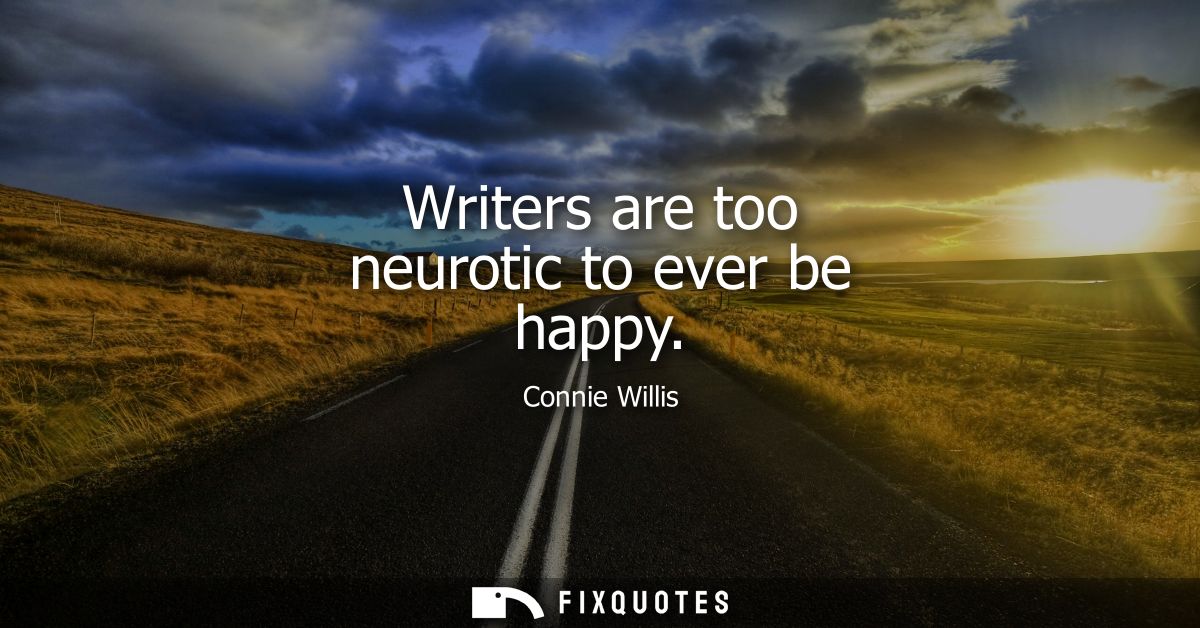
"Writers are too neurotic to ever be happy"
About this Quote
“Writers are too neurotic to ever be happy” lands like a throwaway joke, but it’s really a small act of self-defense. Connie Willis, a science-fiction writer who’s spent a career mapping human panic and tenderness onto time travel and catastrophe, knows the comic value of an overstatement. The line is hyperbolic on purpose: it invites writers to laugh at themselves before anyone else can.
The intent is less diagnosis than permission. “Neurotic” here isn’t clinical; it’s the everyday twitch of attention that makes a person notice what everyone else smooths over. Writing rewards that twitch. The job is built around dissatisfaction: rereading what you’ve done, hearing what’s wrong with it, imagining what you failed to capture. Happiness, in the simple sense of untroubled contentment, becomes structurally inconvenient. If you’re fully at ease, you stop scanning for the hairline crack in the scene, the falseness in a sentence, the missing motive in a character. The same sensitivity that produces good work also produces low-grade torment.
The subtext is affectionate but unsentimental: writers romanticize suffering, then resent it, then convert it into copy. Willis punctures the glamorous myth of the tortured artist by making it sound ordinary, even a little pathetic. Context matters, too: coming from a successful genre writer, it’s a corrective to the idea that achievement cures insecurity. It doesn’t. It just gives the neurosis better lighting and a bigger audience.
The intent is less diagnosis than permission. “Neurotic” here isn’t clinical; it’s the everyday twitch of attention that makes a person notice what everyone else smooths over. Writing rewards that twitch. The job is built around dissatisfaction: rereading what you’ve done, hearing what’s wrong with it, imagining what you failed to capture. Happiness, in the simple sense of untroubled contentment, becomes structurally inconvenient. If you’re fully at ease, you stop scanning for the hairline crack in the scene, the falseness in a sentence, the missing motive in a character. The same sensitivity that produces good work also produces low-grade torment.
The subtext is affectionate but unsentimental: writers romanticize suffering, then resent it, then convert it into copy. Willis punctures the glamorous myth of the tortured artist by making it sound ordinary, even a little pathetic. Context matters, too: coming from a successful genre writer, it’s a corrective to the idea that achievement cures insecurity. It doesn’t. It just gives the neurosis better lighting and a bigger audience.
Quote Details
| Topic | Writing |
|---|---|
| Source | Help us find the source |
| Cite |
Citation Formats
APA Style (7th ed.)
Willis, Connie. (2026, January 16). Writers are too neurotic to ever be happy. FixQuotes. https://fixquotes.com/quotes/writers-are-too-neurotic-to-ever-be-happy-99553/
Chicago Style
Willis, Connie. "Writers are too neurotic to ever be happy." FixQuotes. January 16, 2026. https://fixquotes.com/quotes/writers-are-too-neurotic-to-ever-be-happy-99553/.
MLA Style (9th ed.)
"Writers are too neurotic to ever be happy." FixQuotes, 16 Jan. 2026, https://fixquotes.com/quotes/writers-are-too-neurotic-to-ever-be-happy-99553/. Accessed 3 Apr. 2026.
More Quotes by Connie
Add to List