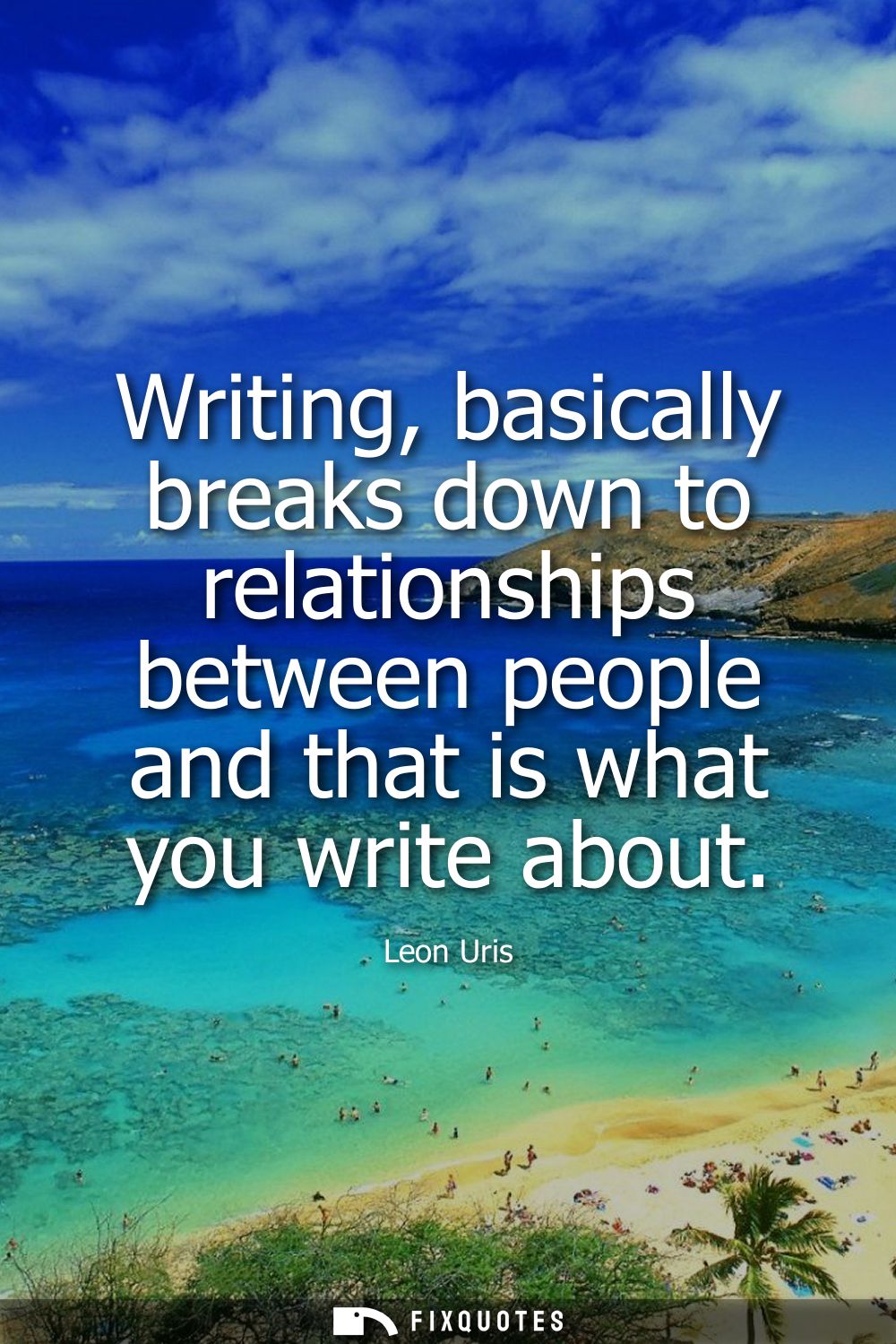
"Writing, basically breaks down to relationships between people, and that is what you write about"
About this Quote
The subtext is also a defense of readability. Uris was a popular historical novelist, not an experimental stylist, and his books succeed by translating grand events into intimate stakes. He’s telling you why epics don’t die on the page: wars and migrations are abstractions until they’re refracted through marriages, rivalries, friendships, parent-child tensions, comradeship under stress. Relationships are the engine that turns “history” into narrative and “information” into urgency.
There’s an implicit critique here of writers who hide behind world-building or concept. Uris is insisting that character isn’t a garnish; it’s the delivery system for meaning. If you can map who needs what from whom, who can’t forgive, who won’t leave, you’ve already got the story. Everything else is architecture.
Quote Details
| Topic | Writing |
|---|---|
| Source | Help us find the source |
| Cite |
Citation Formats
APA Style (7th ed.)
Uris, Leon. (2026, February 18). Writing, basically breaks down to relationships between people, and that is what you write about. FixQuotes. https://fixquotes.com/quotes/writing-basically-breaks-down-to-relationships-88232/
Chicago Style
Uris, Leon. "Writing, basically breaks down to relationships between people, and that is what you write about." FixQuotes. February 18, 2026. https://fixquotes.com/quotes/writing-basically-breaks-down-to-relationships-88232/.
MLA Style (9th ed.)
"Writing, basically breaks down to relationships between people, and that is what you write about." FixQuotes, 18 Feb. 2026, https://fixquotes.com/quotes/writing-basically-breaks-down-to-relationships-88232/. Accessed 25 Mar. 2026.