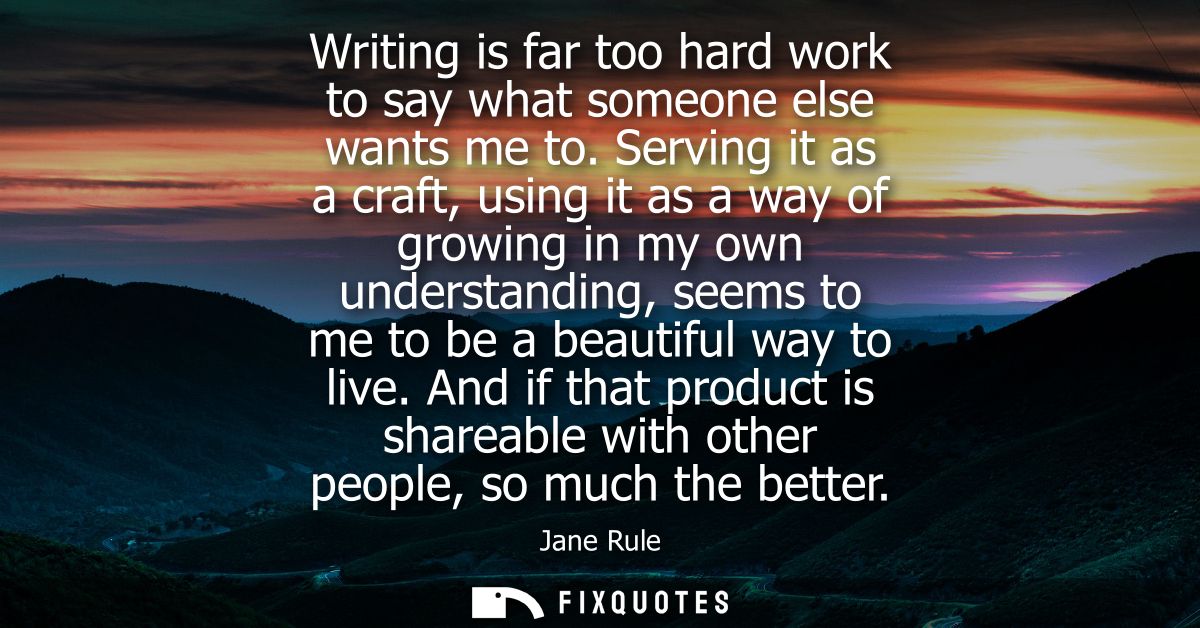
"Writing is far too hard work to say what someone else wants me to. Serving it as a craft, using it as a way of growing in my own understanding, seems to me to be a beautiful way to live. And if that product is shareable with other people, so much the better"
About this Quote
Rule pivots quickly from defiance to devotion. “Serving it as a craft” positions writing as discipline, not inspiration-soaked branding. Craft implies apprenticeship, patience, revision, the willingness to be corrected by the sentence itself. Then she slips in the real stake: writing as “a way of growing in my own understanding.” The subtext is that writing is less transmission than discovery. You don’t write because you already know; you write to find out what you think, what you can bear to name, what you’ll risk making public.
Context matters here: Rule was a lesbian novelist and essayist whose career unfolded amid censorship, moral panic, and the constant social demand to edit oneself into palatability. Read that way, her refusal isn’t just artistic; it’s ethical. She’s rejecting the pressure to convert lived experience into acceptable messaging.
The final clause lands with quiet generosity. Sharing is framed as a byproduct, not the mission statement. She’s not dismissing readers; she’s refusing to be owned by them. The beauty she names is autonomy: a life where the work changes the worker first, and only then, if it can, offers something outward.
Quote Details
| Topic | Writing |
|---|---|
| Source | Help us find the source |
| Cite |
Citation Formats
APA Style (7th ed.)
Rule, Jane. (2026, January 16). Writing is far too hard work to say what someone else wants me to. Serving it as a craft, using it as a way of growing in my own understanding, seems to me to be a beautiful way to live. And if that product is shareable with other people, so much the better. FixQuotes. https://fixquotes.com/quotes/writing-is-far-too-hard-work-to-say-what-someone-102353/
Chicago Style
Rule, Jane. "Writing is far too hard work to say what someone else wants me to. Serving it as a craft, using it as a way of growing in my own understanding, seems to me to be a beautiful way to live. And if that product is shareable with other people, so much the better." FixQuotes. January 16, 2026. https://fixquotes.com/quotes/writing-is-far-too-hard-work-to-say-what-someone-102353/.
MLA Style (9th ed.)
"Writing is far too hard work to say what someone else wants me to. Serving it as a craft, using it as a way of growing in my own understanding, seems to me to be a beautiful way to live. And if that product is shareable with other people, so much the better." FixQuotes, 16 Jan. 2026, https://fixquotes.com/quotes/writing-is-far-too-hard-work-to-say-what-someone-102353/. Accessed 11 Mar. 2026.