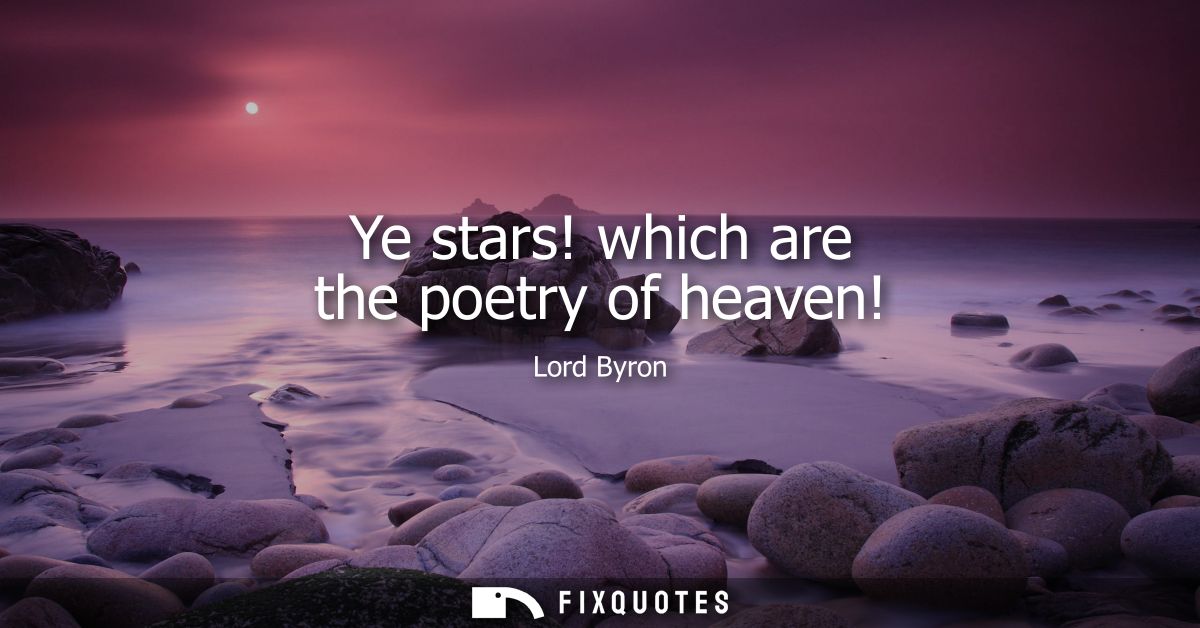
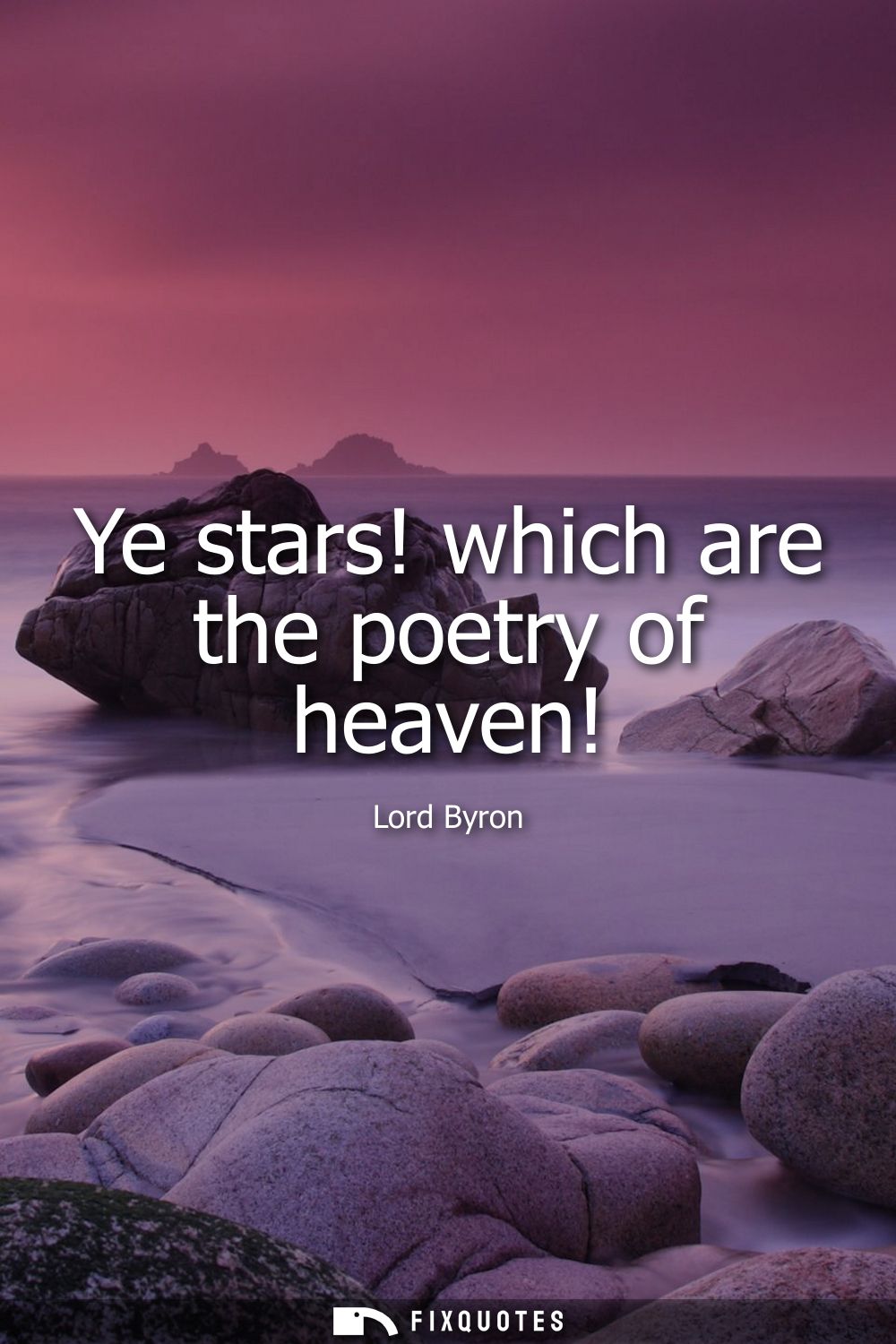
"Ye stars! which are the poetry of heaven!"
About this Quote
Byron flings his gaze upward and turns astronomy into a literary provocation. “Ye stars!” opens like a stage cry - apostrophe as adrenaline - summoning the cosmos as an audience, a jury, a confessional. Then comes the sly pivot: the stars are not just beautiful, not just distant; they are “the poetry of heaven.” In one stroke, the Romantic poet annexes the most objective thing imaginable and claims it for feeling, metaphor, and subjective hunger.
The line works because it’s both reverent and possessive. Byron isn’t simply praising the night sky; he’s insisting that nature already speaks his language. “Poetry” here is a kind of proof: the universe is arranged with the same suggestive, patterned intensity that a poem has. It’s also a dodge around doctrine. He says “heaven,” not God. That substitution matters. It keeps the spiritual charge while sidestepping the church, framing transcendence as aesthetic experience rather than moral instruction. You can sense the Byronic posture: yearning dressed up as brilliance, faith reimagined as taste.
Context sharpens the effect. Byron writes in a period when modern science is making the heavens legible in new ways, even as Romanticism pushes back, arguing that measurement misses the point. His stars are a counter-argument to the cold ledger of facts: the sky remains inexhaustible precisely because it can’t be fully possessed by explanation. The subtext is almost defiant - if the world is going to be disenchanted, Byron will re-enchant it with language.
The line works because it’s both reverent and possessive. Byron isn’t simply praising the night sky; he’s insisting that nature already speaks his language. “Poetry” here is a kind of proof: the universe is arranged with the same suggestive, patterned intensity that a poem has. It’s also a dodge around doctrine. He says “heaven,” not God. That substitution matters. It keeps the spiritual charge while sidestepping the church, framing transcendence as aesthetic experience rather than moral instruction. You can sense the Byronic posture: yearning dressed up as brilliance, faith reimagined as taste.
Context sharpens the effect. Byron writes in a period when modern science is making the heavens legible in new ways, even as Romanticism pushes back, arguing that measurement misses the point. His stars are a counter-argument to the cold ledger of facts: the sky remains inexhaustible precisely because it can’t be fully possessed by explanation. The subtext is almost defiant - if the world is going to be disenchanted, Byron will re-enchant it with language.
Quote Details
| Topic | Poetry |
|---|---|
| Source | Verified source: Childe Harold's Pilgrimage: Canto the Third (Lord Byron, 1816)
Evidence: Ye stars! which are the poetry of heaven, If in your bright leaves we would read the fate Of men and empires, – 'tis to be forgiven, That in our aspirations to be great, Our destinies o'erleap their mortal state, And claim a kindred with you; for ye are A beauty and a mystery, and create In us such love and reverence from afar, That fortune, fame, power, life, have named themselves a star. (Stanza LXXXVIII (88); exact page varies by issue/scan). This line is not a standalone aphorism in Byron; it is the opening of Stanza 88 (LXXXVIII) in Canto III of Childe Harold's Pilgrimage. The primary-source first publication for Canto III is the 1816 London edition printed for John Murray. A library catalogue record for that first edition is provided by The Morgan Library & Museum (showing publication details for the 1816 John Murray printing). The same stanza/line is also shown in multiple transcriptions of Byron’s text (non-compilation context) identifying it specifically as Stanza 88 of Canto III. ([themorgan.org](https://www.themorgan.org/printed-books/72525?utm_source=openai)) Other candidates (1) “The” Poetical Works of Lord Byron (George Gordon Byron Baron Byron, 1873) compilation95.0% George Gordon Byron Baron Byron. LXXXVIII . Ye stars ! which are the poetry of heaven ! If in your bright leaves we w... |
| Cite |
Citation Formats
APA Style (7th ed.)
Byron, Lord. (2026, February 8). Ye stars! which are the poetry of heaven! FixQuotes. https://fixquotes.com/quotes/ye-stars-which-are-the-poetry-of-heaven-8399/
Chicago Style
Byron, Lord. "Ye stars! which are the poetry of heaven!" FixQuotes. February 8, 2026. https://fixquotes.com/quotes/ye-stars-which-are-the-poetry-of-heaven-8399/.
MLA Style (9th ed.)
"Ye stars! which are the poetry of heaven!" FixQuotes, 8 Feb. 2026, https://fixquotes.com/quotes/ye-stars-which-are-the-poetry-of-heaven-8399/. Accessed 21 Mar. 2026.
More Quotes by Lord
Add to List