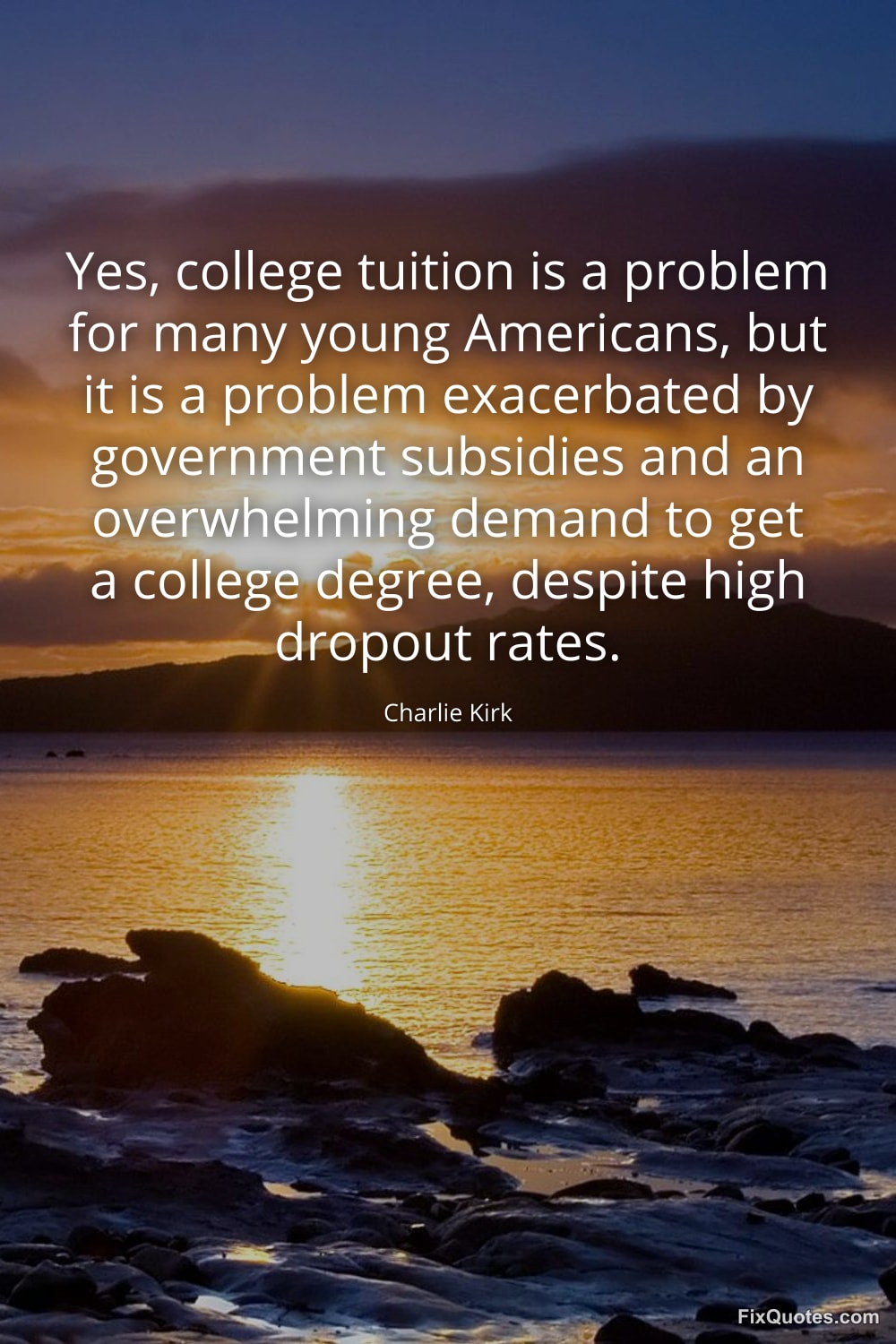
"Yes, college tuition is a problem for many young Americans, but it is a problem exacerbated by government subsidies and an overwhelming demand to get a college degree, despite high dropout rates"
About this Quote
Kirk’s line tries to do a neat rhetorical flip: acknowledge the pain point (tuition) just long enough to redirect blame away from colleges and toward the state and the culture of credential-chasing. The “Yes… but” structure is doing heavy lifting. It signals empathy while setting up a moral: government tried to help and only made things worse. That’s a familiar conservative argument, but here it’s tuned for a younger audience drowning in debt and suspicious of institutions.
The subtext is less about economics than about legitimacy. By pairing “government subsidies” with “overwhelming demand,” Kirk implies a feedback loop: subsidies inflate prices, inflated prices are normalized because everyone’s been told a degree is mandatory, and the whole machine keeps running even as “high dropout rates” reveal how many people are buying a product they won’t finish. Dropout rates aren’t just a statistic in this framing; they’re an indictment, meant to make the degree look like a status ritual rather than an investment.
Context matters: this is post-2008, post-student-debt-crisis politics, where tuition functions as a proxy battle over class mobility, cultural authority, and the value of expertise. Kirk is also speaking to a right-wing critique of the university as both overpriced and ideologically suspect. The line’s intent isn’t merely to diagnose tuition inflation; it’s to justify a pivot away from public solutions and toward alternatives (trade paths, market discipline, personal responsibility) while casting the college pipeline as a kind of mass delusion propped up by policy.
The subtext is less about economics than about legitimacy. By pairing “government subsidies” with “overwhelming demand,” Kirk implies a feedback loop: subsidies inflate prices, inflated prices are normalized because everyone’s been told a degree is mandatory, and the whole machine keeps running even as “high dropout rates” reveal how many people are buying a product they won’t finish. Dropout rates aren’t just a statistic in this framing; they’re an indictment, meant to make the degree look like a status ritual rather than an investment.
Context matters: this is post-2008, post-student-debt-crisis politics, where tuition functions as a proxy battle over class mobility, cultural authority, and the value of expertise. Kirk is also speaking to a right-wing critique of the university as both overpriced and ideologically suspect. The line’s intent isn’t merely to diagnose tuition inflation; it’s to justify a pivot away from public solutions and toward alternatives (trade paths, market discipline, personal responsibility) while casting the college pipeline as a kind of mass delusion propped up by policy.
Quote Details
| Topic | Student |
|---|
More Quotes by Charlie
Add to List