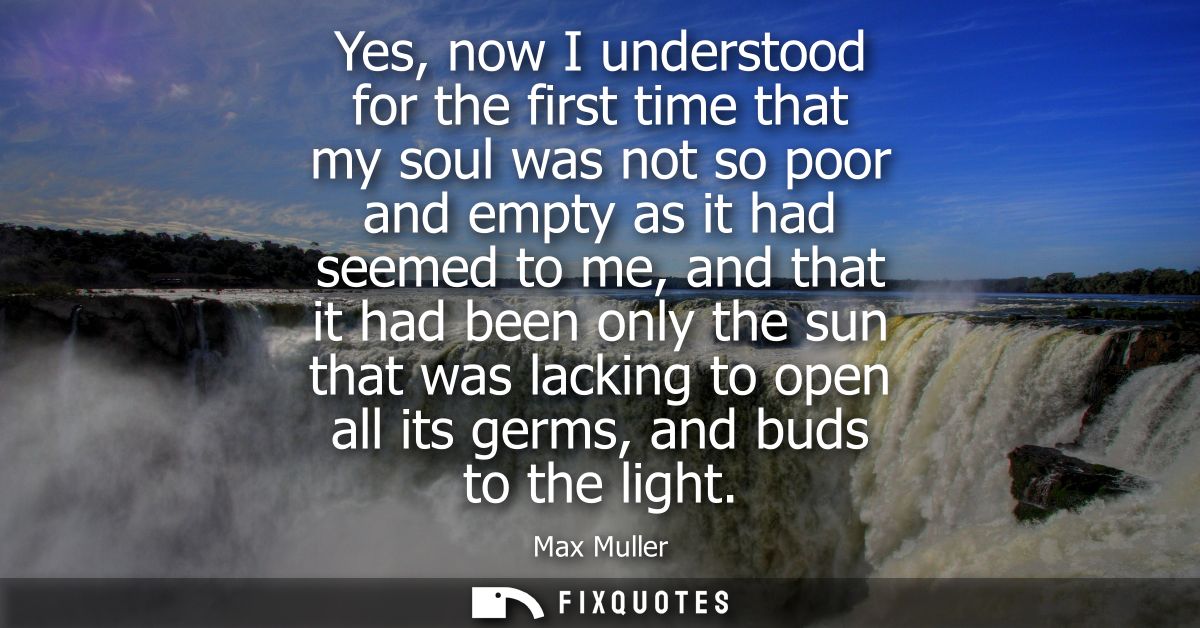
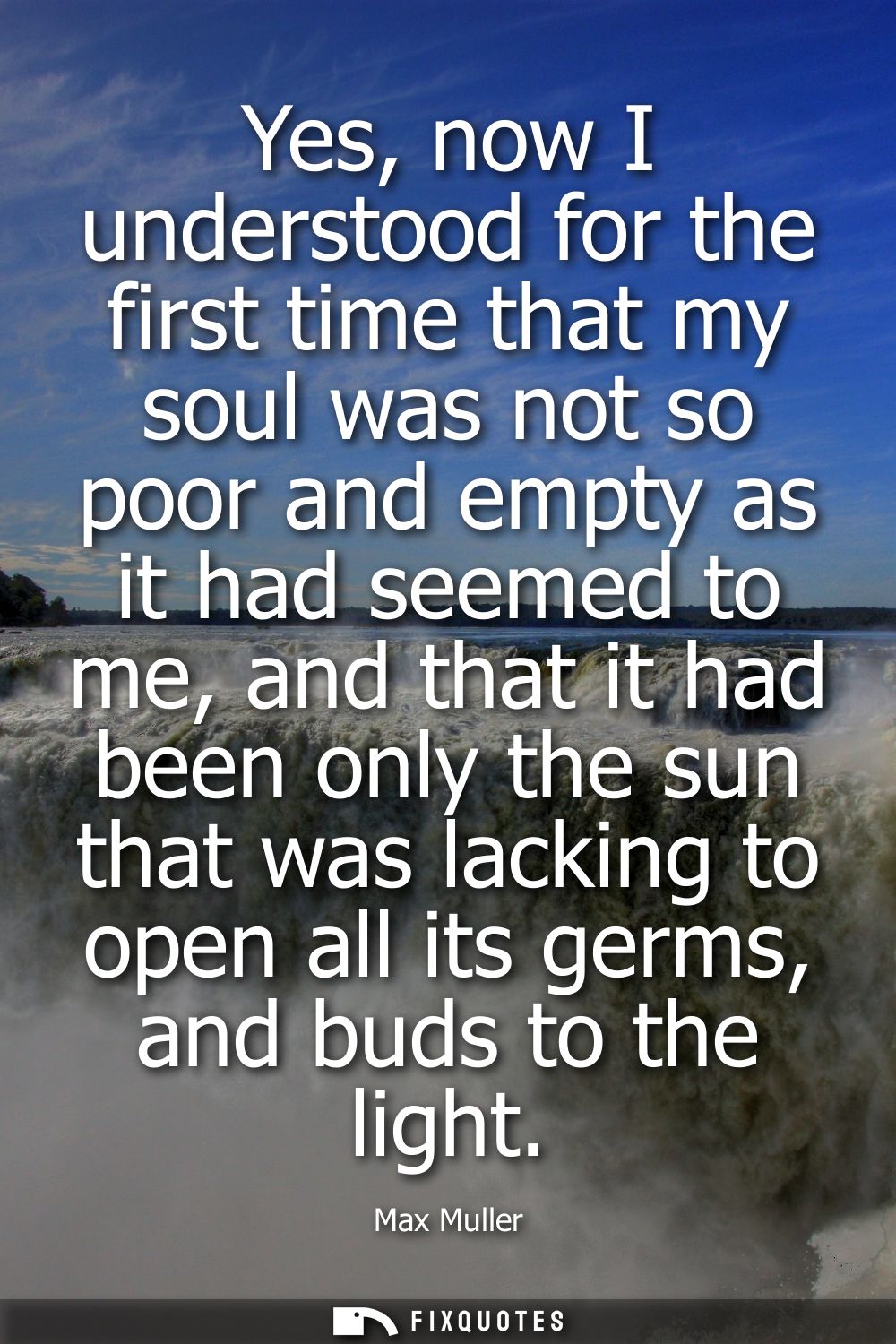
"Yes, now I understood for the first time that my soul was not so poor and empty as it had seemed to me, and that it had been only the sun that was lacking to open all its germs, and buds to the light"
About this Quote
That metaphor matters coming from an educator. Muller isn't romanticizing spontaneous self-discovery; he's defending cultivation. "Germs" and "buds" are not fully formed virtues waiting to be uncovered like treasure. They're living beginnings, vulnerable, time-dependent, and responsive to exposure. The phrase "to the light" doubles as pedagogy: learning as illumination, but also as permission. Your capacities may exist, yet remain unclaimed until the world offers a language, a mentor, a text, a community - some external warmth that makes growth thinkable.
The subtext is almost political in its gentleness. If people can be convinced their souls are empty, they'll accept small lives as natural. Muller suggests the opposite: what looks like personal inadequacy can be environmental deprivation. It's a consoling sentence, but not a soft one. It implies responsibility for whoever controls the sun: schools, institutions, cultural gatekeepers. If flourishing depends on light, then withholding it isn't neutral; it's a form of quiet harm.
Quote Details
| Topic | New Beginnings |
|---|---|
| Source | Help us find the source |
| Cite |
Citation Formats
APA Style (7th ed.)
Muller, Max. (2026, January 16). Yes, now I understood for the first time that my soul was not so poor and empty as it had seemed to me, and that it had been only the sun that was lacking to open all its germs, and buds to the light. FixQuotes. https://fixquotes.com/quotes/yes-now-i-understood-for-the-first-time-that-my-82405/
Chicago Style
Muller, Max. "Yes, now I understood for the first time that my soul was not so poor and empty as it had seemed to me, and that it had been only the sun that was lacking to open all its germs, and buds to the light." FixQuotes. January 16, 2026. https://fixquotes.com/quotes/yes-now-i-understood-for-the-first-time-that-my-82405/.
MLA Style (9th ed.)
"Yes, now I understood for the first time that my soul was not so poor and empty as it had seemed to me, and that it had been only the sun that was lacking to open all its germs, and buds to the light." FixQuotes, 16 Jan. 2026, https://fixquotes.com/quotes/yes-now-i-understood-for-the-first-time-that-my-82405/. Accessed 11 Feb. 2026.