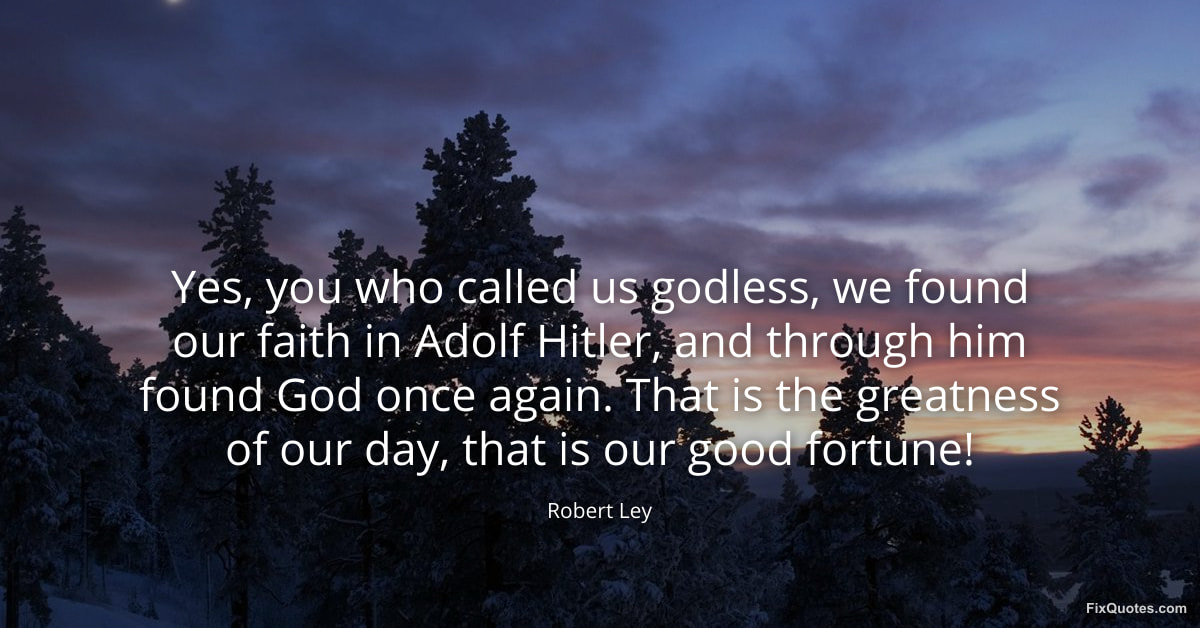
"Yes, you who called us godless, we found our faith in Adolf Hitler, and through him found God once again. That is the greatness of our day, that is our good fortune!"
About this Quote
The genius, in the darkest sense, is the structure of substitution. Hitler becomes the bridge back to God, which quietly inverts every traditional hierarchy. Instead of faith judging power, power becomes the precondition for faith. Ley frames this as a restoration narrative, the kind people reach for in disorienting times: humiliation after World War I, economic catastrophe, social fragmentation. In that churn, "we found our faith" offers belonging; "through him" offers a single, simple pathway; "once again" pretends continuity with a stable past. The fact that it’s new and radical is precisely what’s being smuggled past the listener’s defenses.
The subtext is a threat wrapped as gratitude. If Hitler is the route to God, dissent is not merely political disloyalty; it’s spiritual failure. Ley, a top Nazi labor boss and propaganda fixture, is speaking to both believers and skeptics: to Christians, he offers permission to stop worrying and sanctify the movement; to the accused "godless", he offers a conversion story that launders extremism into meaning.
"Good fortune" is the final tell. Mass politics becomes providence, history becomes destiny, and the audience is asked to feel lucky for being captured by it.
Quote Details
| Topic | Faith |
|---|---|
| Source | Help us find the source |
| Cite |
Citation Formats
APA Style (7th ed.)
Ley, Robert. (2026, January 16). Yes, you who called us godless, we found our faith in Adolf Hitler, and through him found God once again. That is the greatness of our day, that is our good fortune! FixQuotes. https://fixquotes.com/quotes/yes-you-who-called-us-godless-we-found-our-faith-135421/
Chicago Style
Ley, Robert. "Yes, you who called us godless, we found our faith in Adolf Hitler, and through him found God once again. That is the greatness of our day, that is our good fortune!" FixQuotes. January 16, 2026. https://fixquotes.com/quotes/yes-you-who-called-us-godless-we-found-our-faith-135421/.
MLA Style (9th ed.)
"Yes, you who called us godless, we found our faith in Adolf Hitler, and through him found God once again. That is the greatness of our day, that is our good fortune!" FixQuotes, 16 Jan. 2026, https://fixquotes.com/quotes/yes-you-who-called-us-godless-we-found-our-faith-135421/. Accessed 20 Mar. 2026.