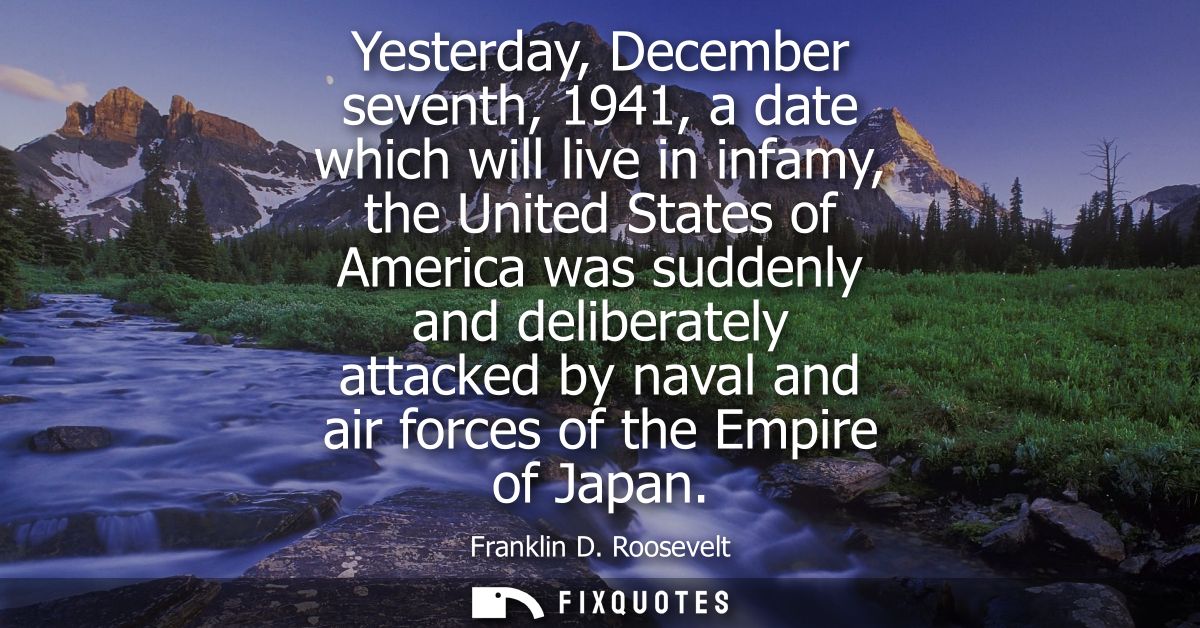
"Yesterday, December seventh, 1941 - a date which will live in infamy - the United States of America was suddenly and deliberately attacked by naval and air forces of the Empire of Japan"
About this Quote
The sentence is built to strip the attack of any romantic “act of war” framing. “Suddenly and deliberately” is a blunt two-step: surprise removes any notion of fair fight, deliberate removes any excuse of accident or misunderstanding. Roosevelt isn’t only describing what happened; he’s preempting counter-narratives that might slow mobilization or complicate public resolve. Even “Empire of Japan” matters. It situates Japan not as a distant people but as an imperial actor, a geopolitical machine, making the conflict feel like a clash with an aggressive system rather than a bilateral dispute.
Context sharpens the intent. In 1941, American opinion was still tugged between intervention and restraint, with isolationism politically potent. This line is designed as a lever: moral certainty + temporal immediacy + unmistakable agency. It authorizes the next steps without saying them yet, converting grief and shock into permission for war. Roosevelt’s rhetoric doesn’t ask Americans to understand; it asks them to agree, together, right now.
Quote Details
| Topic | War |
|---|---|
| Source | Help us find the source |
| Cite |
Citation Formats
APA Style (7th ed.)
Roosevelt, Franklin D. (2026, February 20). Yesterday, December seventh, 1941 - a date which will live in infamy - the United States of America was suddenly and deliberately attacked by naval and air forces of the Empire of Japan. FixQuotes. https://fixquotes.com/quotes/yesterday-december-seventh-1941-a-date-which-will-16521/
Chicago Style
Roosevelt, Franklin D. "Yesterday, December seventh, 1941 - a date which will live in infamy - the United States of America was suddenly and deliberately attacked by naval and air forces of the Empire of Japan." FixQuotes. February 20, 2026. https://fixquotes.com/quotes/yesterday-december-seventh-1941-a-date-which-will-16521/.
MLA Style (9th ed.)
"Yesterday, December seventh, 1941 - a date which will live in infamy - the United States of America was suddenly and deliberately attacked by naval and air forces of the Empire of Japan." FixQuotes, 20 Feb. 2026, https://fixquotes.com/quotes/yesterday-december-seventh-1941-a-date-which-will-16521/. Accessed 25 Mar. 2026.