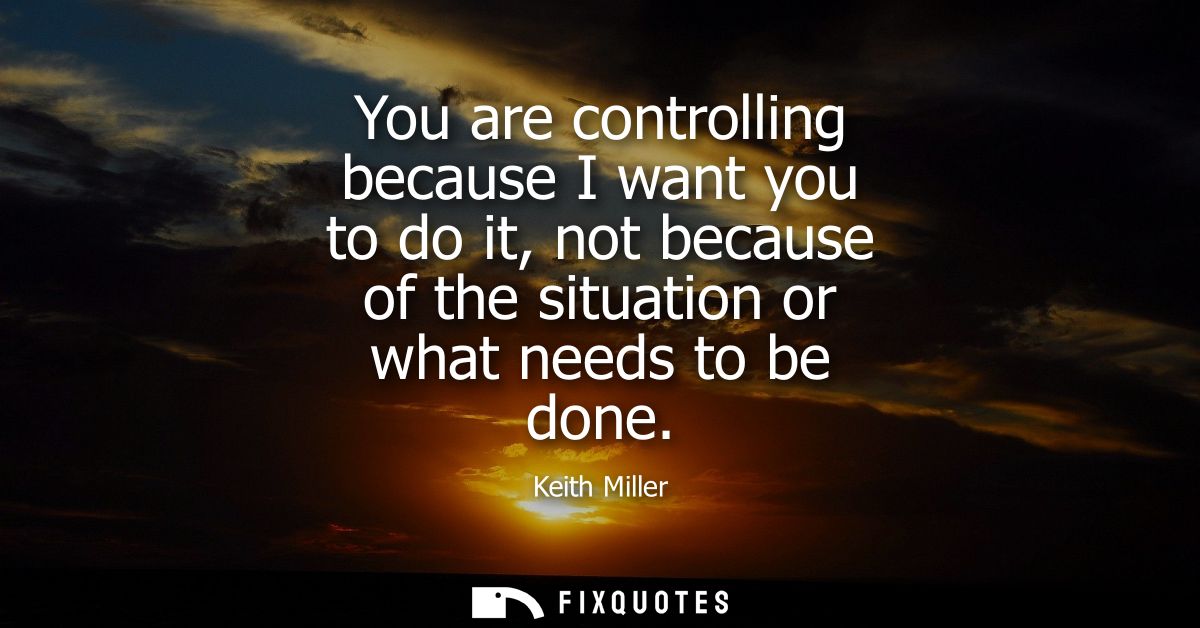
"You are controlling because I want you to do it, not because of the situation or what needs to be done"
About this Quote
It is a small sentence with a big tell: the speaker is trying to redraw the map of power by relocating control from circumstance to desire. “You are controlling” is the accusation, but the clause that follows tries to soften it into something almost flattering: not coercion, just devotion. The rhetorical trick is in the pivot from “the situation” and “what needs to be done” (external necessities that could justify leadership) to “because I want you to do it” (a private craving dressed up as consent).
That move carries two competing subtexts. One is romantic: I like your decisiveness; your direction makes me feel safe; I’m inviting you into the driver’s seat. The other is more unsettling: it reframes manipulation as preference. If control is “because I want you to,” then objections can be pre-empted. Any pushback becomes a rejection of intimacy rather than a boundary dispute. The line quietly conflates wanting with consenting, which is exactly where messy relationships tend to break: desire is volatile; consent is specific.
Miller’s phrasing also exposes a cultural itch about responsibility. People often outsource agency, then resent the person who accepts it. By insisting the controlling behavior isn’t demanded by reality, the speaker attempts to absolve the controller of “necessity” and pin the dynamic on personal appetite. It’s a confession and a defense at once: I asked for this, so don’t blame them; I asked for this, so maybe blame me. The quote works because it dramatizes how control can be co-authored, then misread as a solo act.
That move carries two competing subtexts. One is romantic: I like your decisiveness; your direction makes me feel safe; I’m inviting you into the driver’s seat. The other is more unsettling: it reframes manipulation as preference. If control is “because I want you to,” then objections can be pre-empted. Any pushback becomes a rejection of intimacy rather than a boundary dispute. The line quietly conflates wanting with consenting, which is exactly where messy relationships tend to break: desire is volatile; consent is specific.
Miller’s phrasing also exposes a cultural itch about responsibility. People often outsource agency, then resent the person who accepts it. By insisting the controlling behavior isn’t demanded by reality, the speaker attempts to absolve the controller of “necessity” and pin the dynamic on personal appetite. It’s a confession and a defense at once: I asked for this, so don’t blame them; I asked for this, so maybe blame me. The quote works because it dramatizes how control can be co-authored, then misread as a solo act.
Quote Details
| Topic | Relationship |
|---|
More Quotes by Keith
Add to List