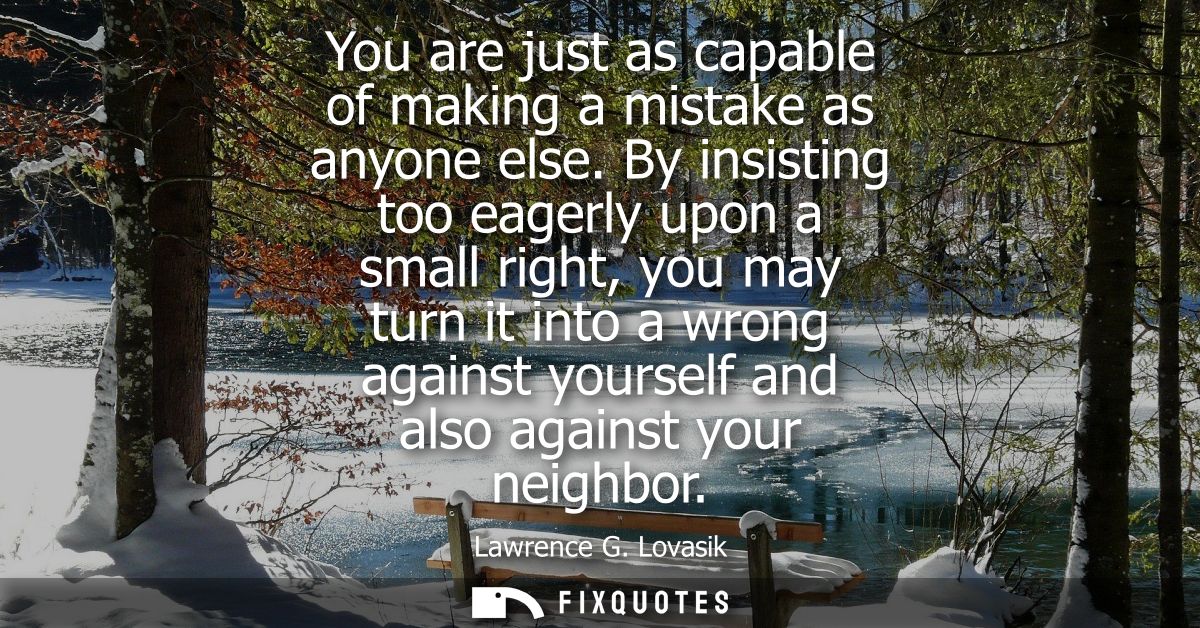
"You are just as capable of making a mistake as anyone else. By insisting too eagerly upon a small right, you may turn it into a wrong against yourself and also against your neighbor"
About this Quote
The phrase “insisting too eagerly upon a small right” carries the real bite. Lovasik isn’t condemning righteousness; he’s diagnosing a familiar escalation: when a legitimate claim (a rule, a boundary, a principle) becomes a performance of dominance. “Too eagerly” signals impatience, heat, and pride - the emotional fuel that turns a correct point into a relational weapon. The “small right” is also a shrewd choice: it’s often the petty certainties that people cling to hardest, because they’re easy to prove and satisfying to enforce.
The subtext is communal. In Christian moral thinking, neighbor isn’t just the person next door; it’s the test case for whether your virtue is real. Lovasik’s warning is that rights detached from charity become self-harming: you may “turn it into a wrong against yourself” by hardening your character, and “against your neighbor” by shrinking empathy into legalism. The context feels pastoral - a guide for ordinary conflict, where the spiritual stakes are not abstract doctrines but the everyday temptation to win and call it holiness.
Quote Details
| Topic | Humility |
|---|---|
| Source | Help us find the source |
| Cite |
Citation Formats
APA Style (7th ed.)
Lovasik, Lawrence G. (2026, January 16). You are just as capable of making a mistake as anyone else. By insisting too eagerly upon a small right, you may turn it into a wrong against yourself and also against your neighbor. FixQuotes. https://fixquotes.com/quotes/you-are-just-as-capable-of-making-a-mistake-as-99026/
Chicago Style
Lovasik, Lawrence G. "You are just as capable of making a mistake as anyone else. By insisting too eagerly upon a small right, you may turn it into a wrong against yourself and also against your neighbor." FixQuotes. January 16, 2026. https://fixquotes.com/quotes/you-are-just-as-capable-of-making-a-mistake-as-99026/.
MLA Style (9th ed.)
"You are just as capable of making a mistake as anyone else. By insisting too eagerly upon a small right, you may turn it into a wrong against yourself and also against your neighbor." FixQuotes, 16 Jan. 2026, https://fixquotes.com/quotes/you-are-just-as-capable-of-making-a-mistake-as-99026/. Accessed 9 Mar. 2026.