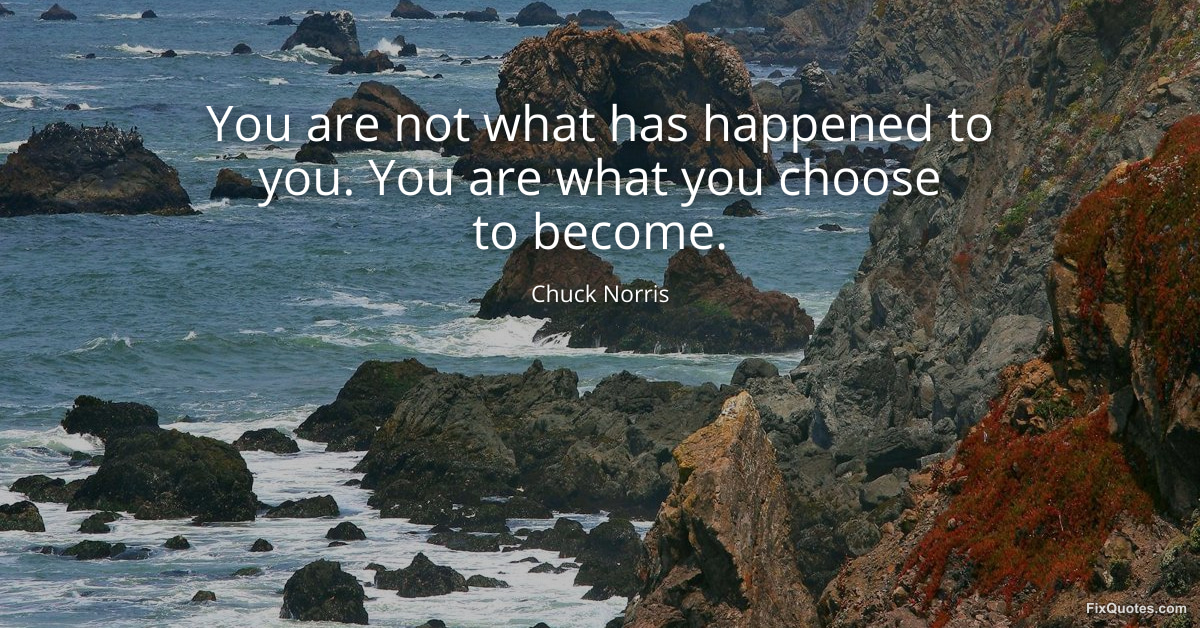
"You are not what has happened to you. You are what you choose to become"
About this Quote
That turn is the engine of the quote. Norris isn't denying that people are shaped by circumstance; he's making a moral argument about authorship. The verb "choose" matters. It frames personhood not as a fixed inheritance but as an ongoing act of will. Coming from an actor whose public persona was built on discipline, stoicism, and physical control, the message fits neatly into the American self-making tradition: grit over grievance, action over explanation.
Its appeal is obvious. It offers dignity to people who feel trapped by what they've endured. It takes the language of motivation and gives it a redemptive edge: your worst day is not your permanent definition. That's why it circulates so easily in self-help culture and social media. It's clean, portable, emotionally legible.
Still, the quote's power is also its simplification. Not everyone has equal room to "choose" their future; structures, luck, and damage are real. Norris sidesteps that complexity because the line is designed less as sociology than as ignition. Its intent is to move people from injury to motion, from narrative of victimhood to narrative of becoming.
Quote Details
| Topic | Reinvention |
|---|---|
| Source | Help us find the source |
| Cite |
Citation Formats
APA Style (7th ed.)
Norris, Chuck. (2026, March 20). You are not what has happened to you. You are what you choose to become. FixQuotes. https://fixquotes.com/quotes/you-are-not-what-has-happened-to-you-you-are-what-186192/
Chicago Style
Norris, Chuck. "You are not what has happened to you. You are what you choose to become." FixQuotes. March 20, 2026. https://fixquotes.com/quotes/you-are-not-what-has-happened-to-you-you-are-what-186192/.
MLA Style (9th ed.)
"You are not what has happened to you. You are what you choose to become." FixQuotes, 20 Mar. 2026, https://fixquotes.com/quotes/you-are-not-what-has-happened-to-you-you-are-what-186192/. Accessed 24 Mar. 2026.