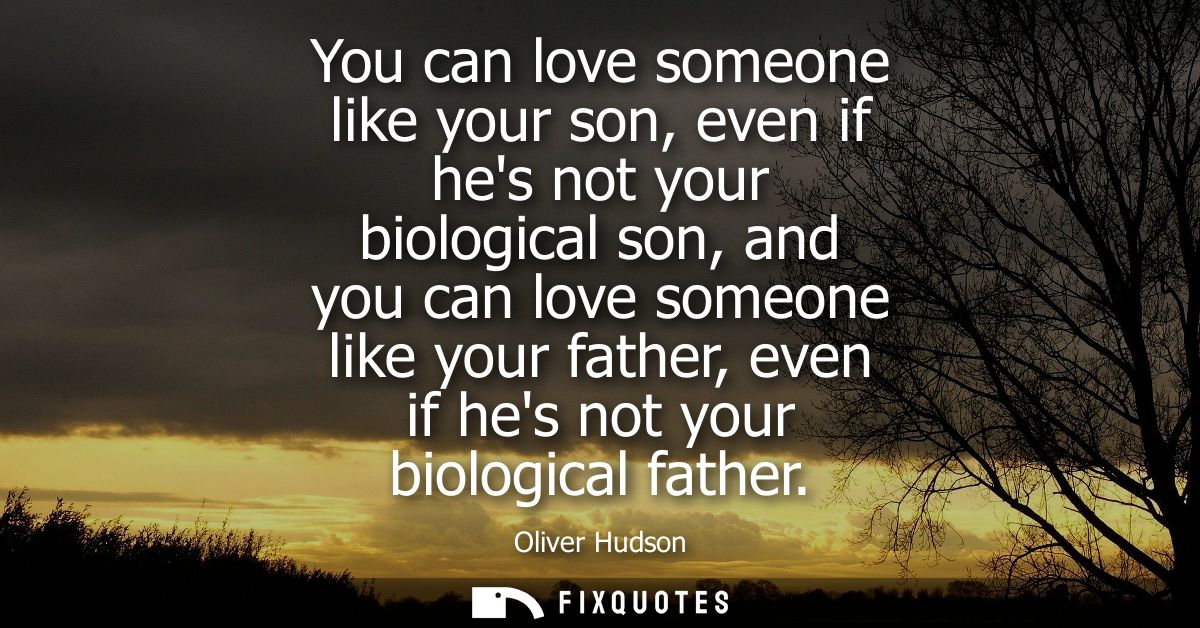
"You can love someone like your son, even if he's not your biological son, and you can love someone like your father, even if he's not your biological father"
About this Quote
The intent feels both personal and strategic. As a public figure whose private relationships are routinely flattened into tabloid math, Hudson uses plain language to reclaim the terms. “Like your son” and “like your father” are careful phrases; they acknowledge the category without letting biology own it. He’s not denying DNA matters to some people, he’s refusing to let it be the only legitimizing force.
Subtext: loyalty and intimacy are built through time, caretaking, and presence, not shared chromosomes. The quote also carries a mild rebuke to the culture that treats “real dad” as synonymous with “biological dad,” a reflex that can erase the parent who actually showed up. By naming both directions (parent-to-child and child-to-parent), Hudson avoids the usual sentimental framing where adults “take in” kids; he validates the child’s attachment too, which is where legitimacy often gets questioned.
Contextually, it lands in an era of blended families and public boundary-setting, where celebrity narratives about parenting double as social scripts. Hudson isn’t making a philosophical argument; he’s making permission feel ordinary.
Quote Details
| Topic | Family |
|---|---|
| Source | Help us find the source |
| Cite |
Citation Formats
APA Style (7th ed.)
Hudson, Oliver. (2026, January 15). You can love someone like your son, even if he's not your biological son, and you can love someone like your father, even if he's not your biological father. FixQuotes. https://fixquotes.com/quotes/you-can-love-someone-like-your-son-even-if-hes-171040/
Chicago Style
Hudson, Oliver. "You can love someone like your son, even if he's not your biological son, and you can love someone like your father, even if he's not your biological father." FixQuotes. January 15, 2026. https://fixquotes.com/quotes/you-can-love-someone-like-your-son-even-if-hes-171040/.
MLA Style (9th ed.)
"You can love someone like your son, even if he's not your biological son, and you can love someone like your father, even if he's not your biological father." FixQuotes, 15 Jan. 2026, https://fixquotes.com/quotes/you-can-love-someone-like-your-son-even-if-hes-171040/. Accessed 3 Apr. 2026.