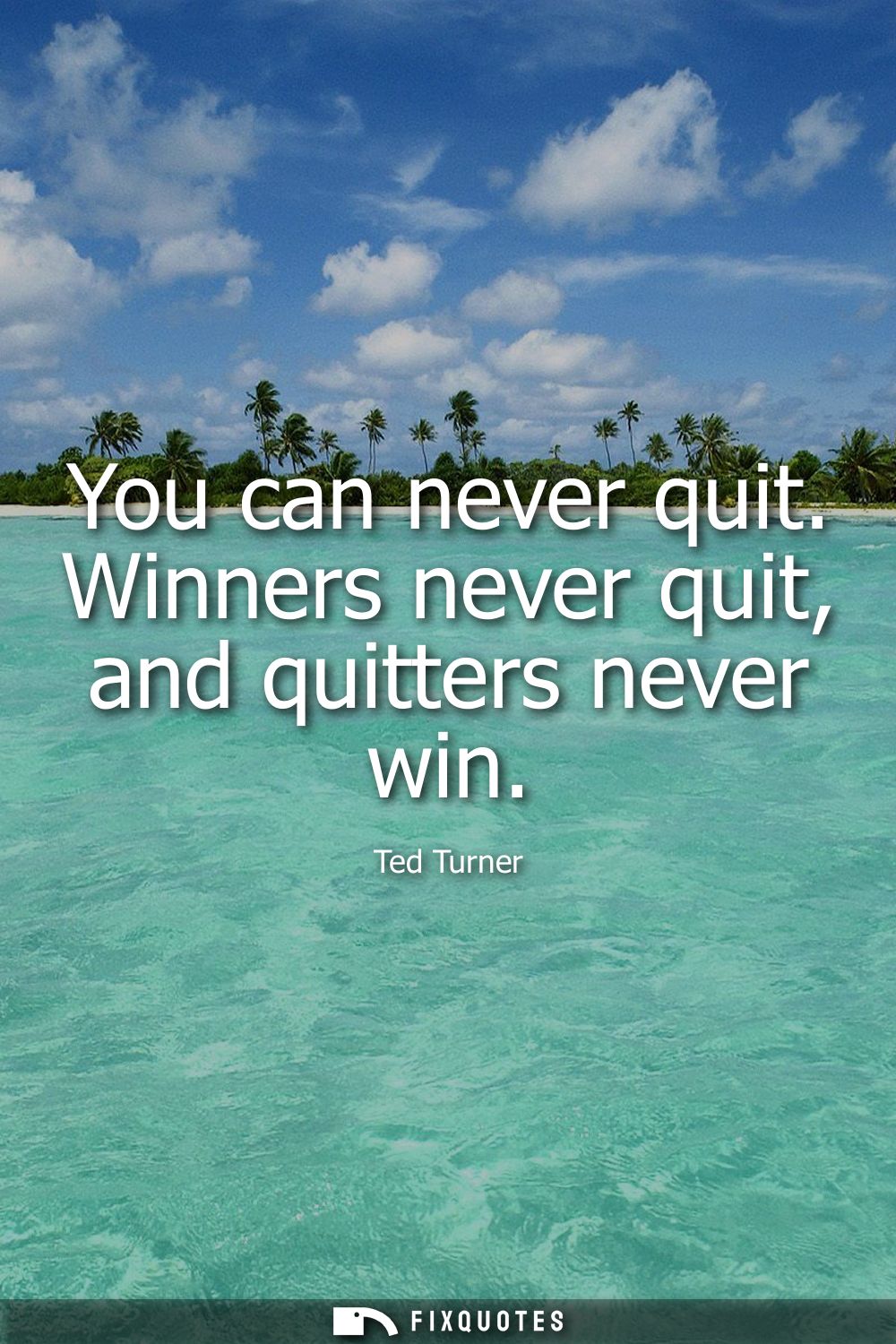
"You can never quit. Winners never quit, and quitters never win"
About this Quote
It is a mantra that turns endurance into morality, the kind of sentence that sounds like advice and behaves like a contract. Ted Turner, the swashbuckling businessman who built an empire by betting big and staying loud, delivers a line that doesn’t just praise persistence; it erases the legitimacy of stopping. The structure is deliberately circular: “never quit” becomes self-evident because the definition of “winner” is engineered to exclude anyone who quits. That tautology is the point. It’s not logic meant to persuade skeptics; it’s identity language meant to recruit believers.
In Turner’s world, where risk is reputational currency and momentum is a business strategy, quitting isn’t a neutral decision. It’s a public admission that the story you’ve been telling about yourself was inflated. This is especially resonant in late-20th-century American corporate culture, where the mythology of the self-made winner became a kind of secular religion: grit as virtue, relentlessness as proof of worth, the market as scoreboard.
The subtext has teeth. If you internalize the slogan, you’ll work longer, tolerate more uncertainty, and treat doubt as disloyalty - useful traits for an entrepreneur and even more useful for the people employing one. It also conveniently scrubs away structural realities: sometimes winners do quit, pivot, sell, walk away, or survive by redefining the game. Turner’s line is less a map of reality than a motivational weapon: simple, absolutist, and calibrated to keep you running when nuance would tell you to stop.
In Turner’s world, where risk is reputational currency and momentum is a business strategy, quitting isn’t a neutral decision. It’s a public admission that the story you’ve been telling about yourself was inflated. This is especially resonant in late-20th-century American corporate culture, where the mythology of the self-made winner became a kind of secular religion: grit as virtue, relentlessness as proof of worth, the market as scoreboard.
The subtext has teeth. If you internalize the slogan, you’ll work longer, tolerate more uncertainty, and treat doubt as disloyalty - useful traits for an entrepreneur and even more useful for the people employing one. It also conveniently scrubs away structural realities: sometimes winners do quit, pivot, sell, walk away, or survive by redefining the game. Turner’s line is less a map of reality than a motivational weapon: simple, absolutist, and calibrated to keep you running when nuance would tell you to stop.
Quote Details
| Topic | Never Give Up |
|---|---|
| Source | Help us find the source |
| Cite |
Citation Formats
APA Style (7th ed.)
Turner, Ted. (2026, January 16). You can never quit. Winners never quit, and quitters never win. FixQuotes. https://fixquotes.com/quotes/you-can-never-quit-winners-never-quit-and-99316/
Chicago Style
Turner, Ted. "You can never quit. Winners never quit, and quitters never win." FixQuotes. January 16, 2026. https://fixquotes.com/quotes/you-can-never-quit-winners-never-quit-and-99316/.
MLA Style (9th ed.)
"You can never quit. Winners never quit, and quitters never win." FixQuotes, 16 Jan. 2026, https://fixquotes.com/quotes/you-can-never-quit-winners-never-quit-and-99316/. Accessed 13 Feb. 2026.
More Quotes by Ted
Add to List