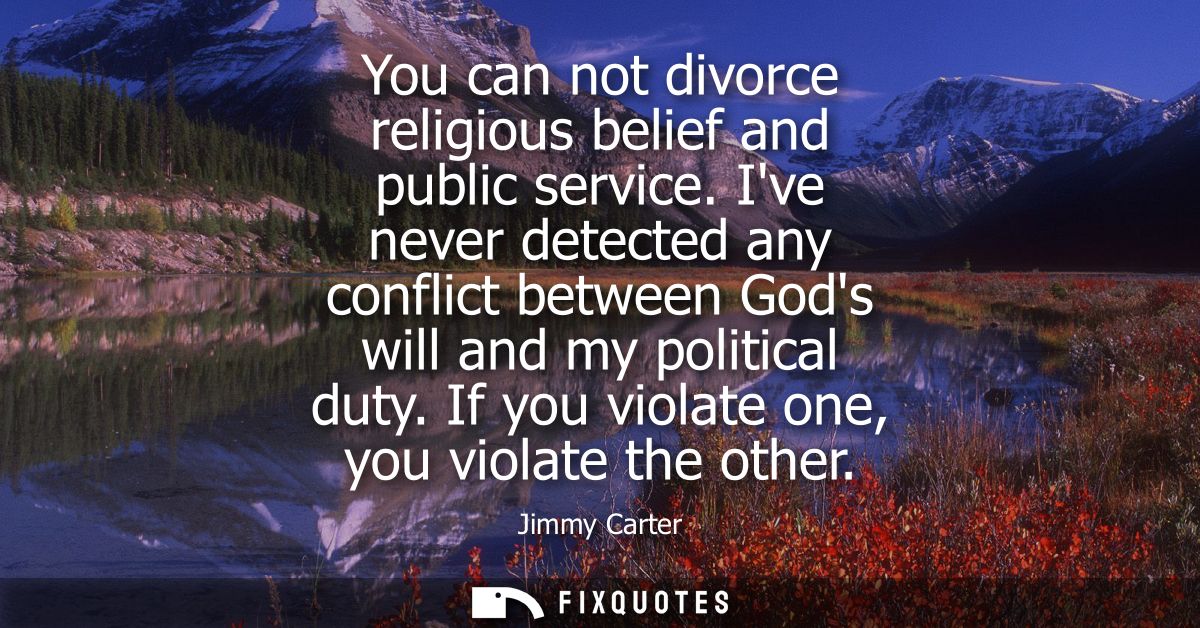
"You can not divorce religious belief and public service. I've never detected any conflict between God's will and my political duty. If you violate one, you violate the other"
About this Quote
The subtext is defensive as much as devotional. Carter governed in a moment when “born again” Christianity was moving from private testimony to political identity, and when the post-Watergate hunger for clean hands made moral language a credential. His words try to answer the suspicion that religious conviction will warp public duty: no, faith doesn’t distort the job; it defines the job. It’s also a preemptive rebuttal to the secular critique that public service must be religiously neutral. Carter doesn’t argue for a theocracy; he argues that neutrality is a myth because every public decision already smuggles in a moral framework.
The risk in the rhetoric is its closed circuit. If “God’s will” and “political duty” are always aligned, then politics becomes less a messy negotiation among citizens and more a test of personal righteousness. That’s powerful in tone, but it narrows democratic humility: compromise starts to look like betrayal, and dissent starts to look like sin.
Quote Details
| Topic | Faith |
|---|---|
| Source | Help us find the source |
| Cite |
Citation Formats
APA Style (7th ed.)
Carter, Jimmy. (2026, January 18). You can not divorce religious belief and public service. I've never detected any conflict between God's will and my political duty. If you violate one, you violate the other. FixQuotes. https://fixquotes.com/quotes/you-can-not-divorce-religious-belief-and-public-19699/
Chicago Style
Carter, Jimmy. "You can not divorce religious belief and public service. I've never detected any conflict between God's will and my political duty. If you violate one, you violate the other." FixQuotes. January 18, 2026. https://fixquotes.com/quotes/you-can-not-divorce-religious-belief-and-public-19699/.
MLA Style (9th ed.)
"You can not divorce religious belief and public service. I've never detected any conflict between God's will and my political duty. If you violate one, you violate the other." FixQuotes, 18 Jan. 2026, https://fixquotes.com/quotes/you-can-not-divorce-religious-belief-and-public-19699/. Accessed 6 Apr. 2026.