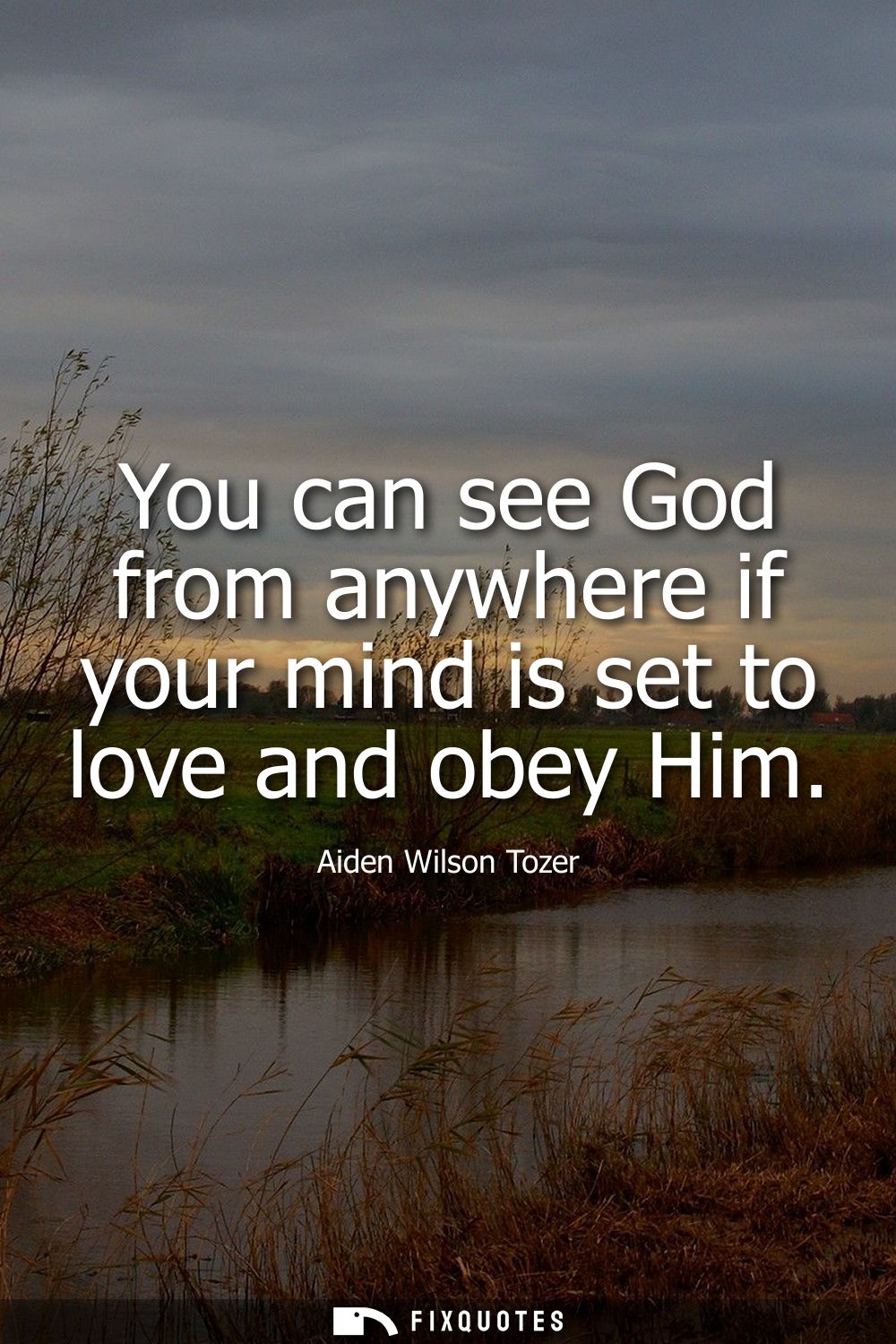
"You can see God from anywhere if your mind is set to love and obey Him"
About this Quote
Tozer’s line is a quiet grenade lobbed into the modern habit of treating spirituality as a scavenger hunt for the right atmosphere. No pilgrimage required, no aesthetic mood lighting, no special access pass: “anywhere” flattens the spiritual hierarchy. The radical claim isn’t that God is visible like a landmark, but that perception is moral before it’s mystical. The decisive variable is not geography but posture: a mind “set” to “love and obey.”
That pairing matters. Tozer refuses the contemporary split between warm feelings and hard demands. Love without obedience becomes self-soothing; obedience without love becomes anxious performance. He welds them together and, in doing so, smuggles in a critique of religious consumerism: if you’re always chasing the next “experience,” you may be avoiding the ordinary disciplines that would actually change you. “See God” becomes less about visions and more about attention trained by surrender.
The subtext is also a rebuke to spiritual elitism. If God can be “seen” anywhere, then the factory floor, the kitchen, the hospital waiting room carry as much potential for encounter as the sanctuary. That democratizes holiness, but it also removes excuses. The line implies that God’s absence is often not metaphysical but perceptual: the heart is angled the wrong way.
Contextually, Tozer preached in a 20th-century Protestant world wrestling with mechanization, distraction, and respectable churchiness. His intent is to re-center faith as a lived orientation, not a weekend performance - a spirituality sturdy enough to survive the unglamorous places where most life happens.
That pairing matters. Tozer refuses the contemporary split between warm feelings and hard demands. Love without obedience becomes self-soothing; obedience without love becomes anxious performance. He welds them together and, in doing so, smuggles in a critique of religious consumerism: if you’re always chasing the next “experience,” you may be avoiding the ordinary disciplines that would actually change you. “See God” becomes less about visions and more about attention trained by surrender.
The subtext is also a rebuke to spiritual elitism. If God can be “seen” anywhere, then the factory floor, the kitchen, the hospital waiting room carry as much potential for encounter as the sanctuary. That democratizes holiness, but it also removes excuses. The line implies that God’s absence is often not metaphysical but perceptual: the heart is angled the wrong way.
Contextually, Tozer preached in a 20th-century Protestant world wrestling with mechanization, distraction, and respectable churchiness. His intent is to re-center faith as a lived orientation, not a weekend performance - a spirituality sturdy enough to survive the unglamorous places where most life happens.
Quote Details
| Topic | God |
|---|---|
| Source | Help us find the source |
More Quotes by Aiden
Add to List