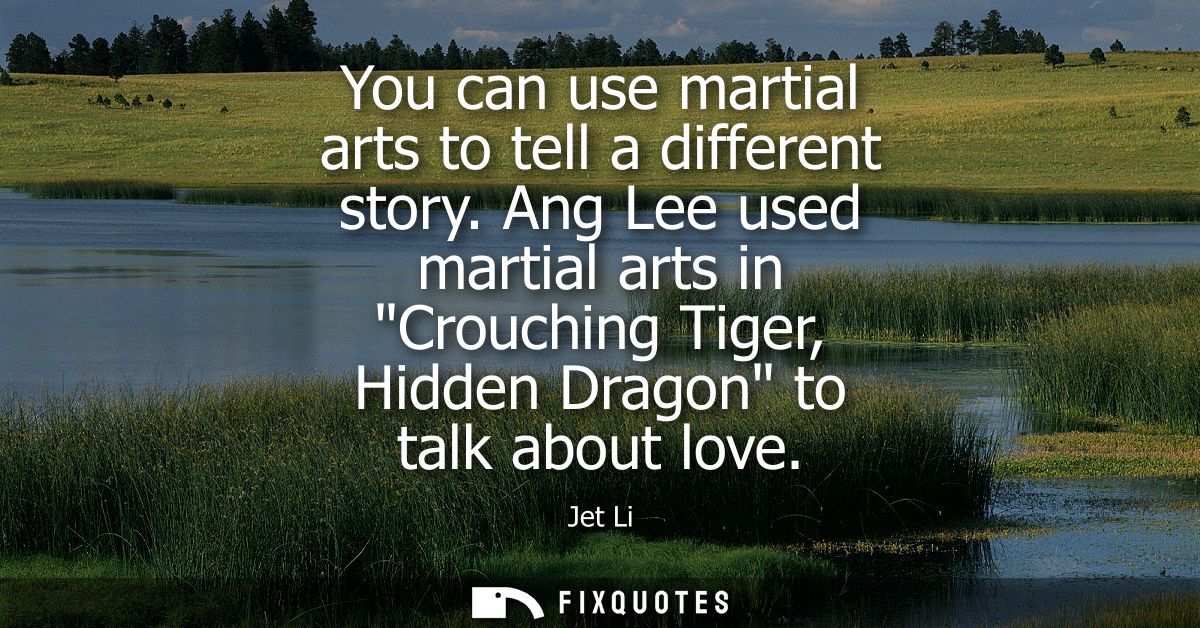
"You can use martial arts to tell a different story. Ang Lee used martial arts in "Crouching Tiger, Hidden Dragon" to talk about love"
About this Quote
Pointing to Ang Lee’s Crouching Tiger, Hidden Dragon is strategic. That film arrived as a crossover event: wuxia aesthetics filtered through an art-house sensibility, sold globally without translating its emotional logic into something more “Western.” Lee uses wirework and balletic motion not to prove toughness but to externalize longing. The fights don’t interrupt the love story; they are the love story, because these characters have been trained to speak with restraint. What can’t be said outright gets displaced into movement: the distance between bodies, the near-touch that becomes a strike, the discipline that reads like devotion and repression at once.
The subtext in Li’s quote is a pushback against the reduction of martial-arts stars to pure physicality. He’s insisting that performers aren’t just athletes on camera; they’re storytellers operating inside a tradition where combat has always been metaphor - for honor, duty, desire, the ache of choices made too late. In a Hollywood ecosystem that often treats fights as content, Li is reminding us they can be character.
Quote Details
| Topic | Movie |
|---|---|
| Source | Help us find the source |
| Cite |
Citation Formats
APA Style (7th ed.)
Li, Jet. (2026, January 17). You can use martial arts to tell a different story. Ang Lee used martial arts in "Crouching Tiger, Hidden Dragon" to talk about love. FixQuotes. https://fixquotes.com/quotes/you-can-use-martial-arts-to-tell-a-different-63969/
Chicago Style
Li, Jet. "You can use martial arts to tell a different story. Ang Lee used martial arts in "Crouching Tiger, Hidden Dragon" to talk about love." FixQuotes. January 17, 2026. https://fixquotes.com/quotes/you-can-use-martial-arts-to-tell-a-different-63969/.
MLA Style (9th ed.)
"You can use martial arts to tell a different story. Ang Lee used martial arts in "Crouching Tiger, Hidden Dragon" to talk about love." FixQuotes, 17 Jan. 2026, https://fixquotes.com/quotes/you-can-use-martial-arts-to-tell-a-different-63969/. Accessed 2 Apr. 2026.