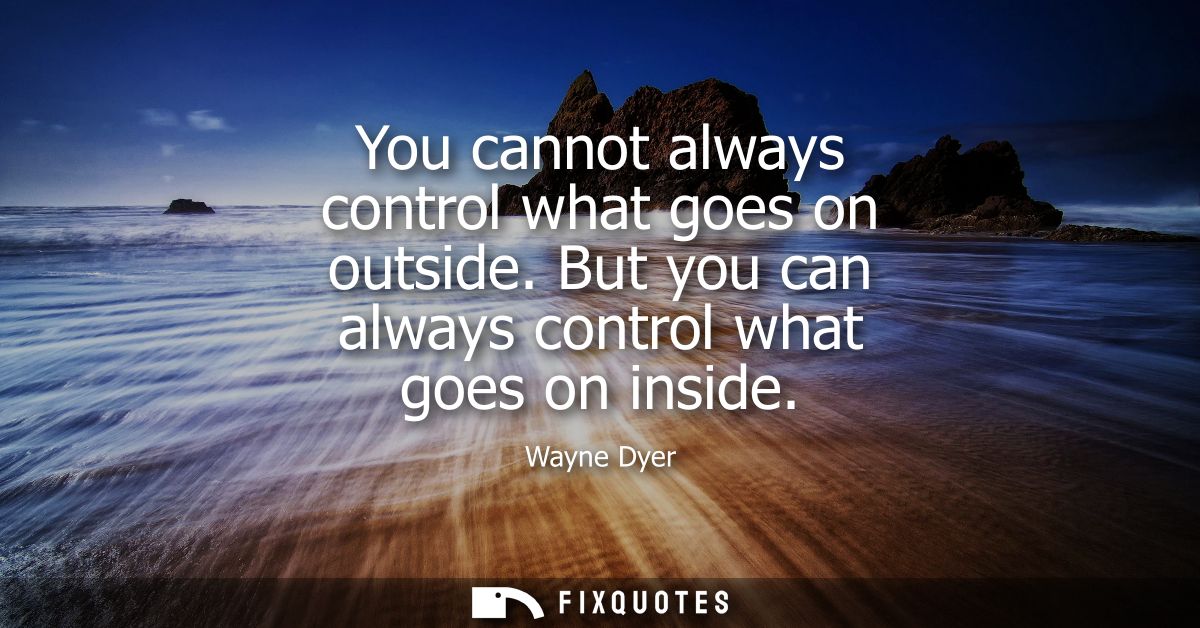
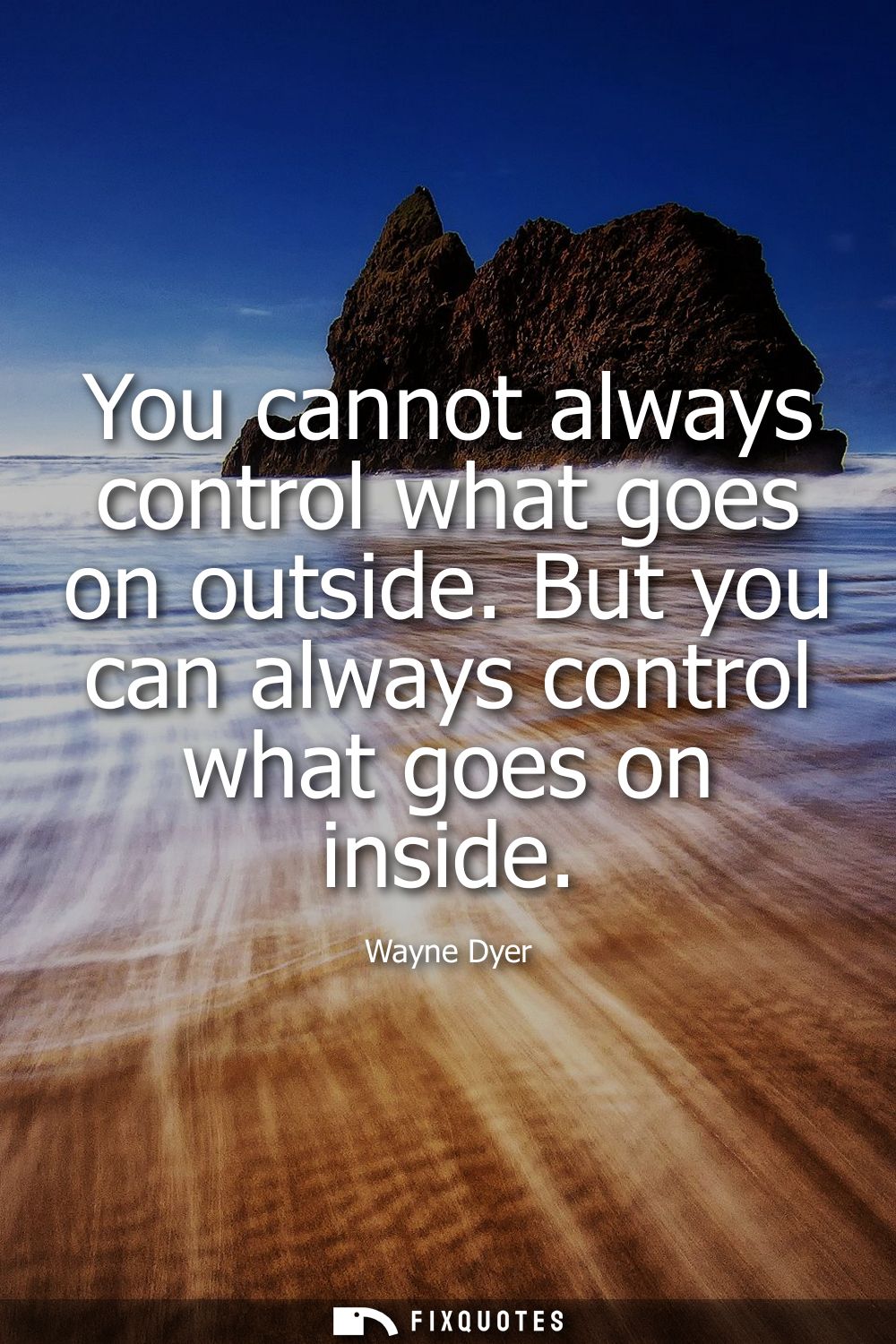
"You cannot always control what goes on outside. But you can always control what goes on inside!"
About this Quote
The intent is practical, almost behavioral: shift locus of control inward to reduce suffering and increase agency. Dyer’s background in psychology matters here, even if his public brand leaned self-help and spiritual calm. The subtext borrows from Stoicism and from cognitive therapy before it became pop-commonplace: events are data; interpretation is where you bleed. “Always” is the pressure point. It’s an aspirational absolute, less a clinical claim than a mantra designed to interrupt panic. In that sense, it functions like a cognitive wedge: even one second of “I can choose my next thought” can de-escalate a spiral.
Contextually, it belongs to late-20th-century therapeutic culture, when personal growth language became a mainstream counterweight to a world increasingly experienced as chaotic, mediated, and beyond individual influence. It’s also quietly moral: if your “inside” is controllable, you’re responsible for it. That’s empowering until it curdles into self-blame. The quote works because it balances on that edge - offering agency, but daring you to use it.
Quote Details
| Topic | Self-Improvement |
|---|---|
| Source | Help us find the source |
| Cite |
Citation Formats
APA Style (7th ed.)
Dyer, Wayne. (2026, February 19). You cannot always control what goes on outside. But you can always control what goes on inside! FixQuotes. https://fixquotes.com/quotes/you-cannot-always-control-what-goes-on-outside-33496/
Chicago Style
Dyer, Wayne. "You cannot always control what goes on outside. But you can always control what goes on inside!" FixQuotes. February 19, 2026. https://fixquotes.com/quotes/you-cannot-always-control-what-goes-on-outside-33496/.
MLA Style (9th ed.)
"You cannot always control what goes on outside. But you can always control what goes on inside!" FixQuotes, 19 Feb. 2026, https://fixquotes.com/quotes/you-cannot-always-control-what-goes-on-outside-33496/. Accessed 28 Mar. 2026.