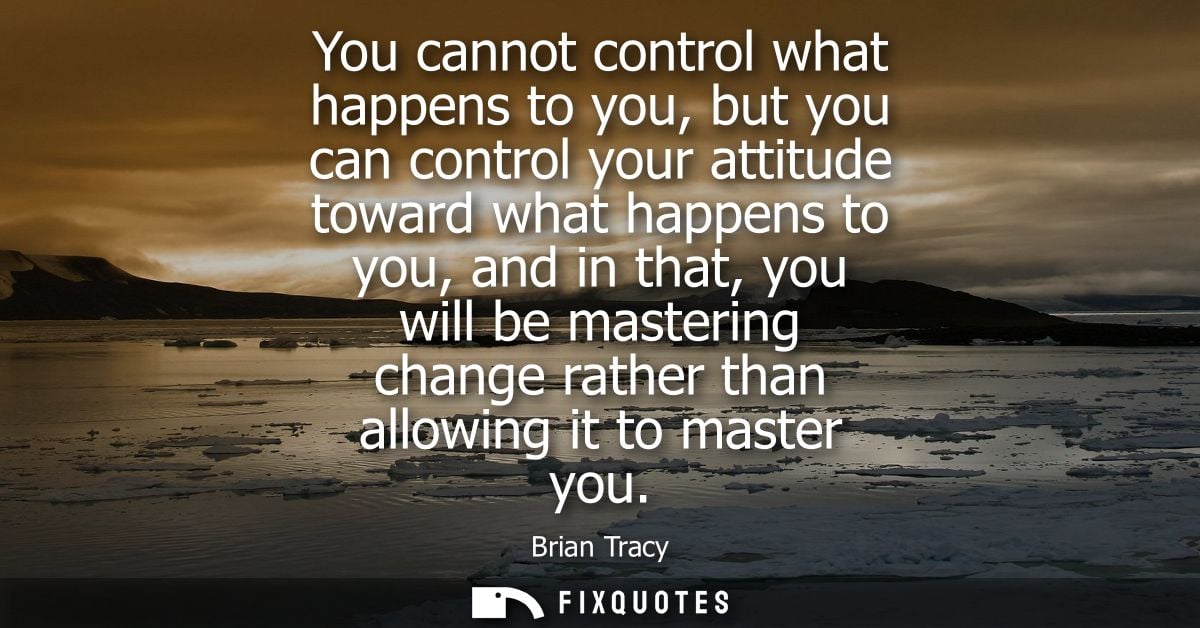
"You cannot control what happens to you, but you can control your attitude toward what happens to you, and in that, you will be mastering change rather than allowing it to master you"
About this Quote
Tracy’s line is a compact piece of self-help realism dressed up as empowerment: the world is messy, unfair, and uncontrollable, but your inner stance is still yours. The craft is in the pivot. It starts by conceding what readers already know (bad things happen; plans collapse) and then quickly offers a lever you can actually pull. That psychological move matters: it turns helplessness into a manageable project.
The subtext is distinctly late-20th-century American professional culture, where “change” isn’t a philosophical abstraction but a constant workplace condition: reorganizations, layoffs, new tech, new metrics. “Mastering change” borrows the language of management and productivity, suggesting not just survival but competence. It’s not “endure,” it’s “master” - a word that flatters the reader’s ambition and implies a hierarchy where you can be on top.
There’s also an ethical and political dodge baked in. By placing the locus of control in “attitude,” the quote offers solace without asking who or what is causing the turmoil. It’s resilience talk that can be liberating for an individual while also conveniently compatible with systems that demand endless adaptation.
Still, the intent is clear: swap reactive emotion for chosen interpretation. Tracy isn’t promising you can change the storm; he’s selling the idea that you can become someone who doesn’t get blown around by it. That’s why the line lands: it doesn’t deny reality, it reframes agency at the one point it’s hardest to outsource.
The subtext is distinctly late-20th-century American professional culture, where “change” isn’t a philosophical abstraction but a constant workplace condition: reorganizations, layoffs, new tech, new metrics. “Mastering change” borrows the language of management and productivity, suggesting not just survival but competence. It’s not “endure,” it’s “master” - a word that flatters the reader’s ambition and implies a hierarchy where you can be on top.
There’s also an ethical and political dodge baked in. By placing the locus of control in “attitude,” the quote offers solace without asking who or what is causing the turmoil. It’s resilience talk that can be liberating for an individual while also conveniently compatible with systems that demand endless adaptation.
Still, the intent is clear: swap reactive emotion for chosen interpretation. Tracy isn’t promising you can change the storm; he’s selling the idea that you can become someone who doesn’t get blown around by it. That’s why the line lands: it doesn’t deny reality, it reframes agency at the one point it’s hardest to outsource.
Quote Details
| Topic | Embrace Change |
|---|
More Quotes by Brian
Add to List