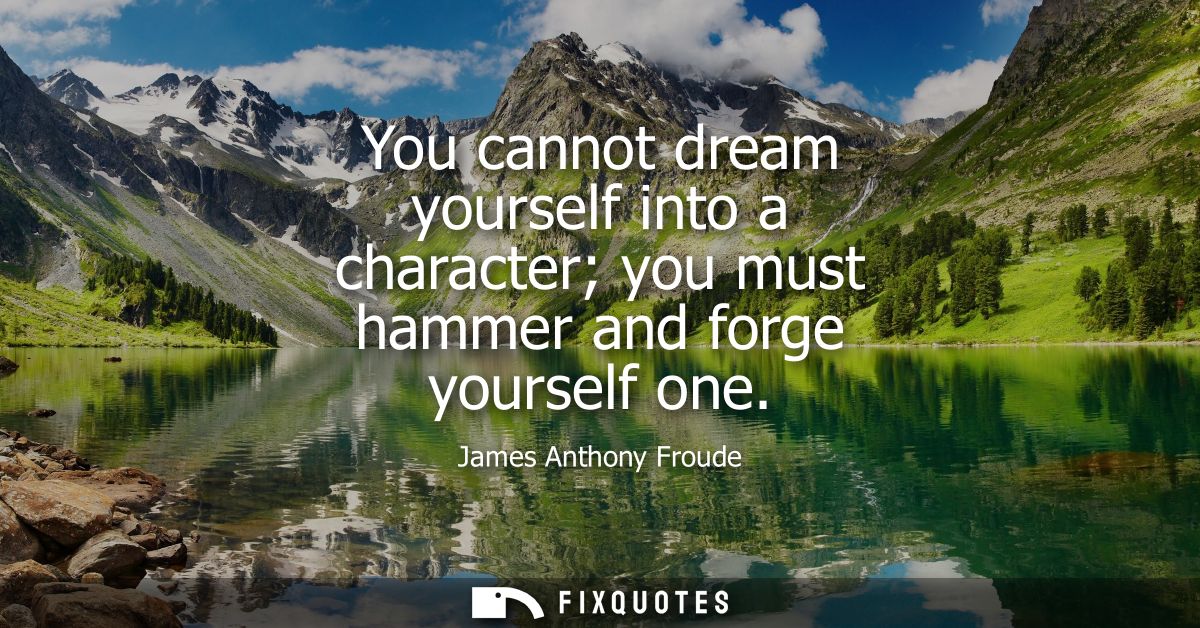
"You cannot dream yourself into a character; you must hammer and forge yourself one"
About this Quote
“Hammer and forge” is a rebuke to the Victorian fantasy that identity is a kind of private aesthetic project, built from wishes, reading lists, and moral resolutions. Froude, a historian by trade, reaches for the language of the smithy because it carries a blunt thesis about how people actually change: under heat, pressure, repetition, and consequence. Dreaming is soft, solitary, and unaccountable; forging is noisy, public, and measurable. The sentence doesn’t just prefer discipline to imagination - it treats imagination, when untested, as a form of self-indulgence.
The intent is practical and, quietly, political. In a 19th-century Britain obsessed with “character” as a civic virtue, Froude is defending the idea that moral steadiness is produced by work and trial, not by sentiment or self-description. As a historian, he’s implicitly importing the logic of biography and national narrative into personal ethics: you become legible through what you do when time pushes back. The subtext is almost anti-romantic. Your interior life may feel decisive, but it’s not the arena where character is proven.
The line also flatters and threatens. It flatters the reader with agency - you can make yourself. It threatens with the cost: forging implies burns, mistakes, wasted metal, and starting over. That’s why it still lands now, in an era of “manifesting” and personal branding. Froude’s point is that identity isn’t a mood board; it’s a tool you either temper through action or never truly possess.
The intent is practical and, quietly, political. In a 19th-century Britain obsessed with “character” as a civic virtue, Froude is defending the idea that moral steadiness is produced by work and trial, not by sentiment or self-description. As a historian, he’s implicitly importing the logic of biography and national narrative into personal ethics: you become legible through what you do when time pushes back. The subtext is almost anti-romantic. Your interior life may feel decisive, but it’s not the arena where character is proven.
The line also flatters and threatens. It flatters the reader with agency - you can make yourself. It threatens with the cost: forging implies burns, mistakes, wasted metal, and starting over. That’s why it still lands now, in an era of “manifesting” and personal branding. Froude’s point is that identity isn’t a mood board; it’s a tool you either temper through action or never truly possess.
Quote Details
| Topic | Self-Improvement |
|---|
More Quotes by James
Add to List