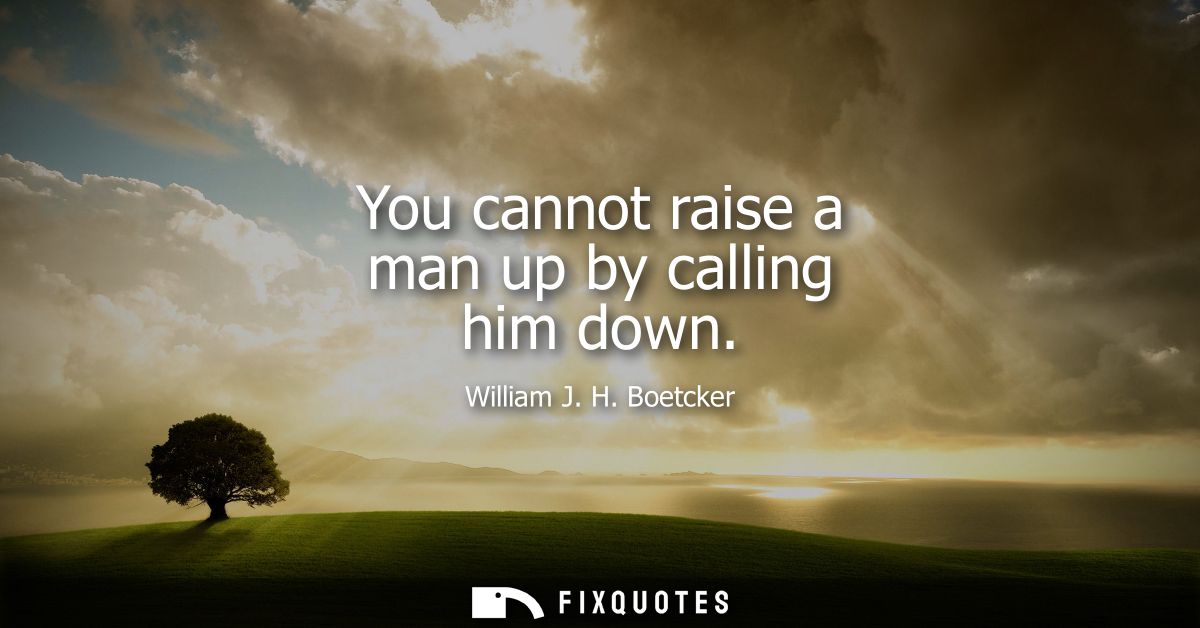
"You cannot raise a man up by calling him down"
About this Quote
Boetcker’s line lands with the snap of a proverb because it rejects a favorite American habit: treating humiliation as motivation. Coming from a clergyman steeped in pastoral work and early 20th-century moral uplift culture, it reads like a corrective to the hard-edged “tough love” that often masquerades as virtue. The phrasing is almost architectural: “raise” versus “calling…down.” He frames human dignity as the load-bearing beam of change, not a sentimental add-on.
The intent is practical, not merely pious. Boetcker is arguing that transformation requires agency, and agency doesn’t survive contempt. “Calling him down” isn’t just criticism; it’s the public demotion of personhood, the kind of speech that reduces someone to their worst moment and then demands they climb out of the hole you’ve dug around them. The subtext is theological and psychological at once: people are not improved by being treated as irredeemable. Shame may force compliance, but it rarely produces character. It breeds secrecy, resentment, and performance.
There’s also an implicit rebuke to moralizers who enjoy the sound of their own righteousness. The sentence quietly shifts responsibility from the “fallen” to the one doing the judging: if your aim is restoration, your method must match your claimed ethics. In a culture that often confuses harshness with honesty, Boetcker offers a sharper standard: truth that lifts is still truth, but it refuses to turn correction into cruelty.
The intent is practical, not merely pious. Boetcker is arguing that transformation requires agency, and agency doesn’t survive contempt. “Calling him down” isn’t just criticism; it’s the public demotion of personhood, the kind of speech that reduces someone to their worst moment and then demands they climb out of the hole you’ve dug around them. The subtext is theological and psychological at once: people are not improved by being treated as irredeemable. Shame may force compliance, but it rarely produces character. It breeds secrecy, resentment, and performance.
There’s also an implicit rebuke to moralizers who enjoy the sound of their own righteousness. The sentence quietly shifts responsibility from the “fallen” to the one doing the judging: if your aim is restoration, your method must match your claimed ethics. In a culture that often confuses harshness with honesty, Boetcker offers a sharper standard: truth that lifts is still truth, but it refuses to turn correction into cruelty.
Quote Details
| Topic | Kindness |
|---|---|
| Source | Help us find the source |
| Cite |
Citation Formats
APA Style (7th ed.)
Boetcker, William J. H. (2026, January 16). You cannot raise a man up by calling him down. FixQuotes. https://fixquotes.com/quotes/you-cannot-raise-a-man-up-by-calling-him-down-111419/
Chicago Style
Boetcker, William J. H. "You cannot raise a man up by calling him down." FixQuotes. January 16, 2026. https://fixquotes.com/quotes/you-cannot-raise-a-man-up-by-calling-him-down-111419/.
MLA Style (9th ed.)
"You cannot raise a man up by calling him down." FixQuotes, 16 Jan. 2026, https://fixquotes.com/quotes/you-cannot-raise-a-man-up-by-calling-him-down-111419/. Accessed 26 Mar. 2026.
More Quotes by William
Add to List