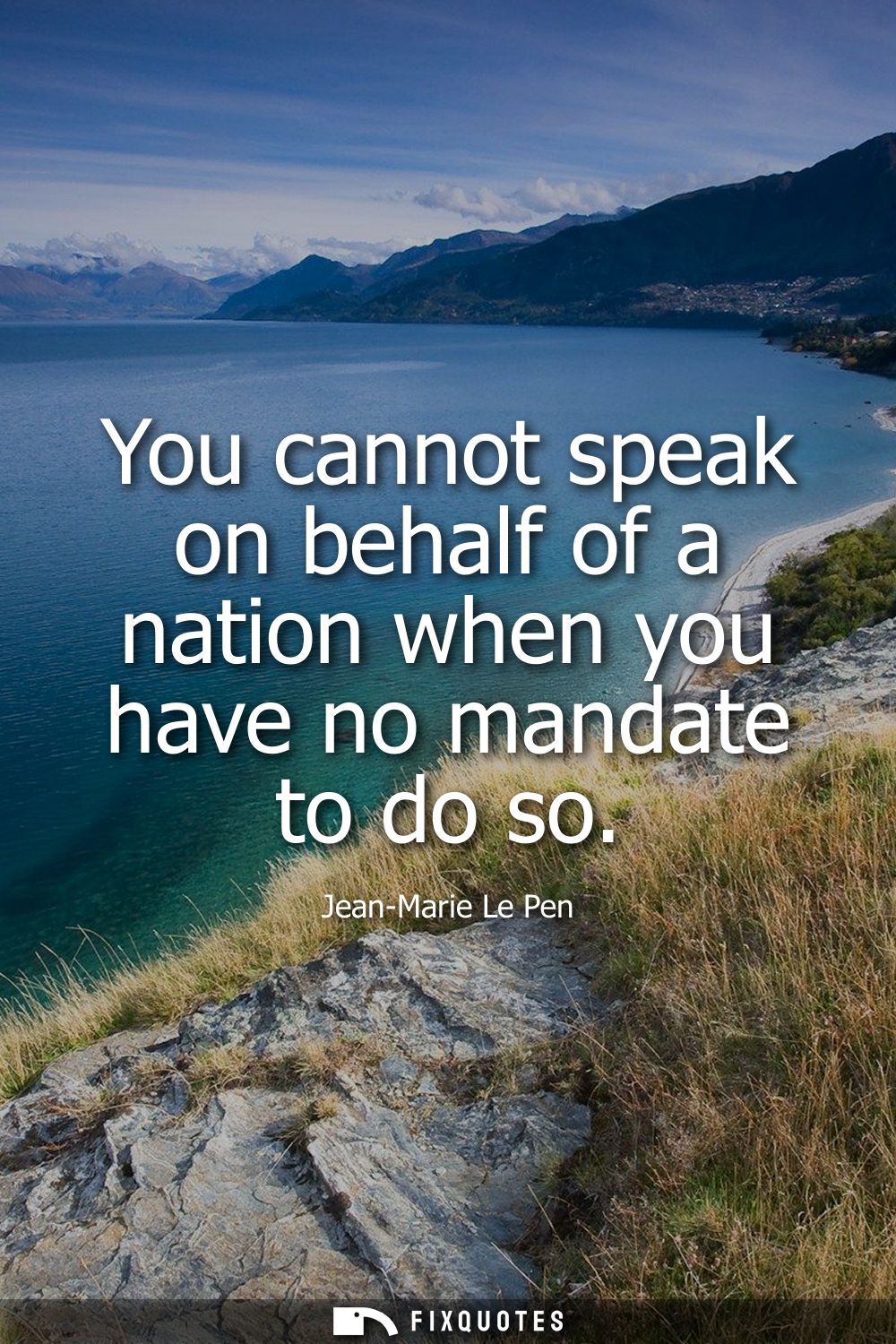
"You cannot speak on behalf of a nation when you have no mandate to do so"
About this Quote
The brilliance, and the danger, is how the sentence turns democracy into a credential rather than a conversation. “On behalf of a nation” invokes a collective body with a single voice, as if pluralism were a technical glitch. Then “no mandate” does double work: it can mean you weren’t elected, but it can also mean your constituency is illegitimate, your expertise suspect, your moral claim unserious. It’s a neat way to disqualify journalists, activists, minority communities, supranational institutions, even artists or intellectuals - anyone who might contest the idea that the nation is best represented by the loudest electoral bloc.
In context, this is classic far-right rhetoric: portray opponents as self-appointed elites while quietly reserving “the people” for your side. It’s a move that flatters the listener (“you, not they, are the real country”) and pressures rivals to prove their right to speak before they even argue. The subtext: if you can’t show papers for belonging, you don’t just lack authority - you lack standing. That’s not only a claim about representation; it’s a bid to narrow the nation until it fits comfortably inside a party line.
Quote Details
| Topic | Leadership |
|---|---|
| Source | Help us find the source |
| Cite |
Citation Formats
APA Style (7th ed.)
Pen, Jean-Marie Le. (2026, January 16). You cannot speak on behalf of a nation when you have no mandate to do so. FixQuotes. https://fixquotes.com/quotes/you-cannot-speak-on-behalf-of-a-nation-when-you-99127/
Chicago Style
Pen, Jean-Marie Le. "You cannot speak on behalf of a nation when you have no mandate to do so." FixQuotes. January 16, 2026. https://fixquotes.com/quotes/you-cannot-speak-on-behalf-of-a-nation-when-you-99127/.
MLA Style (9th ed.)
"You cannot speak on behalf of a nation when you have no mandate to do so." FixQuotes, 16 Jan. 2026, https://fixquotes.com/quotes/you-cannot-speak-on-behalf-of-a-nation-when-you-99127/. Accessed 30 Mar. 2026.