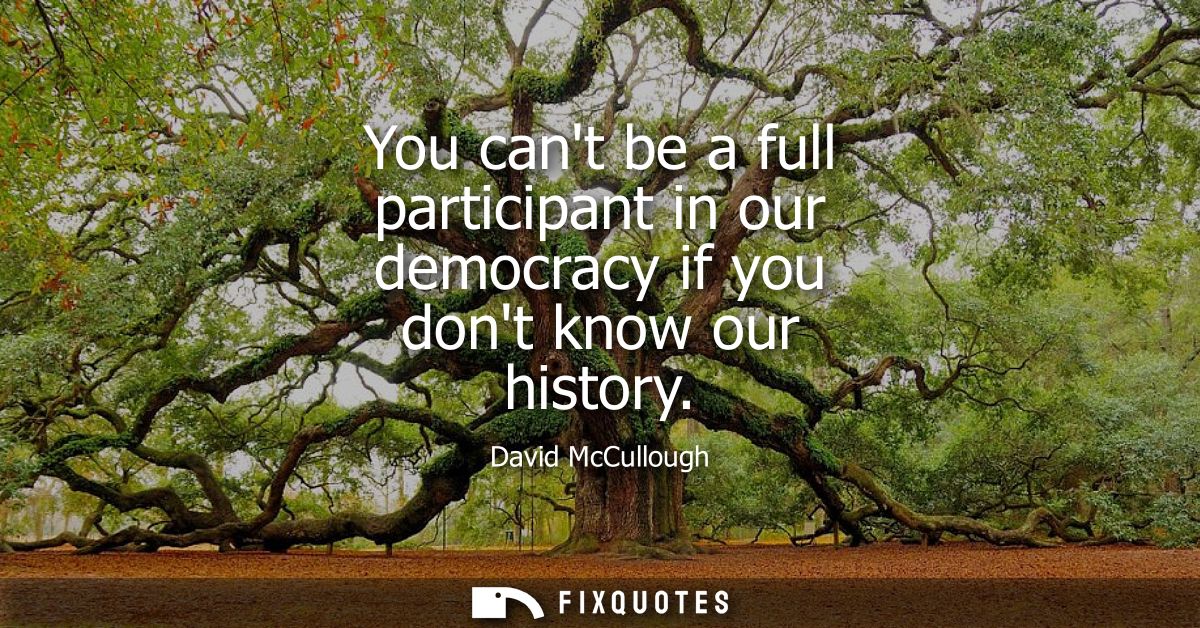
"You can't be a full participant in our democracy if you don't know our history"
About this Quote
The subtext is pointed: ignorance isn’t neutral. If you don’t know what institutions were built to prevent, how rights were won, or how propaganda has worked before, you’re easier to manipulate and harder to mobilize. History becomes a form of self-defense against demagogues, conspiracy thinking, and the seductive simplicity of “we’ve never been worse” or “we’ve always been great.” McCullough is also pushing back on a consumer model of politics where people shop for opinions and treat the past as optional content.
Context matters because McCullough spent decades writing popular narrative history aimed at general readers, arguing that the American story is messy, contingent, and human-scaled. The quote fits a post-9/11 and post-truth era in which civic knowledge declines while political certainty spikes. It’s a historian’s frustration rendered as a public warning: without a shared sense of how we got here, democracy becomes a stage for people who can’t see the script being recycled.
Quote Details
| Topic | Knowledge |
|---|---|
| Source | Help us find the source |
| Cite |
Citation Formats
APA Style (7th ed.)
McCullough, David. (2026, January 15). You can't be a full participant in our democracy if you don't know our history. FixQuotes. https://fixquotes.com/quotes/you-cant-be-a-full-participant-in-our-democracy-143652/
Chicago Style
McCullough, David. "You can't be a full participant in our democracy if you don't know our history." FixQuotes. January 15, 2026. https://fixquotes.com/quotes/you-cant-be-a-full-participant-in-our-democracy-143652/.
MLA Style (9th ed.)
"You can't be a full participant in our democracy if you don't know our history." FixQuotes, 15 Jan. 2026, https://fixquotes.com/quotes/you-cant-be-a-full-participant-in-our-democracy-143652/. Accessed 6 Apr. 2026.