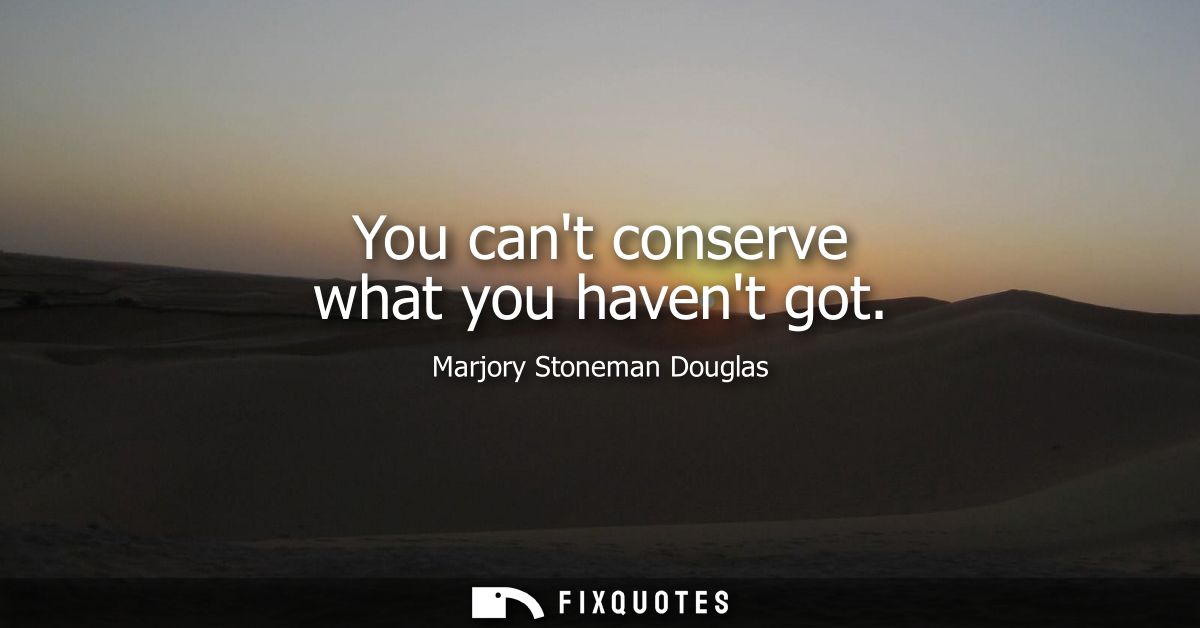
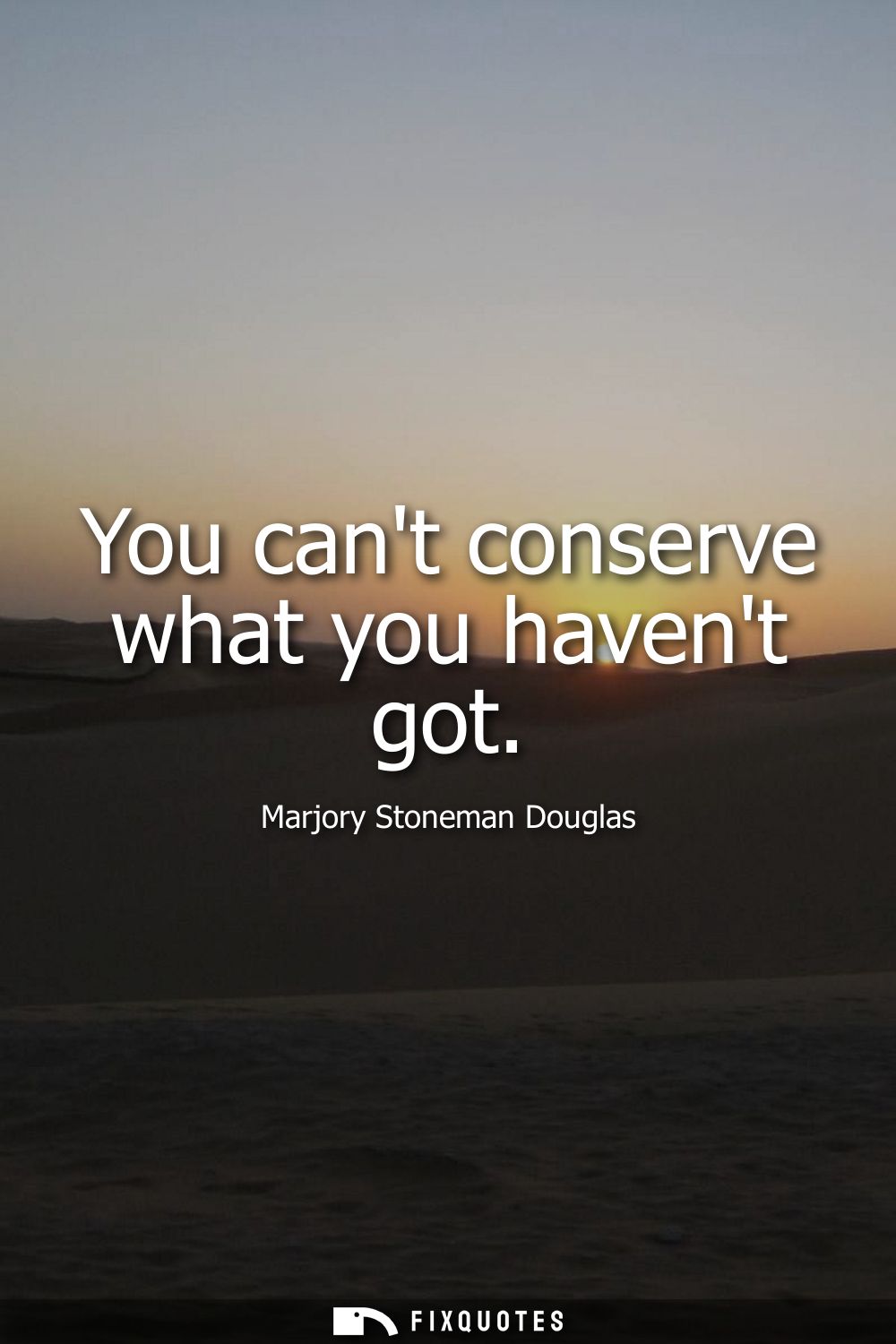
"You can't conserve what you haven't got"
About this Quote
A line this blunt doesn’t bother with inspiration; it issues a procedural warning. Marjory Stoneman Douglas, the journalist-activist who helped invent the modern idea of the Everglades as a living system rather than a swampy inconvenience, strips conservation of its halo and treats it like basic accounting. You can’t protect an abstraction. Conservation isn’t a mood, a bumper sticker, or a grant proposal. It’s a relationship to something tangible, extant, and still functioning.
The intent is almost prosecutorial: stop congratulating yourselves for saving what has already been drained, paved, poisoned, or politically traded away. The subtext carries a jab at the familiar civic ritual of “environmental concern” that arrives late, once the loss is already priced in. Douglas understood the American talent for turning destruction into nostalgia, then calling the nostalgia stewardship. Her sentence denies that escape hatch.
Context matters because she was writing and campaigning during decades when Florida’s wetlands were being carved into canals, suburbs, and agricultural grids. In that world, “conservation” could easily become a soothing term that legitimizes incremental damage: conserve what remains, manage the decline, accept the baseline shift. Douglas flips that logic. If the thing itself disappears, conservation becomes performance art.
The rhetorical power is its simplicity: a childlike construction that lands like an indictment. It forces a timeline into the conversation. Act while the ecosystem still exists, while the public can still recognize it, while the political cost of protection is still lower than the cost of resurrection.
The intent is almost prosecutorial: stop congratulating yourselves for saving what has already been drained, paved, poisoned, or politically traded away. The subtext carries a jab at the familiar civic ritual of “environmental concern” that arrives late, once the loss is already priced in. Douglas understood the American talent for turning destruction into nostalgia, then calling the nostalgia stewardship. Her sentence denies that escape hatch.
Context matters because she was writing and campaigning during decades when Florida’s wetlands were being carved into canals, suburbs, and agricultural grids. In that world, “conservation” could easily become a soothing term that legitimizes incremental damage: conserve what remains, manage the decline, accept the baseline shift. Douglas flips that logic. If the thing itself disappears, conservation becomes performance art.
The rhetorical power is its simplicity: a childlike construction that lands like an indictment. It forces a timeline into the conversation. Act while the ecosystem still exists, while the public can still recognize it, while the political cost of protection is still lower than the cost of resurrection.
Quote Details
| Topic | Nature |
|---|---|
| Source | Later attribution: America's Holy Ground (Brad Lyons, Bruce Barkhauer, 2019) modern compilationISBN: 9780827200791 · ID: 4iKQDwAAQBAJ
Evidence: ... You can't conserve what you haven't got . - MARJORY STONEMAN DOUGLAS , AUTHOR , CONSERVATIONIST , AND EVERGLADES PROPONENT What a country chooses to save is what a country chooses to say about itself . -MOLLIE BEATTIE , DIRECTOR OF THE ... Other candidates (1) National Portrait Gallery: Marjory Stoneman Douglas (Marjory Stoneman Douglas, 1982)50.0% “Conservation is now a dead word,” she declared in 1982. “You can’t conserve what you haven’t got. That’s why we are ... |
| Cite |
Citation Formats
APA Style (7th ed.)
Douglas, Marjory Stoneman. (2026, February 10). You can't conserve what you haven't got. FixQuotes. https://fixquotes.com/quotes/you-cant-conserve-what-you-havent-got-56008/
Chicago Style
Douglas, Marjory Stoneman. "You can't conserve what you haven't got." FixQuotes. February 10, 2026. https://fixquotes.com/quotes/you-cant-conserve-what-you-havent-got-56008/.
MLA Style (9th ed.)
"You can't conserve what you haven't got." FixQuotes, 10 Feb. 2026, https://fixquotes.com/quotes/you-cant-conserve-what-you-havent-got-56008/. Accessed 12 Feb. 2026.
More Quotes by Marjory
Add to List