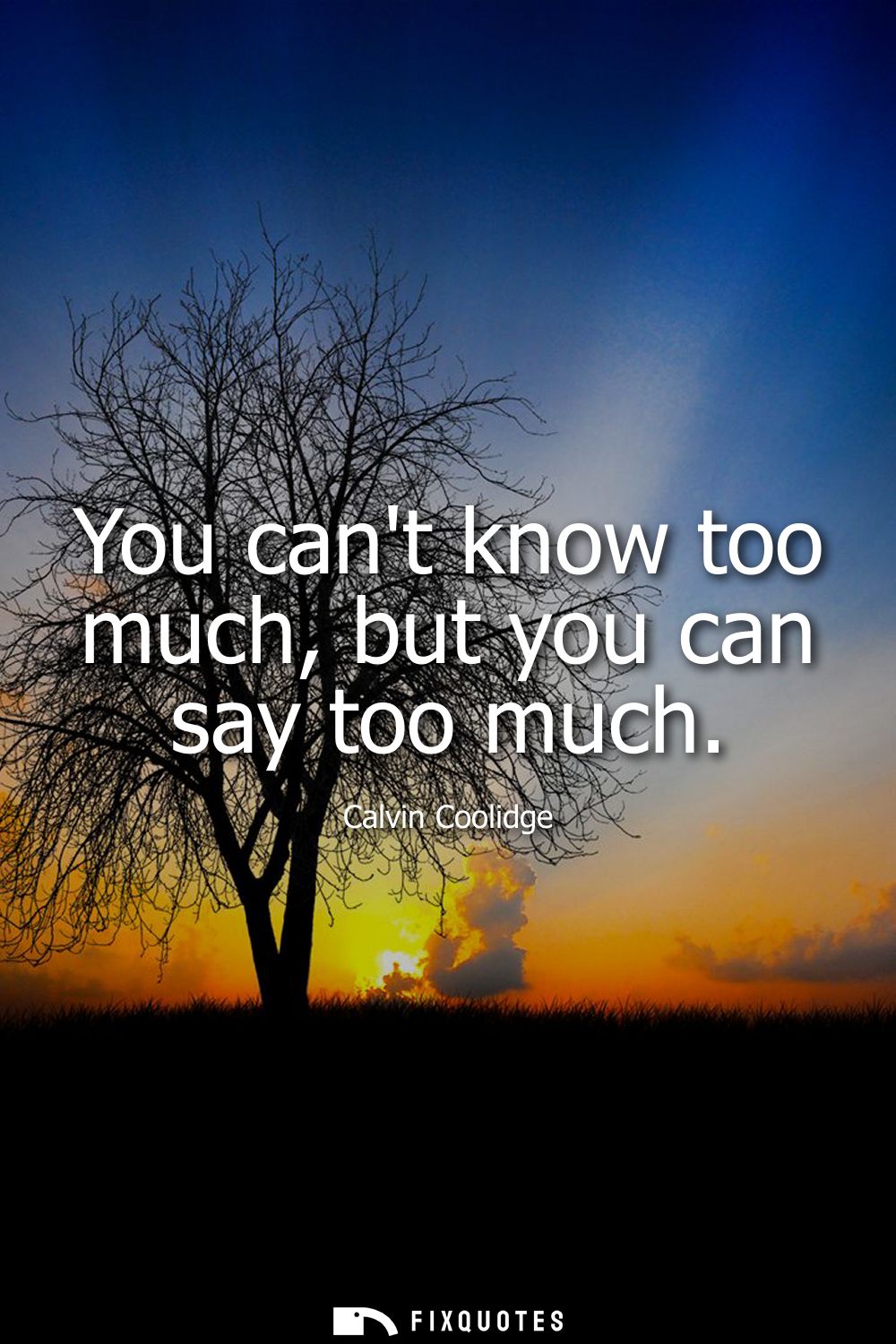
"You can't know too much, but you can say too much"
About this Quote
Coolidge’s line is a miniature manifesto for the kind of power he practiced: not the loud, barnstorming variety, but authority as restraint. “You can’t know too much” flatters the Enlightenment ideal that knowledge is an unalloyed good, a private stockpile that strengthens judgment. Then the second clause snaps shut like a clasp: “but you can say too much.” The pivot isn’t anti-intellectual; it’s anti-exposure. In politics, information isn’t just truth, it’s leverage, vulnerability, and fuel for other people’s narratives.
The intent is practical and a little chilly. Coolidge is warning that speech is not a neutral conduit for knowledge; it’s an action with consequences. Saying “too much” can mean revealing strategy, committing yourself to promises you’ll be held to, or giving opponents raw material. Silence, by contrast, keeps options open. It also projects discipline, which in a public office can read as steadiness rather than evasiveness.
The subtext lands hardest in the context of Coolidge’s presidency and persona. He governed in the 1920s, an era of booming mass media and rising public relations, when the modern expectation that leaders should constantly explain themselves was taking shape. Coolidge resisted that trend, cultivating an image of deliberate economy: fewer words, fewer liabilities. The line doubles as a rebuke to the politics of performance. Learn obsessively, speak sparingly, and let other people drown in their own commentary.
The intent is practical and a little chilly. Coolidge is warning that speech is not a neutral conduit for knowledge; it’s an action with consequences. Saying “too much” can mean revealing strategy, committing yourself to promises you’ll be held to, or giving opponents raw material. Silence, by contrast, keeps options open. It also projects discipline, which in a public office can read as steadiness rather than evasiveness.
The subtext lands hardest in the context of Coolidge’s presidency and persona. He governed in the 1920s, an era of booming mass media and rising public relations, when the modern expectation that leaders should constantly explain themselves was taking shape. Coolidge resisted that trend, cultivating an image of deliberate economy: fewer words, fewer liabilities. The line doubles as a rebuke to the politics of performance. Learn obsessively, speak sparingly, and let other people drown in their own commentary.
Quote Details
| Topic | Wisdom |
|---|---|
| Source | Help us find the source |
| Cite |
Citation Formats
APA Style (7th ed.)
Coolidge, Calvin. (2026, January 15). You can't know too much, but you can say too much. FixQuotes. https://fixquotes.com/quotes/you-cant-know-too-much-but-you-can-say-too-much-34446/
Chicago Style
Coolidge, Calvin. "You can't know too much, but you can say too much." FixQuotes. January 15, 2026. https://fixquotes.com/quotes/you-cant-know-too-much-but-you-can-say-too-much-34446/.
MLA Style (9th ed.)
"You can't know too much, but you can say too much." FixQuotes, 15 Jan. 2026, https://fixquotes.com/quotes/you-cant-know-too-much-but-you-can-say-too-much-34446/. Accessed 3 Apr. 2026.
More Quotes by Calvin
Add to List