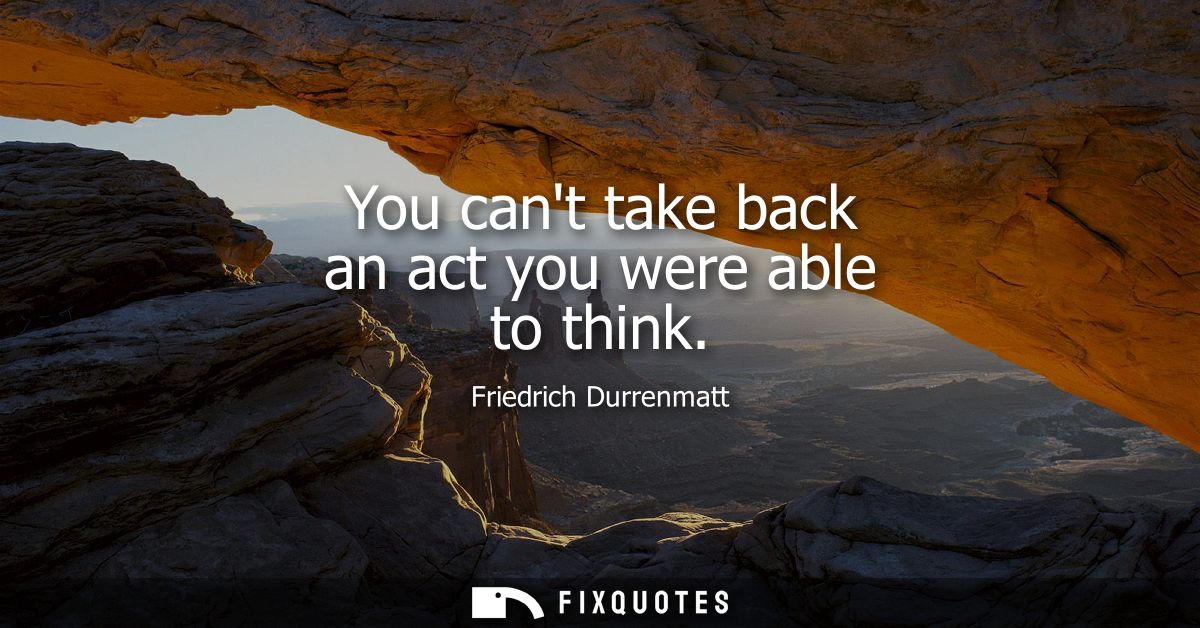
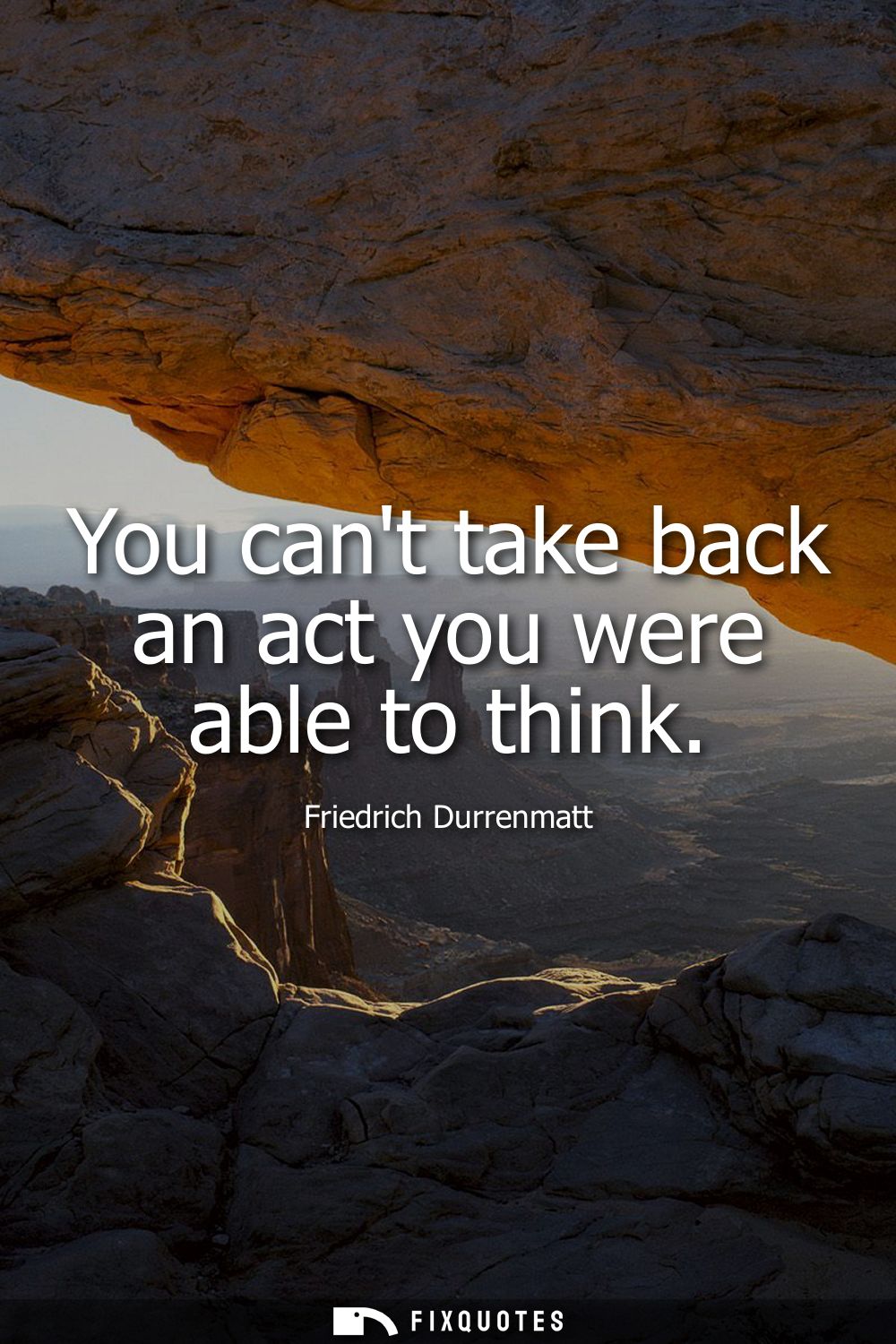
"You can't take back an act you were able to think"
About this Quote
Durrenmatt’s line turns the usual moral warning inside out. We tend to believe the point of no return is the deed: say it, do it, and now you’re stuck with the consequences. He shifts the trapdoor earlier, into the mind. If you were capable of thinking an act through, you’ve already crossed a boundary that can’t be uncrossed. Not because thought is equivalent to crime, but because thinking is a kind of rehearsal: it maps a route, tests justifications, and quietly proves that the self you prefer to imagine is not the only self available.
The intent is less puritanical than forensic. Durrenmatt, steeped in postwar European anxiety and famous for twisting crime and justice into grotesque parables, is suspicious of clean moral alibis. “I didn’t mean it,” “I wasn’t myself,” “It just happened” all collapse once you admit you had the idea, saw its shape, and still carried on. The subtext is about complicity: the mind doesn’t merely observe temptation, it manufactures the logic that makes wrongdoing feel inevitable, even reasonable.
There’s also an edge of dark humor in the phrasing. “Able to think” sounds like a compliment; here it’s an indictment. Intelligence doesn’t save you from guilt, it refines it. The afterlife of the thought becomes its own evidence: even if you never act, you now know what you might do, and that knowledge rewrites your innocence.
The intent is less puritanical than forensic. Durrenmatt, steeped in postwar European anxiety and famous for twisting crime and justice into grotesque parables, is suspicious of clean moral alibis. “I didn’t mean it,” “I wasn’t myself,” “It just happened” all collapse once you admit you had the idea, saw its shape, and still carried on. The subtext is about complicity: the mind doesn’t merely observe temptation, it manufactures the logic that makes wrongdoing feel inevitable, even reasonable.
There’s also an edge of dark humor in the phrasing. “Able to think” sounds like a compliment; here it’s an indictment. Intelligence doesn’t save you from guilt, it refines it. The afterlife of the thought becomes its own evidence: even if you never act, you now know what you might do, and that knowledge rewrites your innocence.
Quote Details
| Topic | Ethics & Morality |
|---|---|
| Source | Help us find the source |
| Cite |
Citation Formats
APA Style (7th ed.)
Durrenmatt, Friedrich. (2026, January 17). You can't take back an act you were able to think. FixQuotes. https://fixquotes.com/quotes/you-cant-take-back-an-act-you-were-able-to-think-54222/
Chicago Style
Durrenmatt, Friedrich. "You can't take back an act you were able to think." FixQuotes. January 17, 2026. https://fixquotes.com/quotes/you-cant-take-back-an-act-you-were-able-to-think-54222/.
MLA Style (9th ed.)
"You can't take back an act you were able to think." FixQuotes, 17 Jan. 2026, https://fixquotes.com/quotes/you-cant-take-back-an-act-you-were-able-to-think-54222/. Accessed 25 Mar. 2026.
More Quotes by Friedrich
Add to List