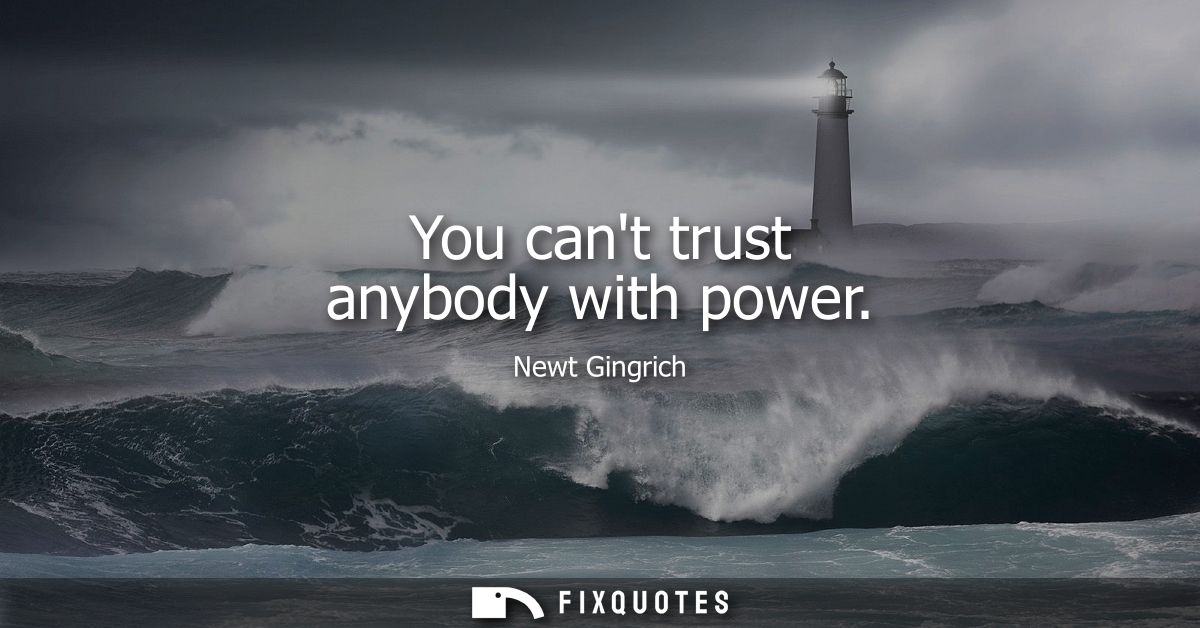
"You can't trust anybody with power"
About this Quote
Strip away the partisan varnish and Gingrich is offering a bleak, populist catechism: power doesn’t merely tempt; it contaminates. The line is blunt enough to sound like common sense, which is precisely its advantage. It asks for no evidence, only recognition. If you’ve ever felt steamrolled by bureaucracy, lectured by an expert class, or burned by a boss, the quote recruits that irritation and redirects it toward a single target: people who hold the levers.
The subtext is strategic. “Anybody” universalizes suspicion, flattening distinctions between rival parties, institutions, even allies. It’s a cynicism that pretends to be humility: I’m not defending my side; I’m indicting all of them. In practice, that posture can function as a permission slip. If no one with power can be trusted, then the only rational politics is permanent combat: delegitimize opponents, bypass norms, treat oversight as a trap, and justify hardball as self-defense.
The context matters because Gingrich’s brand was never tranquil governance; it was insurgency from inside the system. He helped popularize a politics that casts Washington as a hostile occupying force while simultaneously fighting to control it. That tension is the quote’s hidden engine. It performs anti-elitism from a position of elite access, converting institutional authority into a story of betrayal. The line is less a warning than a weapon: it primes audiences to see constraint as naïveté and distrust as civic virtue, leaving “power” as the only thing worth winning and the last thing anyone should be allowed to hold.
The subtext is strategic. “Anybody” universalizes suspicion, flattening distinctions between rival parties, institutions, even allies. It’s a cynicism that pretends to be humility: I’m not defending my side; I’m indicting all of them. In practice, that posture can function as a permission slip. If no one with power can be trusted, then the only rational politics is permanent combat: delegitimize opponents, bypass norms, treat oversight as a trap, and justify hardball as self-defense.
The context matters because Gingrich’s brand was never tranquil governance; it was insurgency from inside the system. He helped popularize a politics that casts Washington as a hostile occupying force while simultaneously fighting to control it. That tension is the quote’s hidden engine. It performs anti-elitism from a position of elite access, converting institutional authority into a story of betrayal. The line is less a warning than a weapon: it primes audiences to see constraint as naïveté and distrust as civic virtue, leaving “power” as the only thing worth winning and the last thing anyone should be allowed to hold.
Quote Details
| Topic | Leadership |
|---|---|
| Source | Help us find the source |
| Cite |
Citation Formats
APA Style (7th ed.)
Gingrich, Newt. (2026, January 17). You can't trust anybody with power. FixQuotes. https://fixquotes.com/quotes/you-cant-trust-anybody-with-power-36777/
Chicago Style
Gingrich, Newt. "You can't trust anybody with power." FixQuotes. January 17, 2026. https://fixquotes.com/quotes/you-cant-trust-anybody-with-power-36777/.
MLA Style (9th ed.)
"You can't trust anybody with power." FixQuotes, 17 Jan. 2026, https://fixquotes.com/quotes/you-cant-trust-anybody-with-power-36777/. Accessed 29 Mar. 2026.
More Quotes by Newt
Add to List