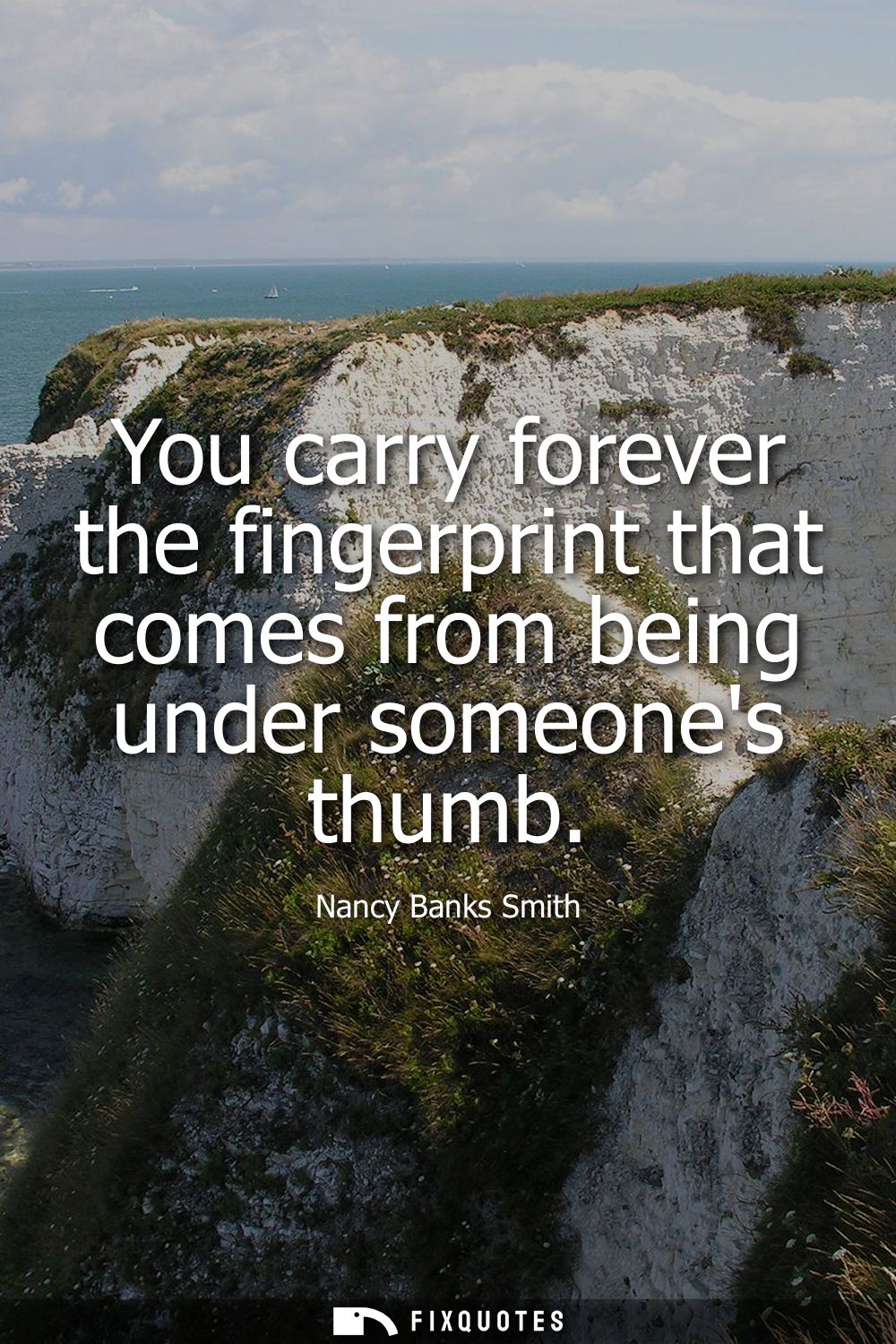
"You carry forever the fingerprint that comes from being under someone's thumb"
About this Quote
The line works because it refuses the comforting fantasy of clean exits. “Forever” isn’t sentimental here; it’s accusatory. Smith’s intent feels journalistic in the best sense: naming a social reality with metaphorical precision. Whether the “thumb” is a parent, partner, boss, institution, or public opinion, the subtext is about power’s afterlife. Control teaches muscle memory. It shapes what you ask for, what you tolerate, how loudly you speak, how quickly you apologize. Even when the thumb is gone, the body still anticipates it.
There’s also a sly reversal: a fingerprint usually belongs to the person doing the touching, not the one being pressed. Smith implies that subjugation can make you carry traces of someone else’s identity - their expectations, their voice, their rules - embedded in your reflexes. The cultural context is a world increasingly fluent in the language of trauma and coercion, but her phrasing avoids therapeutic cliché. It’s a single, unsettling snapshot: power doesn’t just dominate the present; it edits the person who survives it.
Quote Details
| Topic | Mental Health |
|---|---|
| Source | Later attribution: Badass Affirmations (Becca Anderson, 2018) modern compilationISBN: 9781633537538 · ID: yJUREAAAQBAJ
Evidence:
... You carry forever the fingerprint that comes from being under someone's thumb . -Nancy Banks - Smith , a British radio and television critic who was recommended for ( and turned down ! ) the Order of the British Empire You can cry , but ... |
| Cite |
Citation Formats
APA Style (7th ed.)
Smith, Nancy Banks. (2026, March 15). You carry forever the fingerprint that comes from being under someone's thumb. FixQuotes. https://fixquotes.com/quotes/you-carry-forever-the-fingerprint-that-comes-from-122740/
Chicago Style
Smith, Nancy Banks. "You carry forever the fingerprint that comes from being under someone's thumb." FixQuotes. March 15, 2026. https://fixquotes.com/quotes/you-carry-forever-the-fingerprint-that-comes-from-122740/.
MLA Style (9th ed.)
"You carry forever the fingerprint that comes from being under someone's thumb." FixQuotes, 15 Mar. 2026, https://fixquotes.com/quotes/you-carry-forever-the-fingerprint-that-comes-from-122740/. Accessed 4 Apr. 2026.