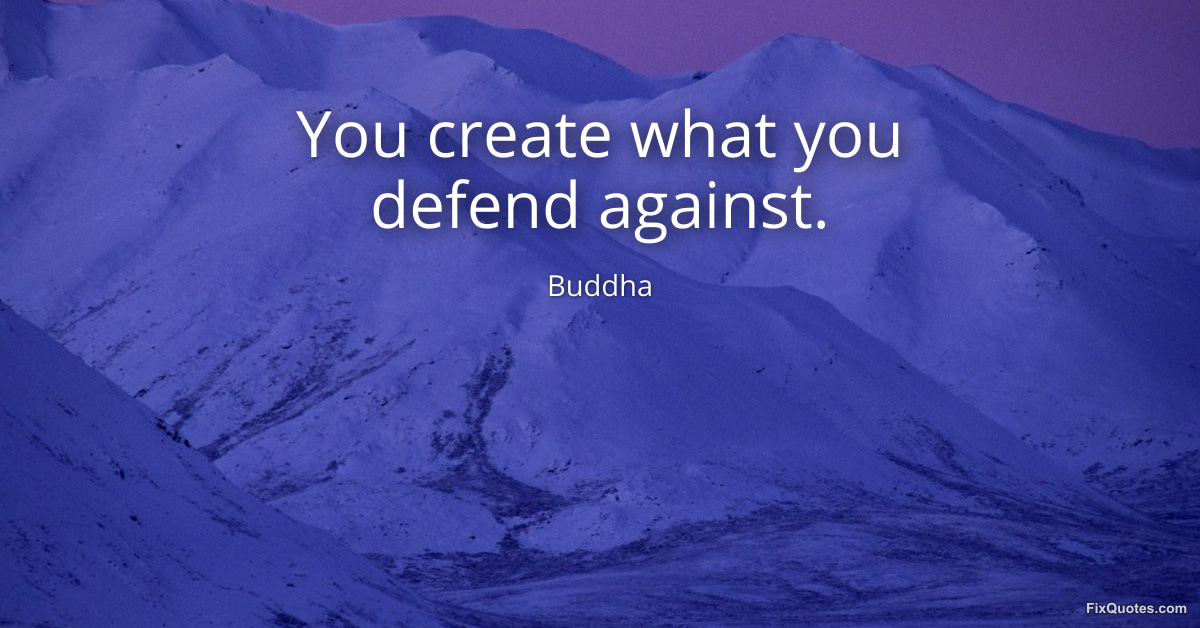
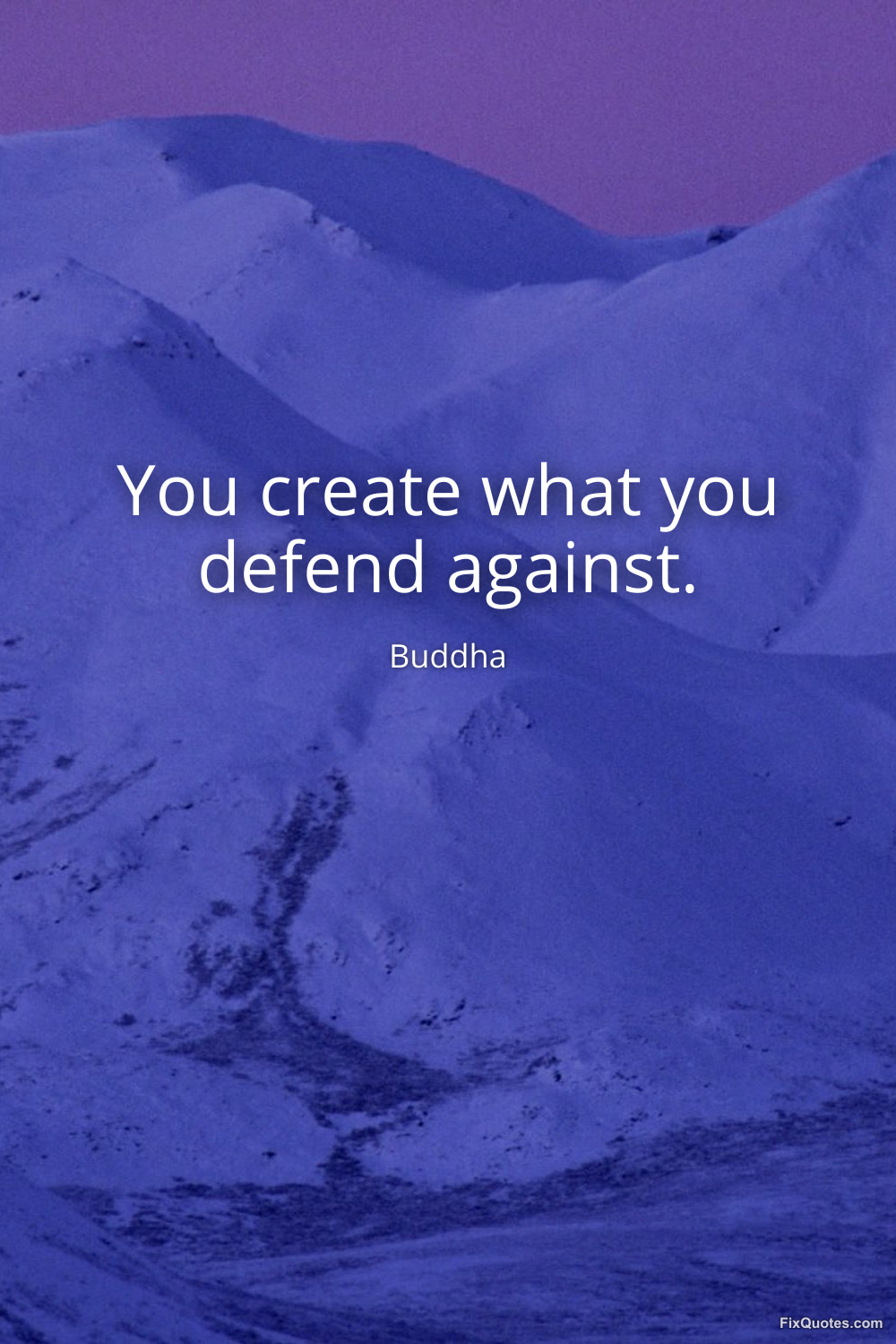
"You create what you defend against"
About this Quote
A warning disguised as a paradox: the harder we brace against a fear, the more we organize our lives around it. Attributed to Buddha, the line carries the moral weight of early Buddhist thought, where suffering is not only caused by pain itself but by attachment, aversion, and the ego's frantic effort to control experience. Defending against something can look prudent, even noble. The subtext is more unsettling: resistance often becomes a form of devotion.
That is why the phrasing lands. "Create" makes the problem active, not accidental. It denies us the comfort of believing our enemies are purely external. In Buddhist terms, what we cling to or push away gains power in the mind; aversion is still a bond. A person obsessed with avoiding humiliation may become rigid, vain, and easily humiliated. A ruler determined to crush disorder can build a society governed by fear, and in doing so generate the very instability he fears. The defense reproduces the threat.
The historical context matters. Buddha's teaching emerged in a world preoccupied with ritual, status, and cycles of suffering. His intervention was radical because it relocated the battlefield inward. Not inward as retreat, but inward as causation. The line rejects the fantasy that salvation comes from more force, more walls, more self-protection. Its intent is corrective: examine the mental habits that manufacture your reality.
What gives the quote its staying power is its political and psychological reach. It applies to the individual ego, but also to institutions. Panic is productive. Fear builds systems in its own image.
That is why the phrasing lands. "Create" makes the problem active, not accidental. It denies us the comfort of believing our enemies are purely external. In Buddhist terms, what we cling to or push away gains power in the mind; aversion is still a bond. A person obsessed with avoiding humiliation may become rigid, vain, and easily humiliated. A ruler determined to crush disorder can build a society governed by fear, and in doing so generate the very instability he fears. The defense reproduces the threat.
The historical context matters. Buddha's teaching emerged in a world preoccupied with ritual, status, and cycles of suffering. His intervention was radical because it relocated the battlefield inward. Not inward as retreat, but inward as causation. The line rejects the fantasy that salvation comes from more force, more walls, more self-protection. Its intent is corrective: examine the mental habits that manufacture your reality.
What gives the quote its staying power is its political and psychological reach. It applies to the individual ego, but also to institutions. Panic is productive. Fear builds systems in its own image.
Quote Details
| Topic | Deep |
|---|---|
| Source | Help us find the source |
| Cite |
Citation Formats
APA Style (7th ed.)
Buddha. (2026, March 10). You create what you defend against. FixQuotes. https://fixquotes.com/quotes/you-create-what-you-defend-against-185959/
Chicago Style
Buddha. "You create what you defend against." FixQuotes. March 10, 2026. https://fixquotes.com/quotes/you-create-what-you-defend-against-185959/.
MLA Style (9th ed.)
"You create what you defend against." FixQuotes, 10 Mar. 2026, https://fixquotes.com/quotes/you-create-what-you-defend-against-185959/. Accessed 3 Apr. 2026.
More Quotes by Buddha
Add to List