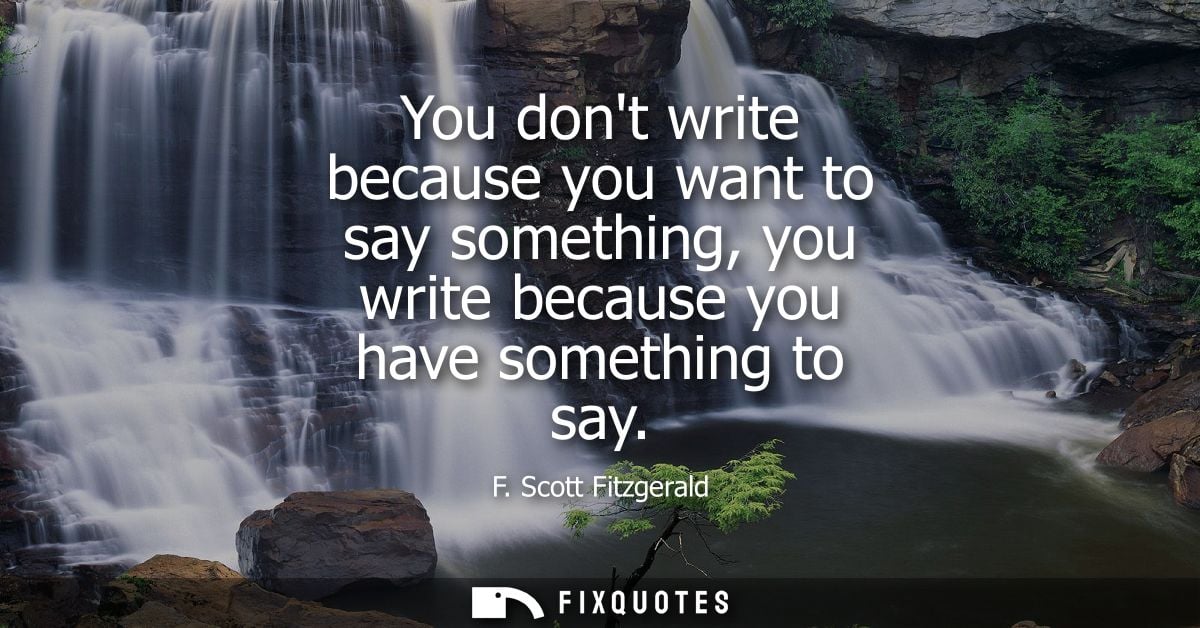
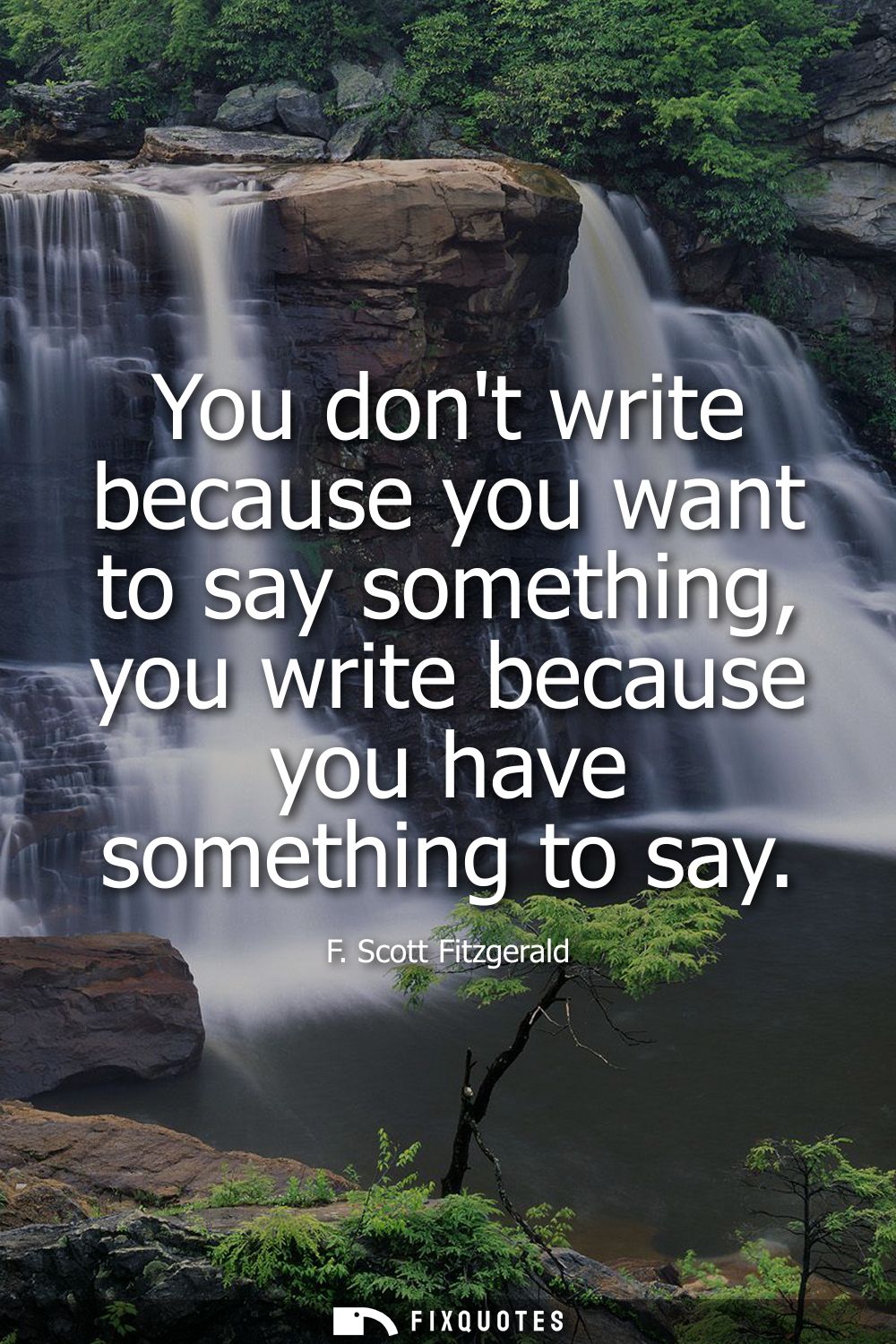
"You don't write because you want to say something, you write because you have something to say"
About this Quote
That distinction is also a quiet jab at literary posturing. Fitzgerald came up in a culture where authorship could be both high art and high status, where the marketplace rewarded style, voice, and mythmaking. He knew how easy it is to confuse fluency with substance, to mistake the dopamine of attention for the discipline of meaning. The quote makes craft secondary but not irrelevant: craft is the channel, not the motive. Technique matters because it’s how you carry the thing that’s already burning.
The subtext is almost moral: writing as obligation. That fits a man who chronicled the shimmer of aspiration and the rot beneath it. Fitzgerald’s best work exposes the gap between what people perform and what they actually know about themselves. Here, he’s applying that same suspicion to writers. If you’re writing to prove you exist, you’ll likely produce ornaments. If you’re writing because you can’t not, you’re at least starting from truth, even when the truth is uncomfortable, messy, or unmarketable.
Quote Details
| Topic | Writing |
|---|---|
| Source | Unverified source: The Notebooks of F. Scott Fitzgerald (F. Scott Fitzgerald, 1978)
Evidence: You don’t write because you want to say something; you write because you’ve got something to say. (Notebook E: "Epigrams, Wise Cracks and Jokes" (item #330)). Primary text is Fitzgerald’s own notebook entry, but it was first published posthumously. The earliest located publication is Edmund Wilso... Other candidates (1) Foreign Goods (Jingan Young, 2018) compilation95.0% ... F. Scott Fitzgerald who said you don't write because you want to say something , you write because you have somet... |
| Cite |
Citation Formats
APA Style (7th ed.)
Fitzgerald, F. Scott. (2026, February 17). You don't write because you want to say something, you write because you have something to say. FixQuotes. https://fixquotes.com/quotes/you-dont-write-because-you-want-to-say-something-6588/
Chicago Style
Fitzgerald, F. Scott. "You don't write because you want to say something, you write because you have something to say." FixQuotes. February 17, 2026. https://fixquotes.com/quotes/you-dont-write-because-you-want-to-say-something-6588/.
MLA Style (9th ed.)
"You don't write because you want to say something, you write because you have something to say." FixQuotes, 17 Feb. 2026, https://fixquotes.com/quotes/you-dont-write-because-you-want-to-say-something-6588/. Accessed 31 Mar. 2026.