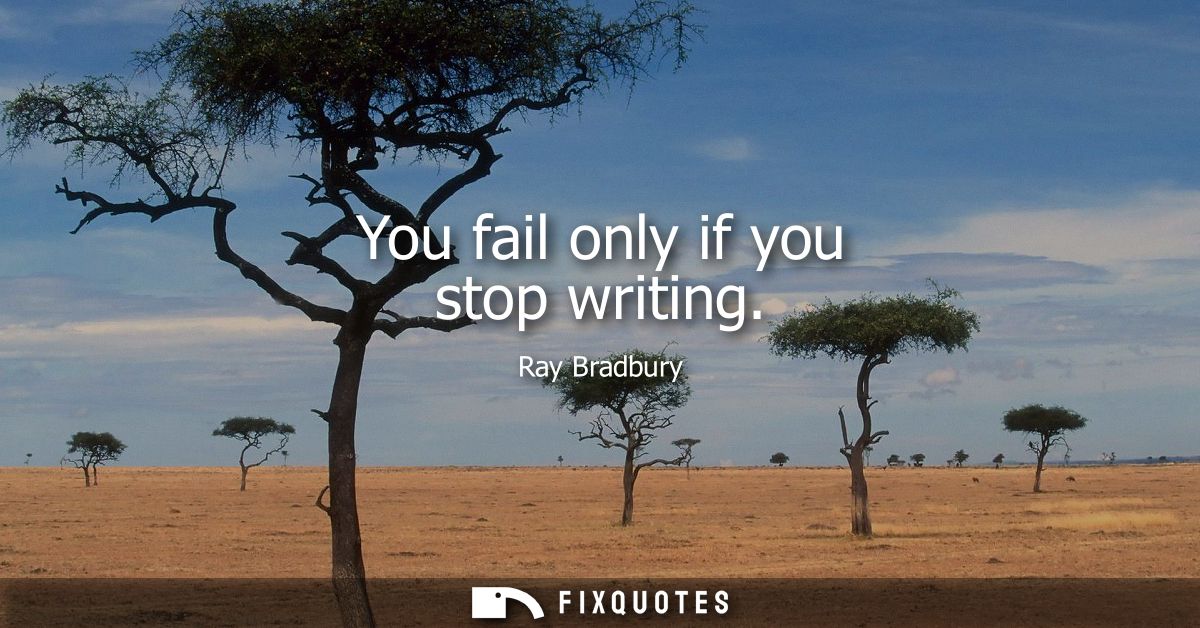
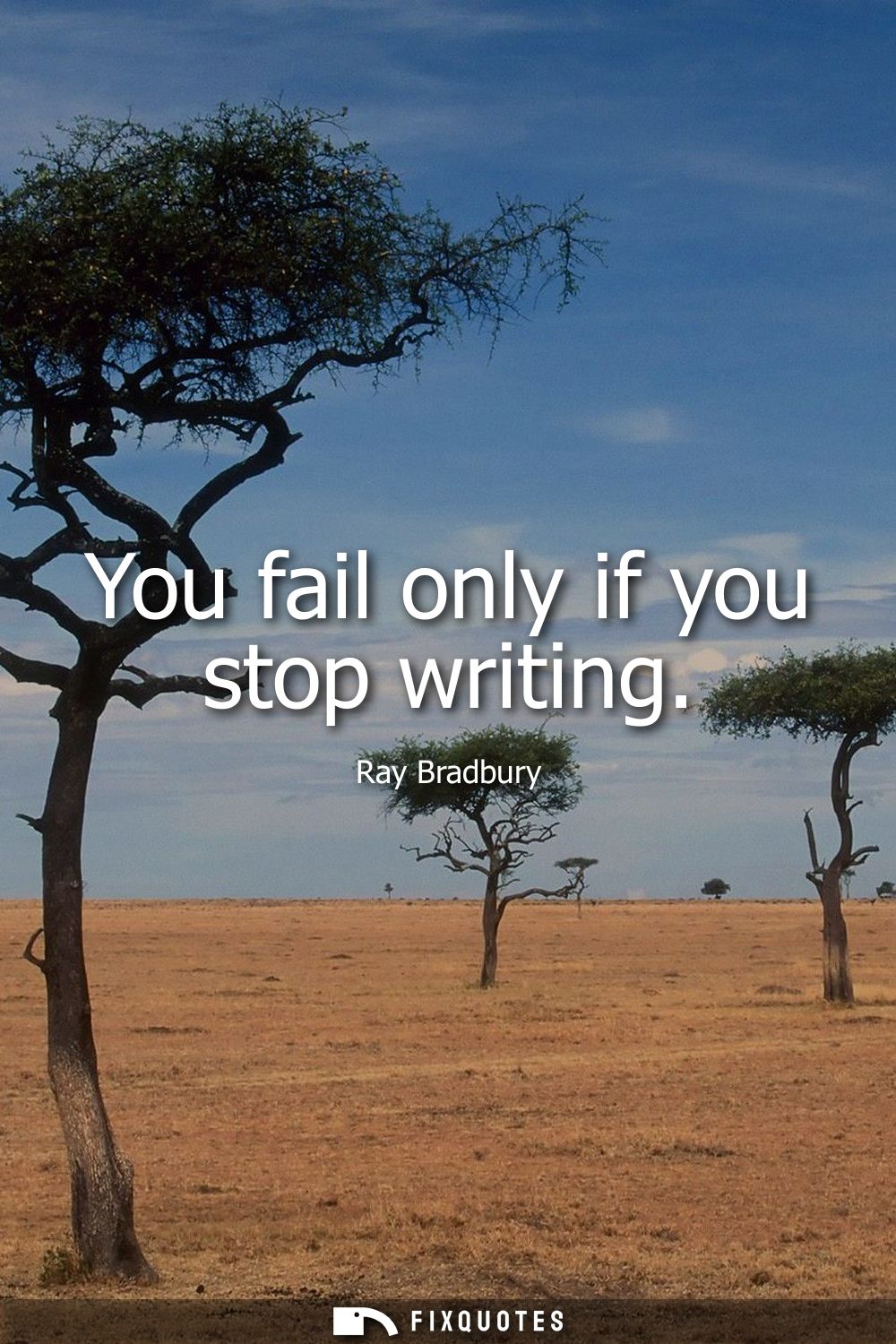
"You fail only if you stop writing"
About this Quote
Failure, in Bradbury's framing, isn't a verdict handed down by critics or the market; it's a decision you make when you abandon the page. The line is blunt on purpose. It reroutes the writer's anxiety away from outcomes you can't control - taste, timing, trends, gatekeepers - toward the one lever you can actually pull: continuing to produce work. Bradbury built a career on velocity and appetite. He wrote with the faith of someone who believed imagination is a muscle, not a muse, and muscles atrophy when you stop using them.
The subtext is a quiet rebuke to the preciousness that paralyzes artists. If you treat every draft like it must be definitive, you give each stumble the power to end you. Bradbury's sentence argues for a different ethic: volume as survival. Keep writing and you convert "failure" into compost - bad stories become practice, rejected submissions become data, and stylistic misfires become proof you're experimenting. Stop writing and you freeze your identity at the point of fear.
Context matters here: Bradbury rose in a mid-century ecosystem of pulp magazines, libraries, and relentless self-driven craft, before the contemporary culture of visibility metrics and instant feedback. Read today, the quote doubles as resistance to algorithmic discouragement. It's permission to measure a writing life by continuity rather than virality. The intent isn't to deny hardship; it's to make quitting the only true defeat, because everything else can be revised, resold, or repurposed - as long as you stay in motion.
The subtext is a quiet rebuke to the preciousness that paralyzes artists. If you treat every draft like it must be definitive, you give each stumble the power to end you. Bradbury's sentence argues for a different ethic: volume as survival. Keep writing and you convert "failure" into compost - bad stories become practice, rejected submissions become data, and stylistic misfires become proof you're experimenting. Stop writing and you freeze your identity at the point of fear.
Context matters here: Bradbury rose in a mid-century ecosystem of pulp magazines, libraries, and relentless self-driven craft, before the contemporary culture of visibility metrics and instant feedback. Read today, the quote doubles as resistance to algorithmic discouragement. It's permission to measure a writing life by continuity rather than virality. The intent isn't to deny hardship; it's to make quitting the only true defeat, because everything else can be revised, resold, or repurposed - as long as you stay in motion.
Quote Details
| Topic | Writing |
|---|---|
| Source | Help us find the source |
| Cite |
Citation Formats
APA Style (7th ed.)
Bradbury, Ray. (2026, January 14). You fail only if you stop writing. FixQuotes. https://fixquotes.com/quotes/you-fail-only-if-you-stop-writing-90551/
Chicago Style
Bradbury, Ray. "You fail only if you stop writing." FixQuotes. January 14, 2026. https://fixquotes.com/quotes/you-fail-only-if-you-stop-writing-90551/.
MLA Style (9th ed.)
"You fail only if you stop writing." FixQuotes, 14 Jan. 2026, https://fixquotes.com/quotes/you-fail-only-if-you-stop-writing-90551/. Accessed 12 Feb. 2026.
More Quotes by Ray
Add to List