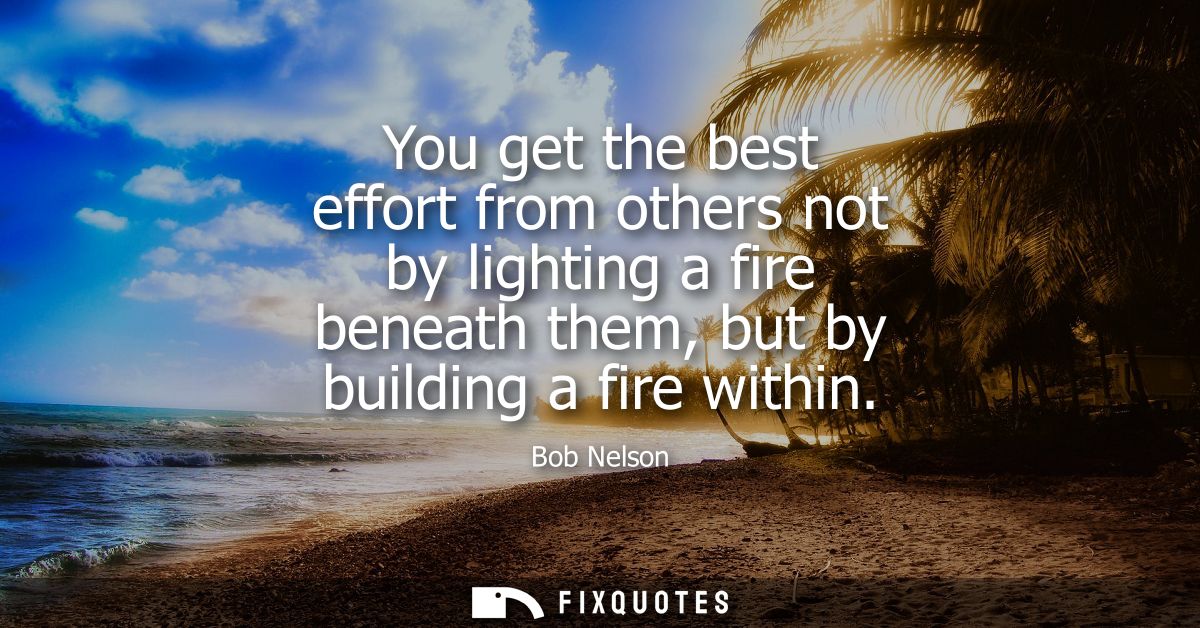
"You get the best effort from others, not by lighting a fire beneath them, but by building a fire within"
About this Quote
The subtext is a critique of management by adrenaline. “Lighting a fire beneath” evokes discomfort and urgency; it may produce motion, but it also produces resentment and short-term thinking. Nelson’s alternative implies a longer arc: sustainable performance comes from internalized purpose and recognition, not constant external stimulation. It’s also a soft rebuke to leaders who believe intensity equals leadership. The best effort, he suggests, is volunteered, not extracted.
Context matters: this kind of language thrives in late-20th-century and early-21st-century corporate life, where companies want commitment without calling it loyalty and want “culture” to do the work that higher pay or clearer boundaries used to do. Building a fire within can be humane - mentorship, trust, credit, craft. It can also be a conveniently inspirational way to ask for more discretionary labor. The quote works because it’s both a genuine leadership ideal and a mirror held up to the incentives managers would rather not name.
Quote Details
| Topic | Leadership |
|---|---|
| Source | Verified source: Workforce: Targeted Rewards Have Greater Value , and Big... (Bob Nelson, 1998)
Evidence: “You get the best effort from others not by lighting a fire beneath them, but by building a fire within them.” (pp. 66–71 (Vol. 77, No. 11; Nov. 1998)). This is the earliest primary-source publication I could verify online that directly attributes the quote to Bob Nelson in context of employee recognition/rewards. The same wording also appears on the back-cover copy for later editions of Nelson’s book '1001 Ways to Reward Employees' (indicating Nelson used it as a summary/positioning line), but I could not verify, via an accessible scan/preview, the exact first-edition (1994) interior page where it first appeared, nor an earlier (pre-1998) interview/speech transcript. So: earliest VERIFIED publication = Nov. 1998 in Workforce; earliest LIKELY origin may still be Nelson’s 1994 book or earlier talks, but that cannot be confirmed from primary evidence available in the web sources I could access. Other candidates (1) Contribute to Working Effectively with Others (Melody R. Green, 2002) compilation95.0% ... You get the best effort from others not by lighting a fire beneath them , but by building a fire within them . ' ... |
| Cite |
Citation Formats
APA Style (7th ed.)
Nelson, Bob. (2026, February 16). You get the best effort from others, not by lighting a fire beneath them, but by building a fire within. FixQuotes. https://fixquotes.com/quotes/you-get-the-best-effort-from-others-not-by-123392/
Chicago Style
Nelson, Bob. "You get the best effort from others, not by lighting a fire beneath them, but by building a fire within." FixQuotes. February 16, 2026. https://fixquotes.com/quotes/you-get-the-best-effort-from-others-not-by-123392/.
MLA Style (9th ed.)
"You get the best effort from others, not by lighting a fire beneath them, but by building a fire within." FixQuotes, 16 Feb. 2026, https://fixquotes.com/quotes/you-get-the-best-effort-from-others-not-by-123392/. Accessed 29 Mar. 2026.