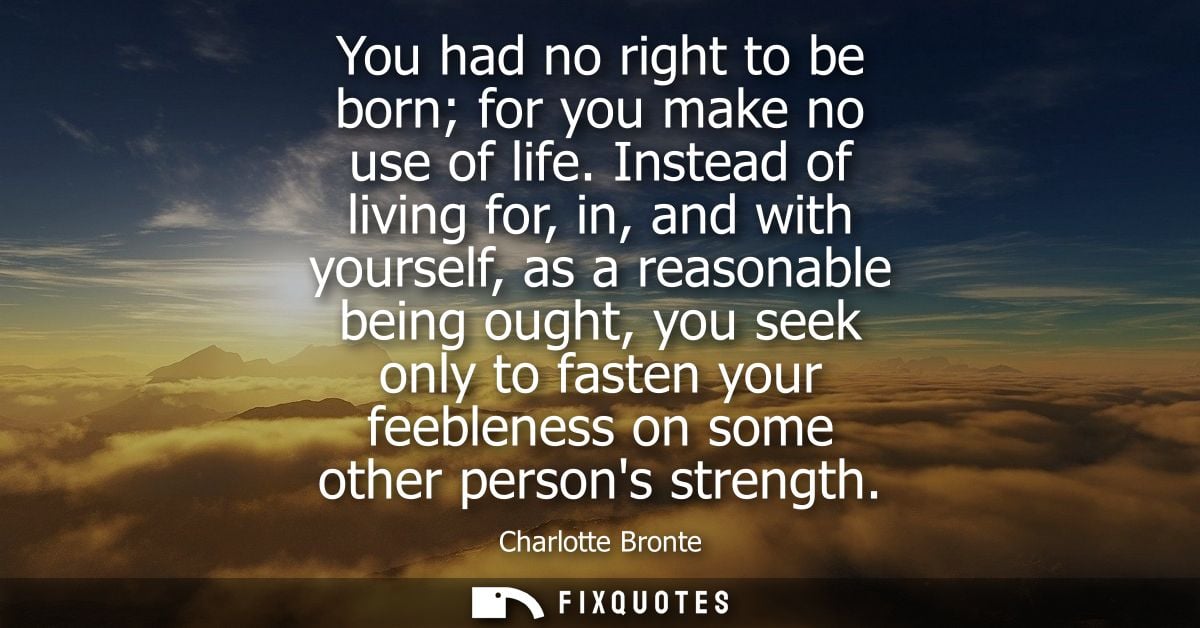
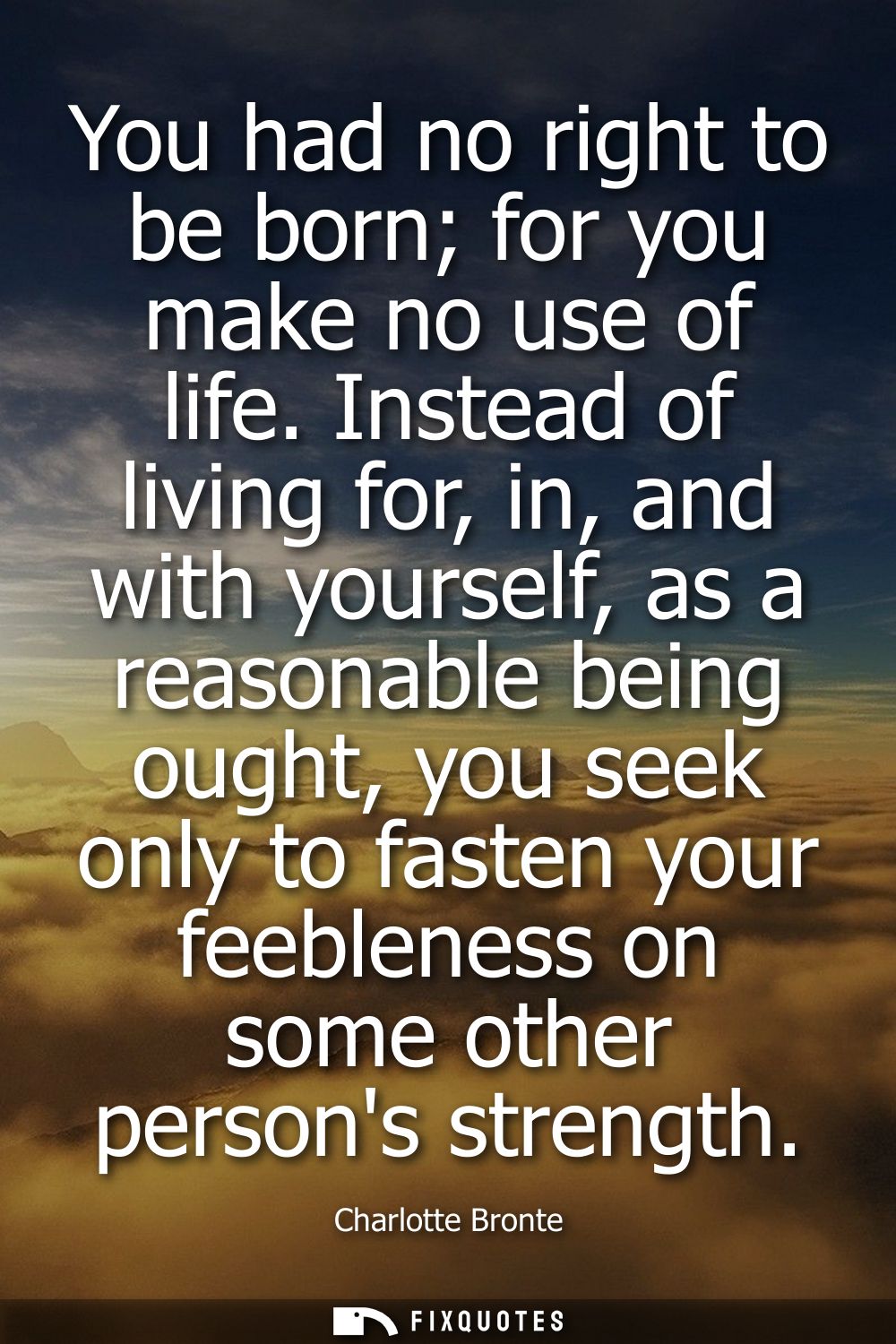
"You had no right to be born; for you make no use of life. Instead of living for, in, and with yourself, as a reasonable being ought, you seek only to fasten your feebleness on some other person's strength"
About this Quote
The sentence works because it’s built on a ladder of escalating judgment. First, existence is put on trial. Then life is framed as something to be “used,” as if personhood carries obligations. Then comes Bronte’s core contrast: living “for, in, and with yourself” versus “fasten your feebleness” onto another. That verb, “fasten,” is doing heavy lifting. It suggests not love or dependence but attachment as theft, as a cling that constrains the other person’s freedom.
The subtext is social as much as personal. In Bronte’s world, dependence is gendered and economically real; women are often trained to survive through others. Yet the rebuke refuses to romanticize that training. It insists on inner sovereignty even when external options are narrow, a radical demand coming from a novelist who knew the costs of poverty and confinement. Bronte’s intent is to shame the manipulative appeal to pity, to expose “need” as a strategy that can masquerade as tenderness while quietly feeding on another’s power.
Quote Details
| Topic | Self-Improvement |
|---|---|
| Source | Help us find the source |
| Cite |
Citation Formats
APA Style (7th ed.)
Bronte, Charlotte. (2026, January 17). You had no right to be born; for you make no use of life. Instead of living for, in, and with yourself, as a reasonable being ought, you seek only to fasten your feebleness on some other person's strength. FixQuotes. https://fixquotes.com/quotes/you-had-no-right-to-be-born-for-you-make-no-use-64316/
Chicago Style
Bronte, Charlotte. "You had no right to be born; for you make no use of life. Instead of living for, in, and with yourself, as a reasonable being ought, you seek only to fasten your feebleness on some other person's strength." FixQuotes. January 17, 2026. https://fixquotes.com/quotes/you-had-no-right-to-be-born-for-you-make-no-use-64316/.
MLA Style (9th ed.)
"You had no right to be born; for you make no use of life. Instead of living for, in, and with yourself, as a reasonable being ought, you seek only to fasten your feebleness on some other person's strength." FixQuotes, 17 Jan. 2026, https://fixquotes.com/quotes/you-had-no-right-to-be-born-for-you-make-no-use-64316/. Accessed 2 Apr. 2026.