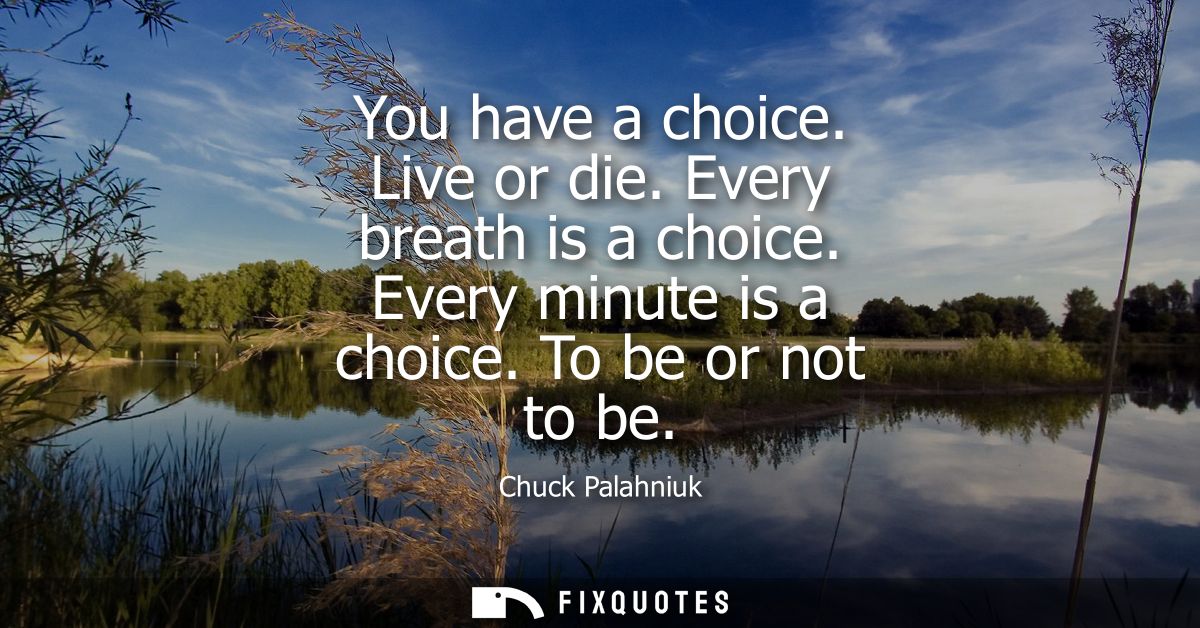
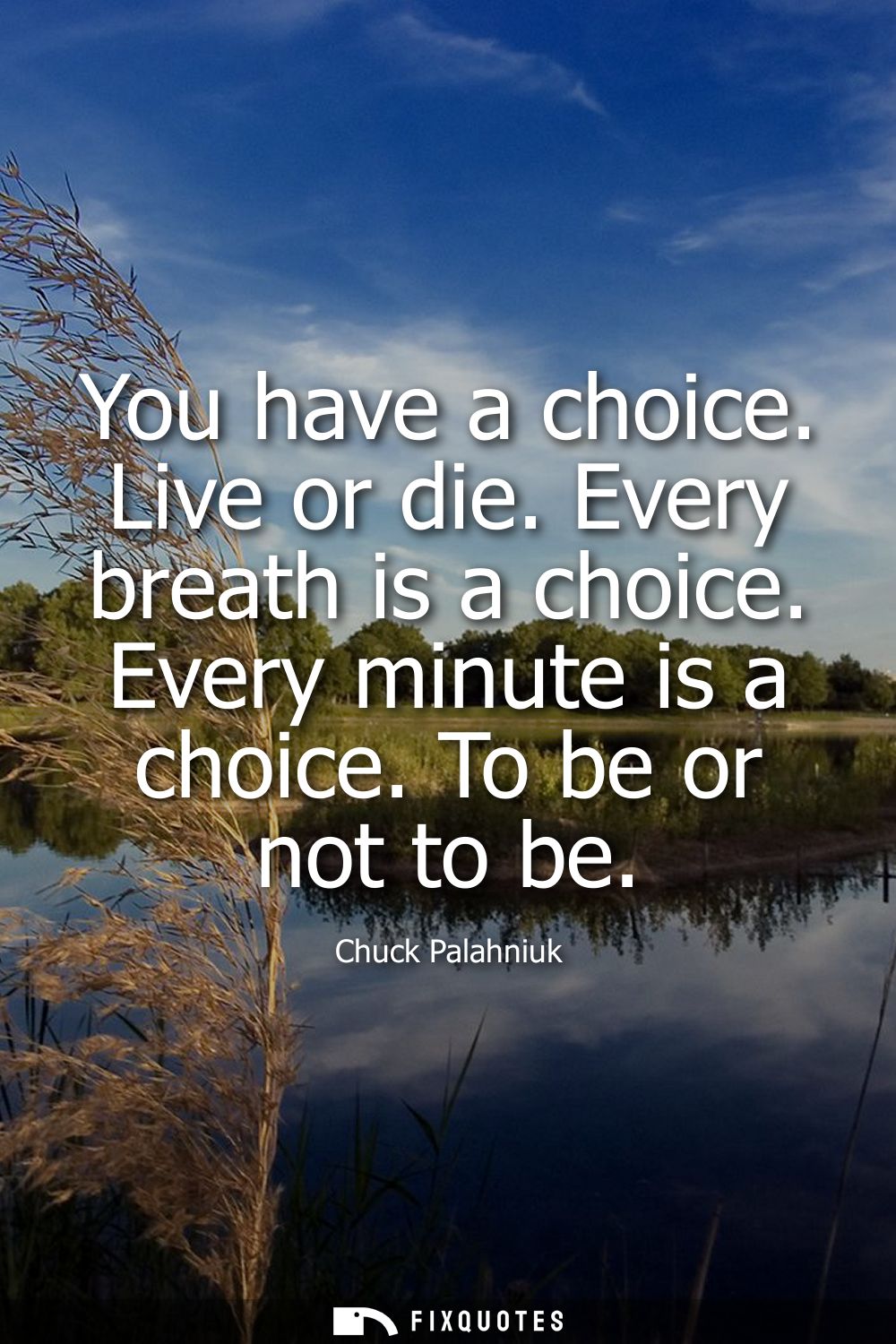
"You have a choice. Live or die. Every breath is a choice. Every minute is a choice. To be or not to be"
About this Quote
The repetition is doing the real work. It’s not lyrical; it’s percussive, like someone shaking you by the collar. Palahniuk’s narrators often live in the deadened zone between survival and life, where people outsource desire to routines, jobs, addictions, or ideology. By framing time itself as a decision, he exposes passivity as an active practice. You don’t drift into a life; you choose drift, minute after minute.
Then he detonates the Shakespeare tag: "To be or not to be". It’s a theft on purpose, a way of mocking the prestige of high culture while recruiting its authority. Hamlet agonizes. Palahniuk audits. The borrowed line becomes a pressure test: if you’re going to quote the canonical crisis, prove you understand it in the only currency that counts here - action.
Contextually, it sits comfortably in Palahniuk’s broader project: diagnosing a culture numb with comfort, fantasizing about catastrophe just to feel real again. The intent isn’t to romanticize death; it’s to shame the half-life we accept as normal.
Quote Details
| Topic | Free Will & Fate |
|---|---|
| Source | Later attribution: Inside the Mind of Chuck Palahniuk (Frank Johnson, 2014) modern compilationID: u5iZBAAAQBAJ
Evidence: ... You have a choice . Live or die . Every breath is a choice . Every minute is a choice . To be or not to be . " " The only difference between suicide and martyrdom is press coverage . " * " We all die . The goal isn't to Philosophy. Other candidates (1) Survivor (Chuck Palahniuk, 1999)50.0% Every breath is a choice. Every minute is a choice. To be or not to be. Every time you don't throw yourself down the ... |
| Cite |
Citation Formats
APA Style (7th ed.)
Palahniuk, Chuck. (2026, February 28). You have a choice. Live or die. Every breath is a choice. Every minute is a choice. To be or not to be. FixQuotes. https://fixquotes.com/quotes/you-have-a-choice-live-or-die-every-breath-is-a-23097/
Chicago Style
Palahniuk, Chuck. "You have a choice. Live or die. Every breath is a choice. Every minute is a choice. To be or not to be." FixQuotes. February 28, 2026. https://fixquotes.com/quotes/you-have-a-choice-live-or-die-every-breath-is-a-23097/.
MLA Style (9th ed.)
"You have a choice. Live or die. Every breath is a choice. Every minute is a choice. To be or not to be." FixQuotes, 28 Feb. 2026, https://fixquotes.com/quotes/you-have-a-choice-live-or-die-every-breath-is-a-23097/. Accessed 1 Apr. 2026.