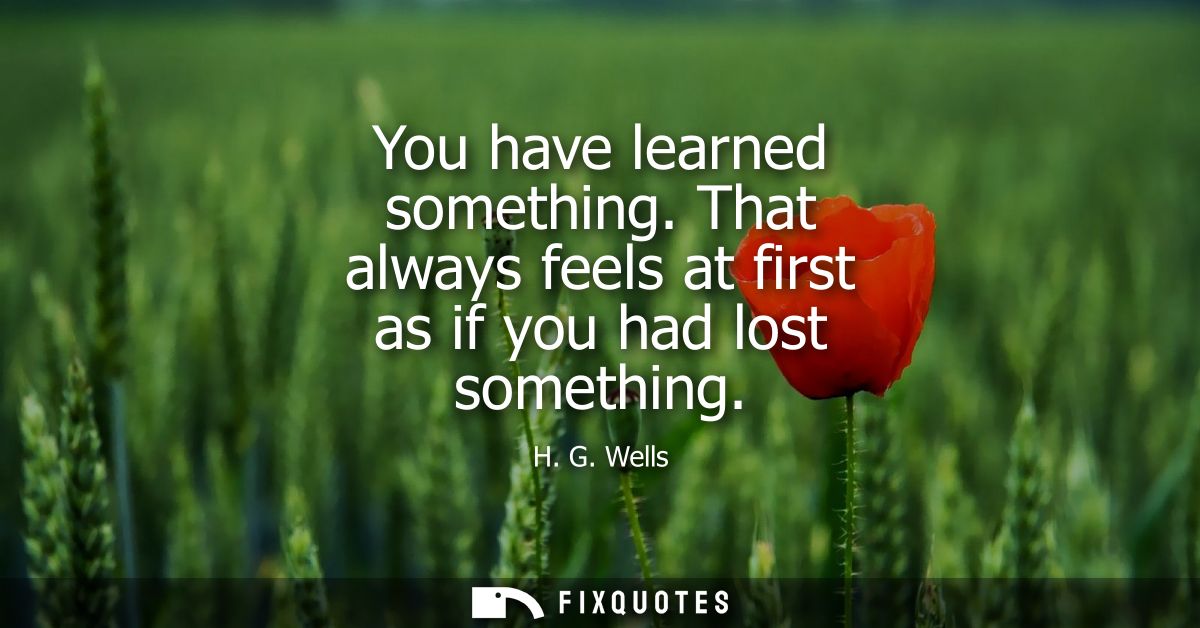
"You have learned something. That always feels at first as if you had lost something"
About this Quote
The subtext is almost evolutionary. To learn is to trade certainty for accuracy, and certainty is addictive. That initial feeling of loss is the withdrawal: the collapsing of old narratives, the embarrassment of having been wrong, the grief of innocence. Wells, an author steeped in scientific modernity and social critique, understood that knowledge has consequences. His era was saturated with discoveries and upheavals - Darwin’s long shadow, industrial capitalism, the acceleration of technology - all of it eroding inherited beliefs about nature, class, empire, even human exceptionalism. Enlightenment came with disorientation.
The sentence is engineered to land softly and then linger. “You have learned something” sounds like a teacher’s pat on the shoulder; the second sentence pivots into a confession. “Always” is the knife: he’s not describing a rare mood but a reliable law of the mind. Wells isn’t warning us off learning; he’s normalizing the ache, implying that if education feels like loss, it might be working.
Quote Details
| Topic | Learning |
|---|---|
| Source | Help us find the source |
| Cite |
Citation Formats
APA Style (7th ed.)
Wells, H.G. (2026, January 18). You have learned something. That always feels at first as if you had lost something. FixQuotes. https://fixquotes.com/quotes/you-have-learned-something-that-always-feels-at-12848/
Chicago Style
Wells, H.G. "You have learned something. That always feels at first as if you had lost something." FixQuotes. January 18, 2026. https://fixquotes.com/quotes/you-have-learned-something-that-always-feels-at-12848/.
MLA Style (9th ed.)
"You have learned something. That always feels at first as if you had lost something." FixQuotes, 18 Jan. 2026, https://fixquotes.com/quotes/you-have-learned-something-that-always-feels-at-12848/. Accessed 12 Feb. 2026.