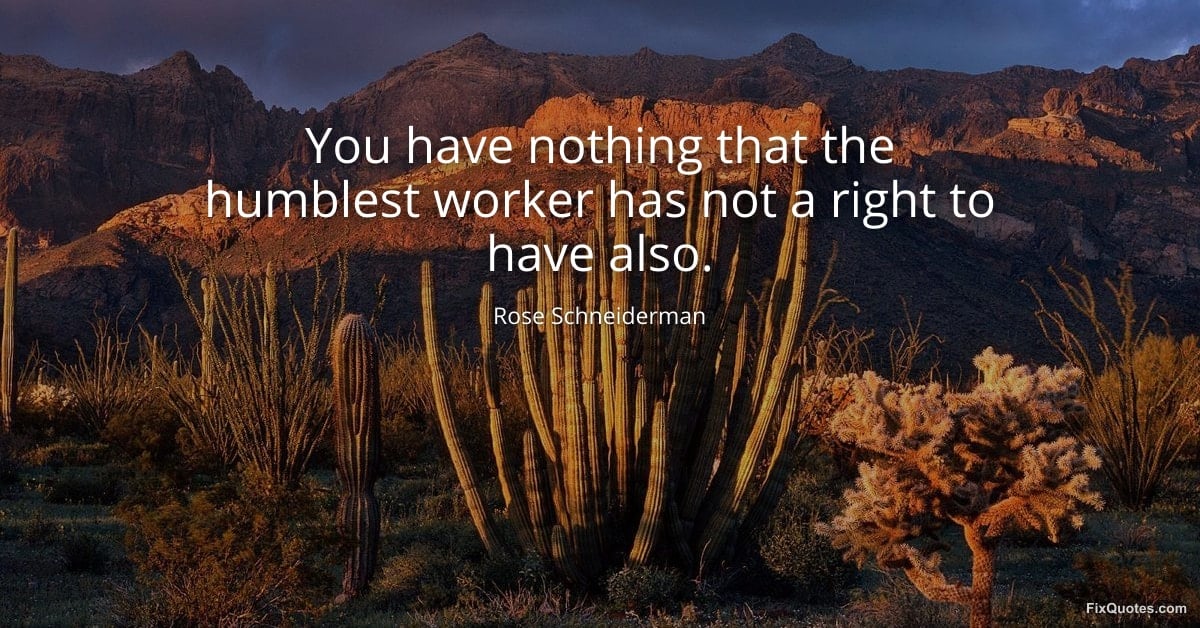
"You have nothing that the humblest worker has not a right to have also"
About this Quote
The specific intent is strategic: collapse the rhetorical distance between the well-off listener and the laboring majority. Schneiderman doesn’t say workers deserve “more”; she says the powerful possess no special claim to safety, leisure, education, or a future. That’s a radical move because it replaces the usual labor movement ask (better wages, fewer hours) with a broader democratic demand: equal rights to the conditions of a livable life.
The subtext is also a warning. If the elites insist on monopolizing what ought to be common rights, they’re not merely being selfish; they’re undermining social legitimacy. Schneiderman, a union organizer shaped by sweatshop labor and the Triangle Shirtwaist Factory fire era, understood how catastrophe exposes hierarchy: some bodies are treated as disposable until they burn in locked rooms. Against that backdrop, the sentence reads like an ethical ultimatum: your comfort is not evidence of superiority, and the system that grants it at others’ expense is not stable, or defensible.
Quote Details
| Topic | Equality |
|---|---|
| Source | Help us find the source |
| Cite |
Citation Formats
APA Style (7th ed.)
Schneiderman, Rose. (2026, January 17). You have nothing that the humblest worker has not a right to have also. FixQuotes. https://fixquotes.com/quotes/you-have-nothing-that-the-humblest-worker-has-not-65406/
Chicago Style
Schneiderman, Rose. "You have nothing that the humblest worker has not a right to have also." FixQuotes. January 17, 2026. https://fixquotes.com/quotes/you-have-nothing-that-the-humblest-worker-has-not-65406/.
MLA Style (9th ed.)
"You have nothing that the humblest worker has not a right to have also." FixQuotes, 17 Jan. 2026, https://fixquotes.com/quotes/you-have-nothing-that-the-humblest-worker-has-not-65406/. Accessed 29 Mar. 2026.