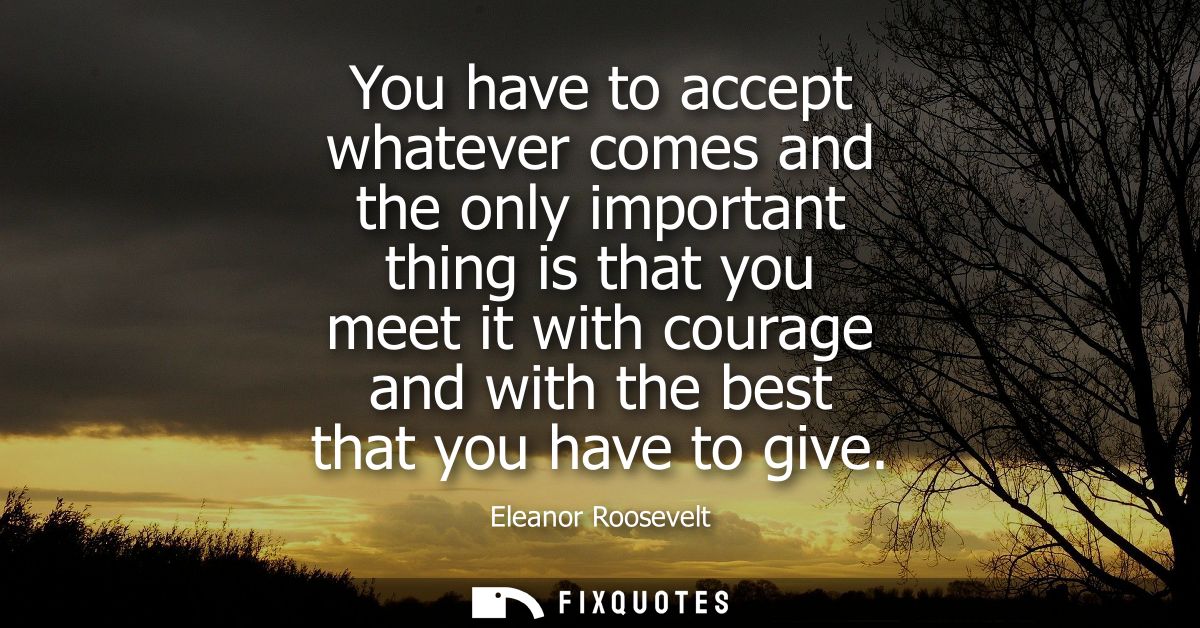
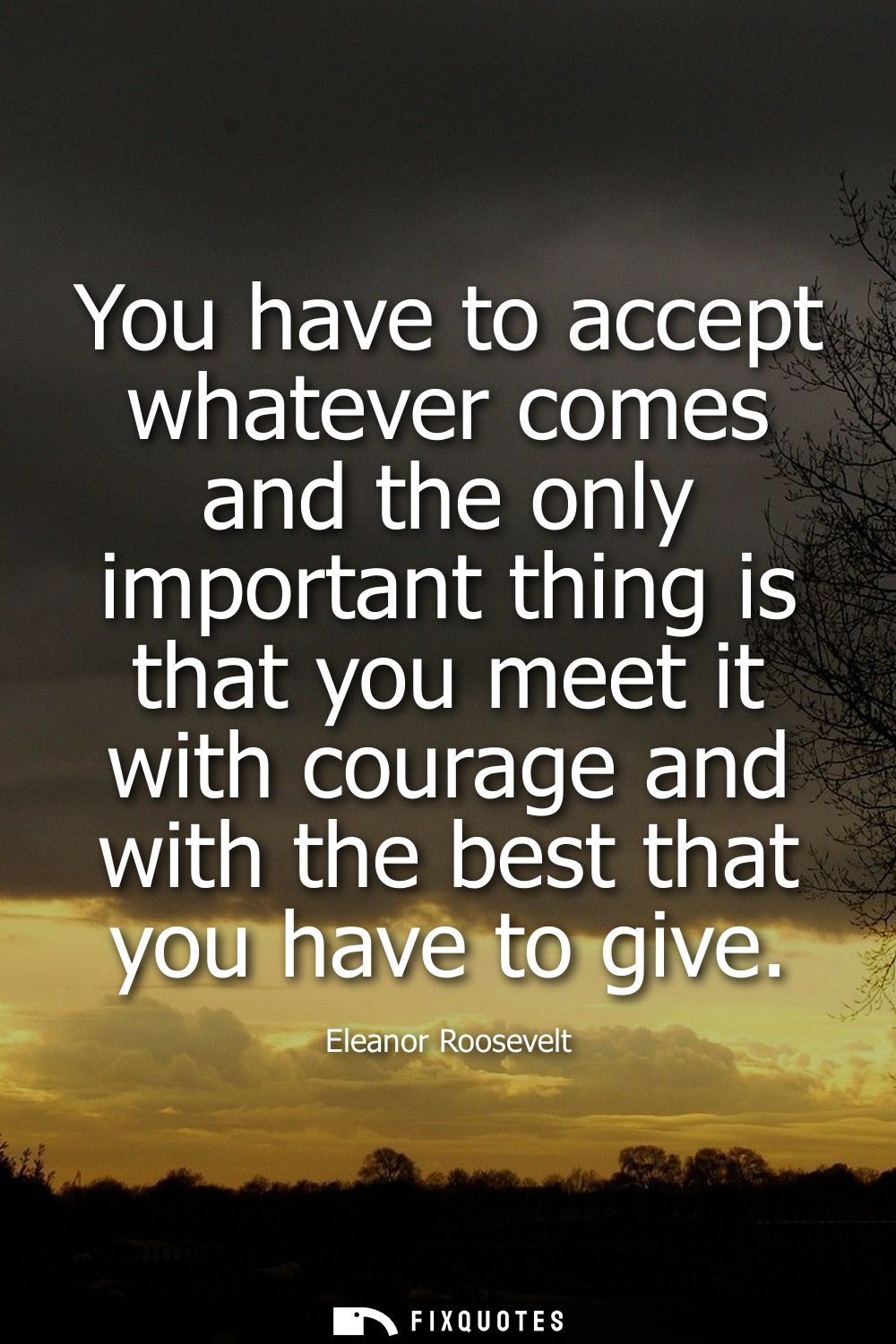
"You have to accept whatever comes, and the only important thing is that you meet it with courage and with the best that you have to give"
About this Quote
The subtext is shaped by the particular theater she lived in. As First Lady during the Depression and World War II, she watched catastrophe become administrative routine: telegrams, casualty lists, ration lines, displaced families. “Whatever comes” isn’t metaphysical; it’s historical. That’s why the word “meet” matters. It’s an active verb, almost confrontational, implying a face-to-face encounter with fear, criticism, grief, and political backlash. Roosevelt had ample experience “meeting” hostile press, entrenched segregationists, and skeptics who resented her public advocacy. Acceptance, here, is the precondition for action, not the substitute for it.
The phrase “the best that you have to give” is doing cultural work, too. It democratizes courage: not heroics, not perfection, but your best under constraint. Coming from a woman boxed in by gender expectations yet expanding the role anyway, it’s a pragmatic ethic for public life. She’s arguing that dignity isn’t a mood; it’s performance under pressure, repeated until it becomes character.
Quote Details
| Topic | Resilience |
|---|---|
| Source | Verified source: You Learn by Living (Eleanor Roosevelt, 1960)
Evidence: You have to accept whatever comes and the only important thing is that you meet it with courage and with the best that you have to give. (Chapter 9, "Facing Responsibility"; page 152). The strongest primary-source attribution I could verify points to Eleanor Roosevelt's own book You Learn by Living (1960). Multiple secondary-but-source-focused references specifically place the quotation in the chapter "Facing Responsibility," page 152, and one quote-research page also notes the quote appears in later published correspondence, suggesting the book may not be the earliest wording she ever used privately, but it is the earliest authorial publication I could substantiate from available evidence. I was not able to inspect a trustworthy scanned first-edition page image directly, so page 152 should be treated as likely but not fully image-verified. Other candidates (1) Wisdom for the Soul (Larry Chang, 2006) compilation97.4% ... You have to accept whatever comes and the only important thing is that you meet it with courage and with the best... |
| Cite |
Citation Formats
APA Style (7th ed.)
Roosevelt, Eleanor. (2026, March 15). You have to accept whatever comes, and the only important thing is that you meet it with courage and with the best that you have to give. FixQuotes. https://fixquotes.com/quotes/you-have-to-accept-whatever-comes-and-the-only-19299/
Chicago Style
Roosevelt, Eleanor. "You have to accept whatever comes, and the only important thing is that you meet it with courage and with the best that you have to give." FixQuotes. March 15, 2026. https://fixquotes.com/quotes/you-have-to-accept-whatever-comes-and-the-only-19299/.
MLA Style (9th ed.)
"You have to accept whatever comes, and the only important thing is that you meet it with courage and with the best that you have to give." FixQuotes, 15 Mar. 2026, https://fixquotes.com/quotes/you-have-to-accept-whatever-comes-and-the-only-19299/. Accessed 30 Mar. 2026.