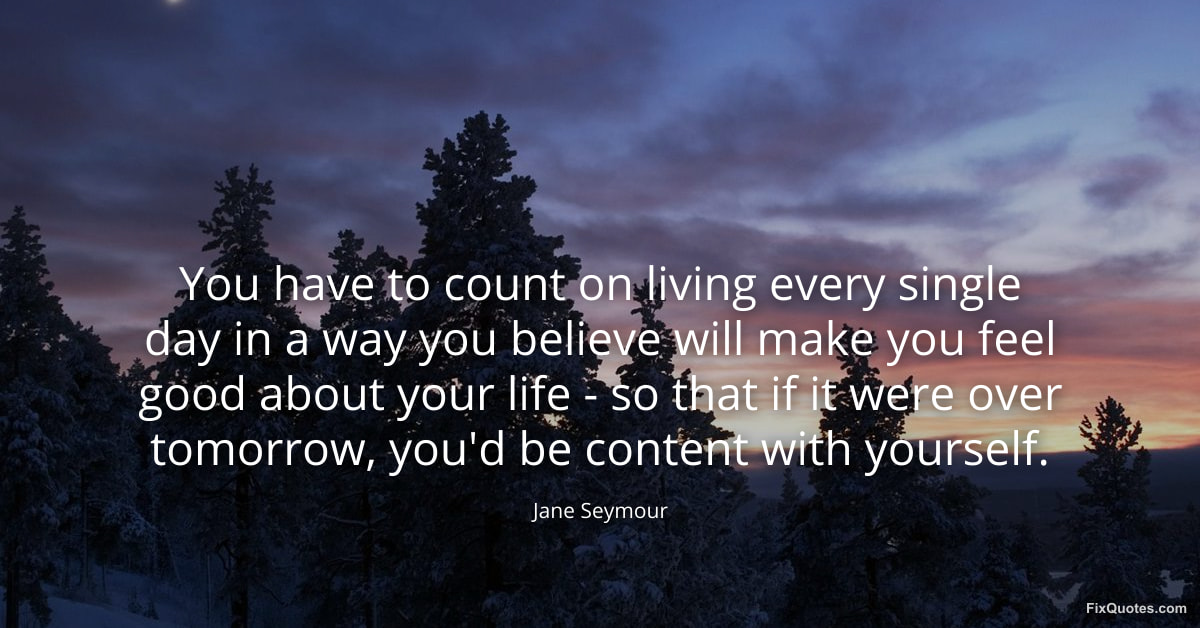
"You have to count on living every single day in a way you believe will make you feel good about your life - so that if it were over tomorrow, you'd be content with yourself"
About this Quote
The specific intent is practical, almost managerial: make daily choices that your future self can sign off on. Not “be happy every day,” but “live in a way you believe will make you feel good.” That phrase matters. Seymour builds in subjectivity and humility; she’s not prescribing virtue, she’s insisting on alignment. The standard isn’t perfection or productivity, it’s self-recognition.
The subtext is a rebuke to postponement culture. We’re trained to defer meaning until after the promotion, the relationship, the makeover, the next year’s version of ourselves. Seymour flips the timeline: if your life ended abruptly, would your choices still look like yours? It’s mortality talk without the melodrama, a way of smuggling the big question into a sentence you can actually use on a Tuesday.
Contextually, it echoes a post-1990s celebrity wellness vernacular, but it’s sharper than most. Contentment here isn’t complacency; it’s moral and emotional coherence - the quiet confidence of not needing a rewrite when the curtain drops.
Quote Details
| Topic | Live in the Moment |
|---|---|
| Source | Help us find the source |
| Cite |
Citation Formats
APA Style (7th ed.)
Seymour, Jane. (2026, January 15). You have to count on living every single day in a way you believe will make you feel good about your life - so that if it were over tomorrow, you'd be content with yourself. FixQuotes. https://fixquotes.com/quotes/you-have-to-count-on-living-every-single-day-in-a-170040/
Chicago Style
Seymour, Jane. "You have to count on living every single day in a way you believe will make you feel good about your life - so that if it were over tomorrow, you'd be content with yourself." FixQuotes. January 15, 2026. https://fixquotes.com/quotes/you-have-to-count-on-living-every-single-day-in-a-170040/.
MLA Style (9th ed.)
"You have to count on living every single day in a way you believe will make you feel good about your life - so that if it were over tomorrow, you'd be content with yourself." FixQuotes, 15 Jan. 2026, https://fixquotes.com/quotes/you-have-to-count-on-living-every-single-day-in-a-170040/. Accessed 7 Mar. 2026.