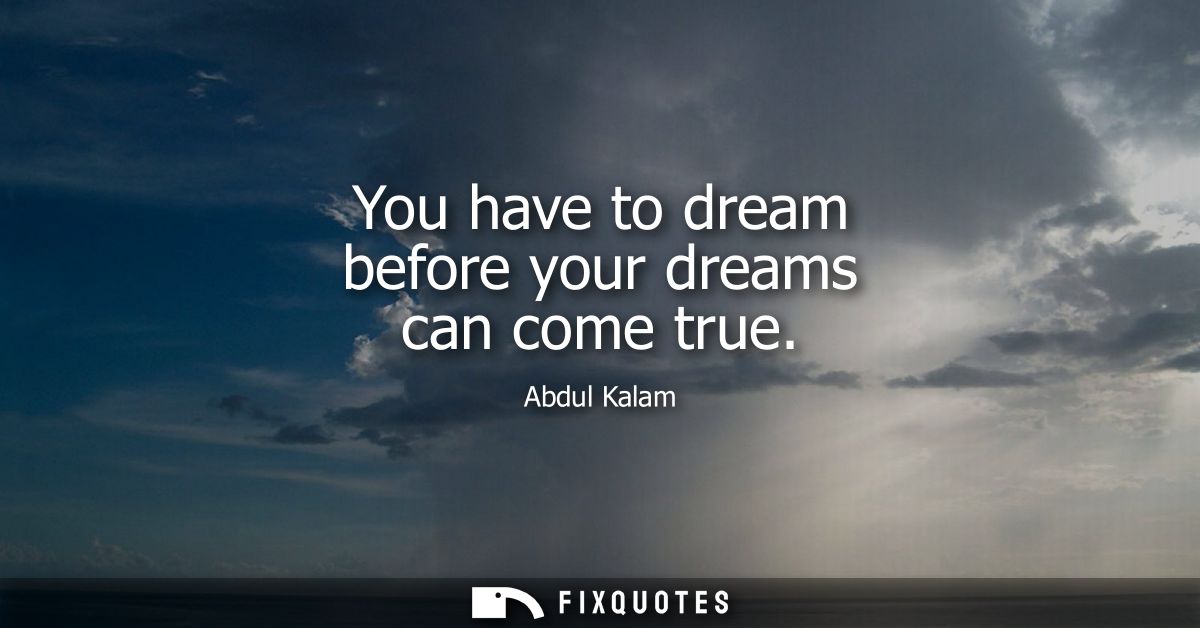
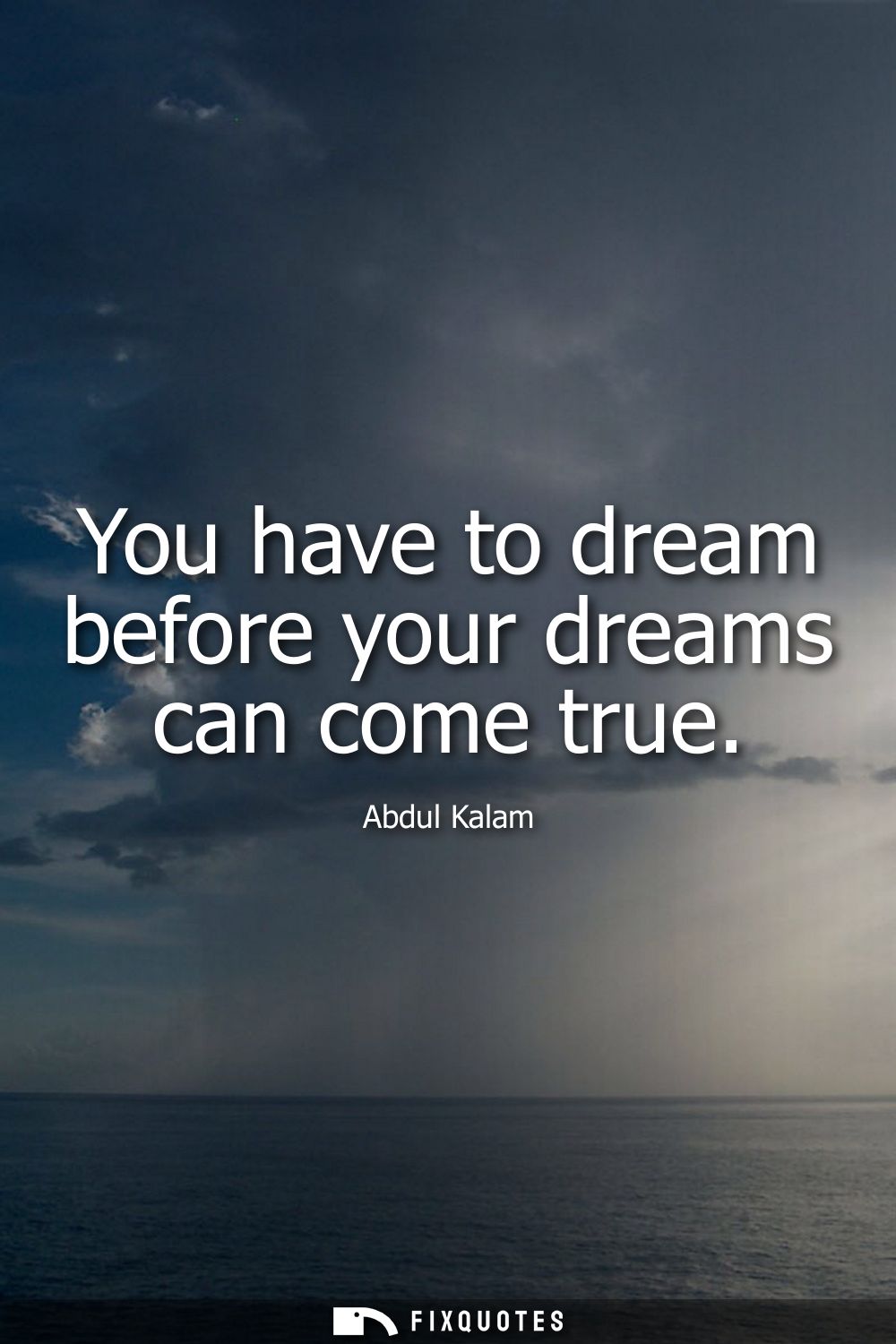
"You have to dream before your dreams can come true"
About this Quote
“Dream” is doing double duty here: it’s the soft word we use for private yearning, and the hard prerequisite for public achievement. Abdul Kalam, a scientist-statesman whose life threaded India’s postcolonial ambition through rockets, laboratories, and the presidency, isn’t offering a Hallmark pillow slogan. He’s laying down a sequence. Before policy, before budgets, before national pride or personal success, there has to be an act of imagination that’s vivid enough to reorganize your behavior.
The intent is quietly disciplinary. “Have to” turns aspiration into obligation; dreaming becomes work, not escape. Kalam’s subtext is that progress doesn’t begin with credentials or permission. It begins with a mental prototype: a future you can see clearly enough to start building. Coming from a figure associated with big-state projects and technological modernity, the line also smuggles in a civic argument: nations, like individuals, rise or stall based on what they dare to picture. In a country negotiating scarcity, inequality, and the aftershocks of colonial extraction, “dream” becomes a tool against fatalism.
Why it works is its simplicity without softness. The sentence offers no guarantee of success, only a condition for possibility. It flatters you a little (your dreams matter) while challenging you more (if you can’t envision it, don’t expect it). In the age of hustle culture and algorithmic distraction, it’s a reminder that the first act of agency is still internal: refusing to let the future be default-selected for you.
The intent is quietly disciplinary. “Have to” turns aspiration into obligation; dreaming becomes work, not escape. Kalam’s subtext is that progress doesn’t begin with credentials or permission. It begins with a mental prototype: a future you can see clearly enough to start building. Coming from a figure associated with big-state projects and technological modernity, the line also smuggles in a civic argument: nations, like individuals, rise or stall based on what they dare to picture. In a country negotiating scarcity, inequality, and the aftershocks of colonial extraction, “dream” becomes a tool against fatalism.
Why it works is its simplicity without softness. The sentence offers no guarantee of success, only a condition for possibility. It flatters you a little (your dreams matter) while challenging you more (if you can’t envision it, don’t expect it). In the age of hustle culture and algorithmic distraction, it’s a reminder that the first act of agency is still internal: refusing to let the future be default-selected for you.
Quote Details
| Topic | Motivational |
|---|---|
| Source | Help us find the source |
| Cite |
Citation Formats
APA Style (7th ed.)
Kalam, Abdul. (2026, January 17). You have to dream before your dreams can come true. FixQuotes. https://fixquotes.com/quotes/you-have-to-dream-before-your-dreams-can-come-true-63301/
Chicago Style
Kalam, Abdul. "You have to dream before your dreams can come true." FixQuotes. January 17, 2026. https://fixquotes.com/quotes/you-have-to-dream-before-your-dreams-can-come-true-63301/.
MLA Style (9th ed.)
"You have to dream before your dreams can come true." FixQuotes, 17 Jan. 2026, https://fixquotes.com/quotes/you-have-to-dream-before-your-dreams-can-come-true-63301/. Accessed 8 Apr. 2026.
More Quotes by Abdul
Add to List