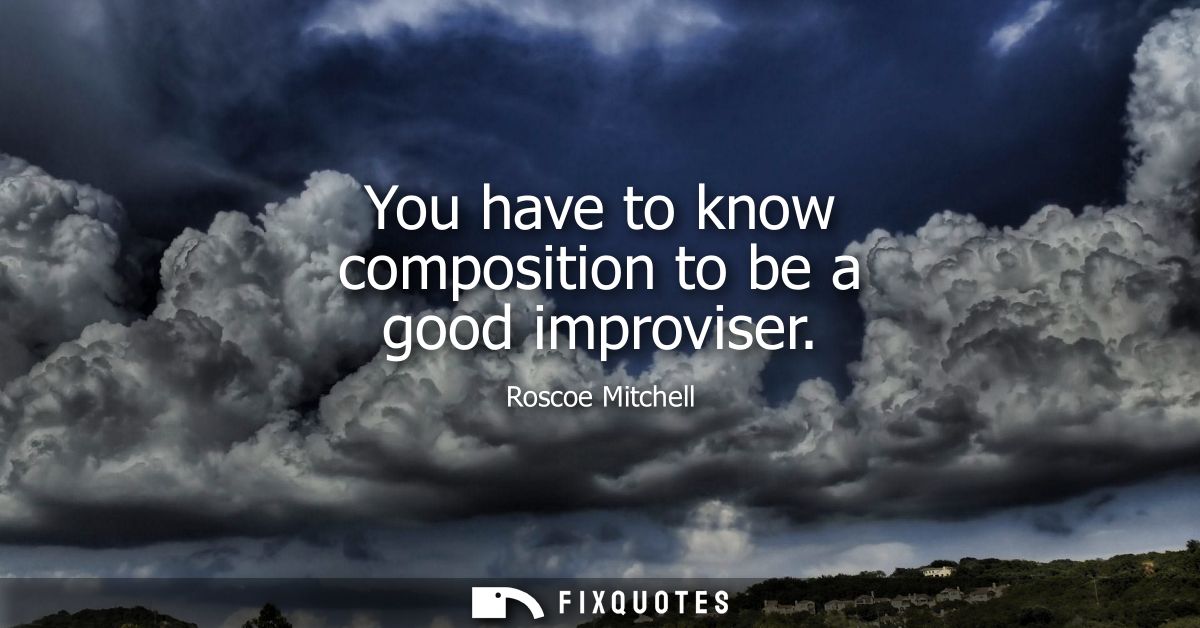
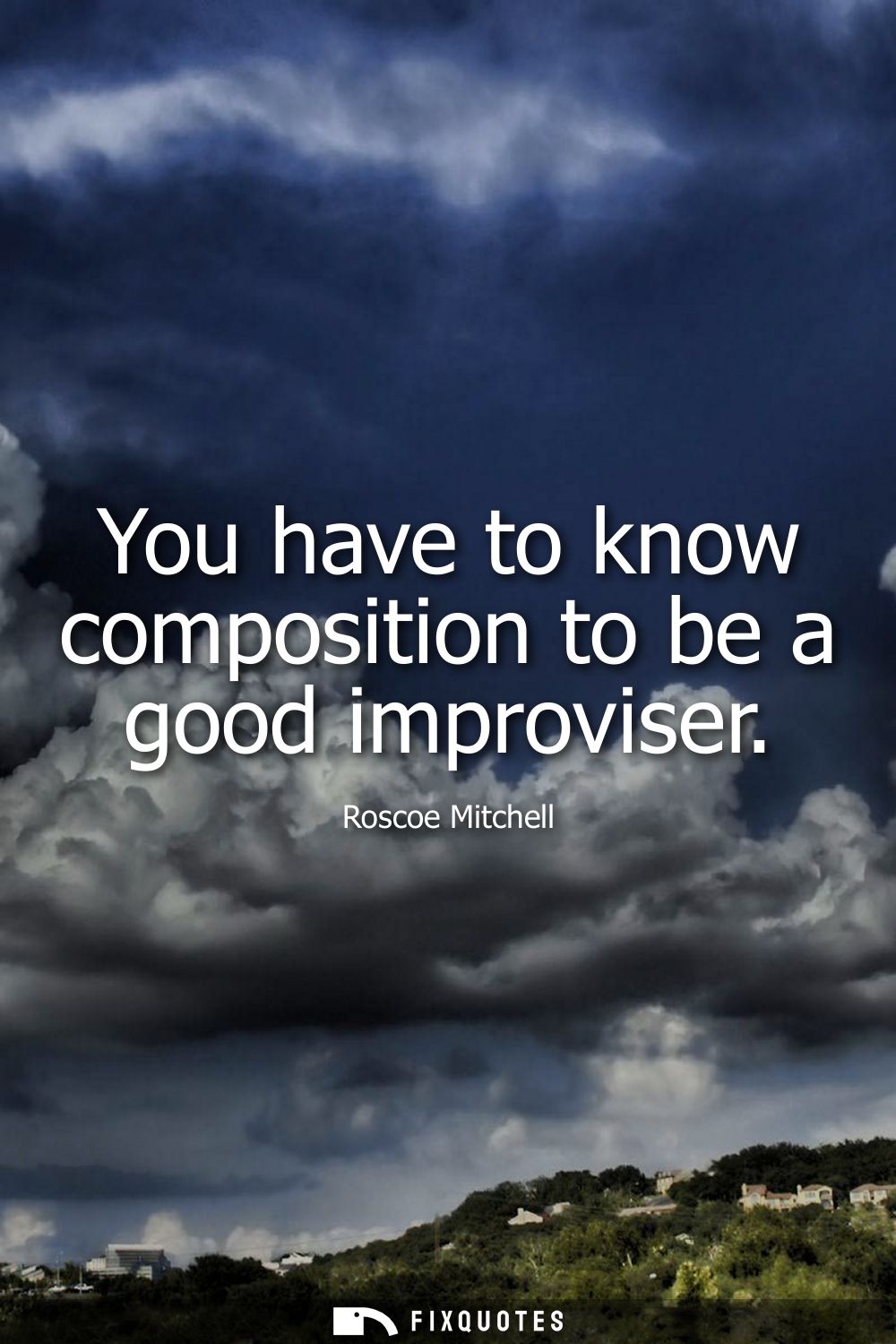
"You have to know composition to be a good improviser"
About this Quote
Mitchell’s line cuts through a romantic myth that still clings to improvisation: that it’s pure instinct, untrained lightning in a bottle. Coming from an AACM architect who helped redefine what “jazz” could even be, the point isn’t to domesticate freedom; it’s to expose the infrastructure that makes freedom legible.
“You have to know composition” doesn’t mean you need to write sonatas before you take a solo. It means you need an internalized sense of form: how tension accumulates, how motifs mutate, how silence functions as a structural choice, how ensemble dynamics can be orchestrated in real time. Mitchell’s own music often blurs the border between written material and spontaneous decision-making, so the statement doubles as a listening lesson. When the Art Ensemble sounds like it’s detonating rules, it’s actually executing a deeper order: pacing, timbre, register, density, the theatrical placement of sound in space.
The subtext is mildly corrective, even polemical. Mitchell is pushing back against the industry’s tendency to sell Black avant-garde improvisation as mystical “natural” expression rather than rigorous craft. Improvisation becomes a site of authorship, not just performance; the improviser is a composer operating at speed, accountable to coherence, memory, and consequence.
Context matters: for musicians emerging from mid-century jazz circuits that prized virtuoso solos, AACM players insisted on systems, concepts, and collective composition. Mitchell’s sentence is that ethos in miniature: spontaneity, yes, but with architecture underneath.
“You have to know composition” doesn’t mean you need to write sonatas before you take a solo. It means you need an internalized sense of form: how tension accumulates, how motifs mutate, how silence functions as a structural choice, how ensemble dynamics can be orchestrated in real time. Mitchell’s own music often blurs the border between written material and spontaneous decision-making, so the statement doubles as a listening lesson. When the Art Ensemble sounds like it’s detonating rules, it’s actually executing a deeper order: pacing, timbre, register, density, the theatrical placement of sound in space.
The subtext is mildly corrective, even polemical. Mitchell is pushing back against the industry’s tendency to sell Black avant-garde improvisation as mystical “natural” expression rather than rigorous craft. Improvisation becomes a site of authorship, not just performance; the improviser is a composer operating at speed, accountable to coherence, memory, and consequence.
Context matters: for musicians emerging from mid-century jazz circuits that prized virtuoso solos, AACM players insisted on systems, concepts, and collective composition. Mitchell’s sentence is that ethos in miniature: spontaneity, yes, but with architecture underneath.
Quote Details
| Topic | Music |
|---|---|
| Source | Help us find the source |
| Cite |
Citation Formats
APA Style (7th ed.)
Mitchell, Roscoe. (2026, January 16). You have to know composition to be a good improviser. FixQuotes. https://fixquotes.com/quotes/you-have-to-know-composition-to-be-a-good-102747/
Chicago Style
Mitchell, Roscoe. "You have to know composition to be a good improviser." FixQuotes. January 16, 2026. https://fixquotes.com/quotes/you-have-to-know-composition-to-be-a-good-102747/.
MLA Style (9th ed.)
"You have to know composition to be a good improviser." FixQuotes, 16 Jan. 2026, https://fixquotes.com/quotes/you-have-to-know-composition-to-be-a-good-102747/. Accessed 12 Feb. 2026.
More Quotes by Roscoe
Add to List