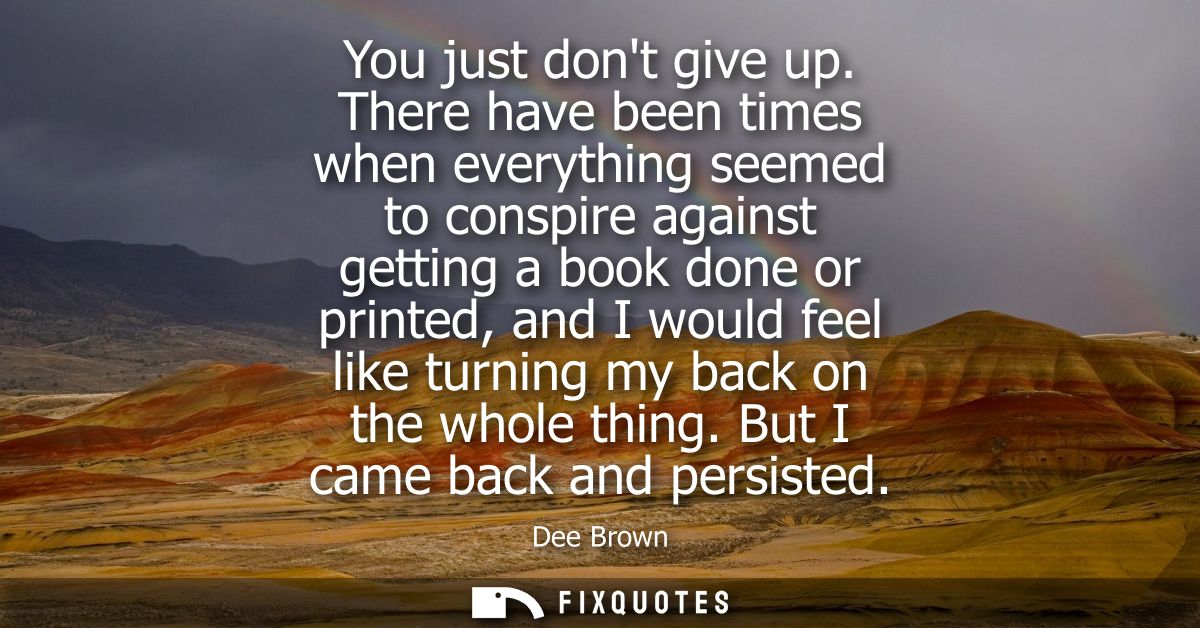
"You just don't give up. There have been times when everything seemed to conspire against getting a book done or printed, and I would feel like turning my back on the whole thing. But I came back and persisted"
About this Quote
The subtext is a quiet demystification of authorship. Brown admits to the impulse to “turn my back on the whole thing,” which punctures the macho myth that real writers never doubt. That confession matters because it frames persistence not as heroic personality but as a decision you re-make after losing faith. “I came back” is the key verb: resilience as return, not as constant forward motion.
Context sharpens the intent. Brown’s career depended on the publishing machinery of mid-century America, and his most famous work, Bury My Heart at Wounded Knee, confronted a national narrative that preferred not to be confronted. For a writer taking on that kind of subject, resistance isn’t only internal; it’s cultural. The quote reads like a field report from someone who learned that telling an inconvenient story requires a second skill alongside craft: the willingness to endure the boring, bruising parts long enough for the work to reach the public.
Quote Details
| Topic | Never Give Up |
|---|---|
| Source | Help us find the source |
| Cite |
Citation Formats
APA Style (7th ed.)
Brown, Dee. (2026, January 16). You just don't give up. There have been times when everything seemed to conspire against getting a book done or printed, and I would feel like turning my back on the whole thing. But I came back and persisted. FixQuotes. https://fixquotes.com/quotes/you-just-dont-give-up-there-have-been-times-when-136167/
Chicago Style
Brown, Dee. "You just don't give up. There have been times when everything seemed to conspire against getting a book done or printed, and I would feel like turning my back on the whole thing. But I came back and persisted." FixQuotes. January 16, 2026. https://fixquotes.com/quotes/you-just-dont-give-up-there-have-been-times-when-136167/.
MLA Style (9th ed.)
"You just don't give up. There have been times when everything seemed to conspire against getting a book done or printed, and I would feel like turning my back on the whole thing. But I came back and persisted." FixQuotes, 16 Jan. 2026, https://fixquotes.com/quotes/you-just-dont-give-up-there-have-been-times-when-136167/. Accessed 9 Mar. 2026.