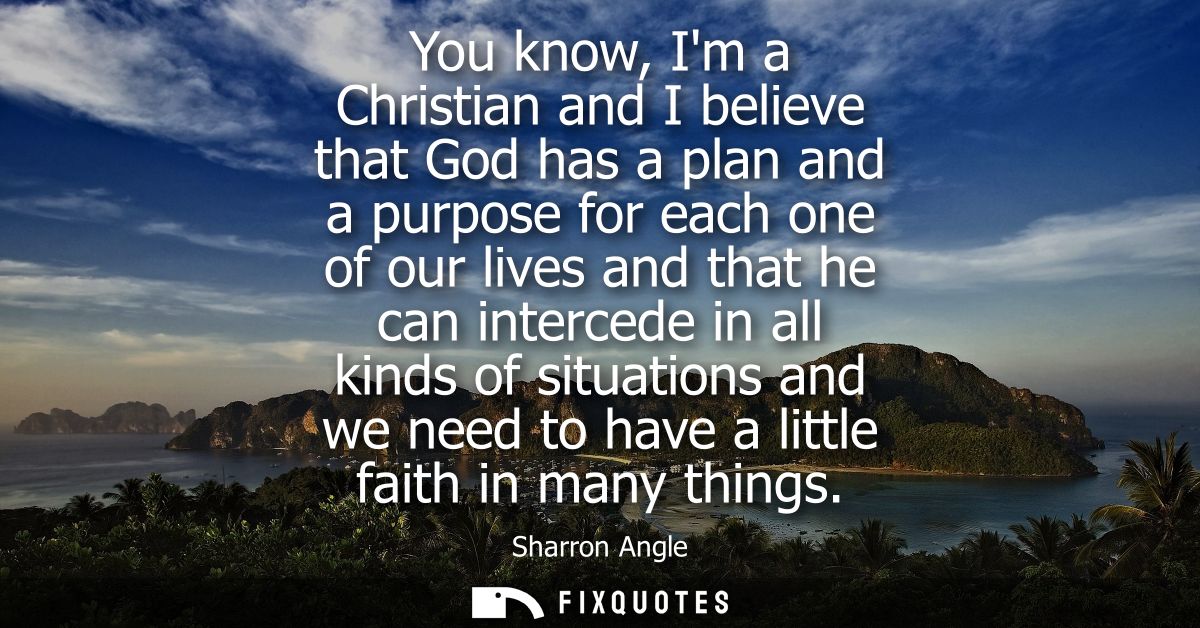
"You know, I'm a Christian and I believe that God has a plan and a purpose for each one of our lives and that he can intercede in all kinds of situations and we need to have a little faith in many things"
About this Quote
The intent is reassurance, but the subtext is authority. If God’s plan is the ultimate logic, disagreement can be recast as spiritual deficiency rather than civic debate. “Intercede” is especially loaded: it implies that human systems (courts, hospitals, social programs) are secondary to supernatural intervention. That can be comforting to supporters who want meaning in uncertainty; it can also function as a rhetorical escape hatch when facts get messy. Faith becomes the fallback explanation when governance can’t promise results.
Context matters because Angle isn’t speaking as a pastor; she’s speaking as a politician whose job is to make choices under constraint. The quote offers emotional coherence in a culture that often experiences politics as chaos, but it also blurs the line between personal conviction and public obligation. It’s an appeal to trust her not just as a candidate, but as an instrument of providence - and that’s a powerful ask in a democracy built on skepticism.
Quote Details
| Topic | Faith |
|---|---|
| Source | Help us find the source |
| Cite |
Citation Formats
APA Style (7th ed.)
Angle, Sharron. (2026, January 17). You know, I'm a Christian and I believe that God has a plan and a purpose for each one of our lives and that he can intercede in all kinds of situations and we need to have a little faith in many things. FixQuotes. https://fixquotes.com/quotes/you-know-im-a-christian-and-i-believe-that-god-77473/
Chicago Style
Angle, Sharron. "You know, I'm a Christian and I believe that God has a plan and a purpose for each one of our lives and that he can intercede in all kinds of situations and we need to have a little faith in many things." FixQuotes. January 17, 2026. https://fixquotes.com/quotes/you-know-im-a-christian-and-i-believe-that-god-77473/.
MLA Style (9th ed.)
"You know, I'm a Christian and I believe that God has a plan and a purpose for each one of our lives and that he can intercede in all kinds of situations and we need to have a little faith in many things." FixQuotes, 17 Jan. 2026, https://fixquotes.com/quotes/you-know-im-a-christian-and-i-believe-that-god-77473/. Accessed 7 Apr. 2026.