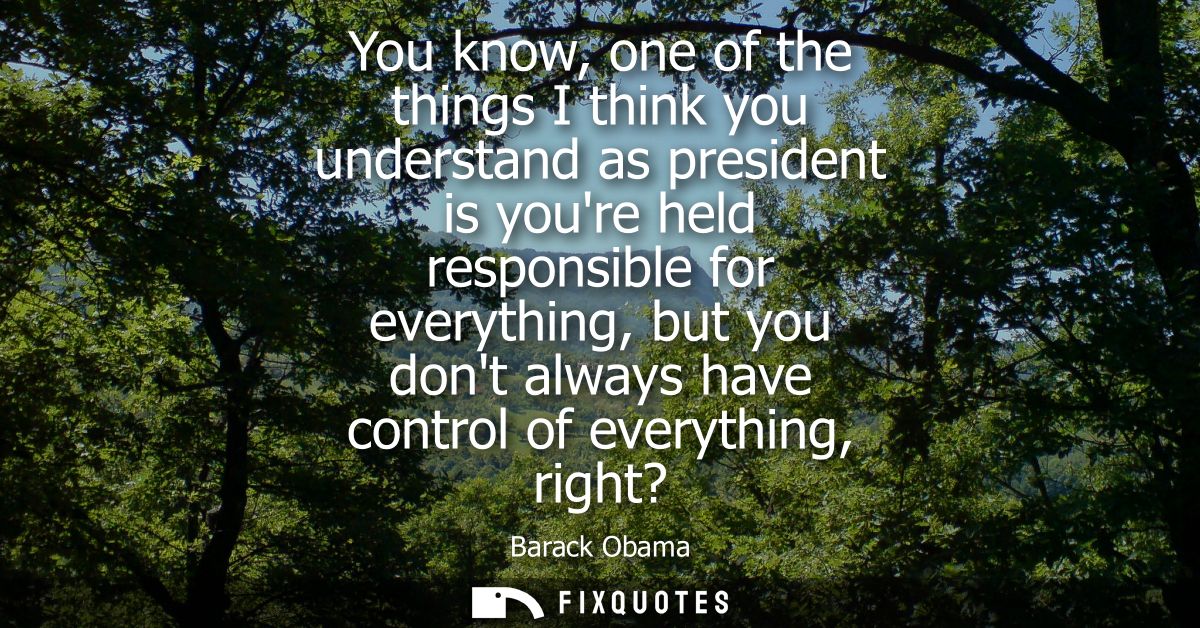
"You know, one of the things I think you understand as president is you're held responsible for everything, but you don't always have control of everything, right?"
About this Quote
The intent is twofold. First, it’s an inoculation against the politics of omnipotence: a reminder that accountability in a democracy often exceeds anyone’s actual capacity to steer outcomes. Second, it subtly resets expectations. Obama isn’t denying responsibility; he’s distinguishing moral and political responsibility (you own the consequences) from operational control (you can’t command the entire system). That distinction matters in an era when voters demand immediate results from problems that sprawl across Congress, courts, markets, state governments, and international actors.
Contextually, this is Obama the institutionalist talking: the president as manager of a massive apparatus, not a lone hero. The subtext carries a critique of modern media and partisan incentives that reward the illusion of total control - and punish leaders for admitting complexity. It’s a line built to sound reasonable, because reasonableness is the argument: the job is bigger than the person, and our expectations are part of the problem.
Quote Details
| Topic | Leadership |
|---|---|
| Source | Help us find the source |
| Cite |
Citation Formats
APA Style (7th ed.)
Obama, Barack. (2026, January 18). You know, one of the things I think you understand as president is you're held responsible for everything, but you don't always have control of everything, right? FixQuotes. https://fixquotes.com/quotes/you-know-one-of-the-things-i-think-you-understand-18401/
Chicago Style
Obama, Barack. "You know, one of the things I think you understand as president is you're held responsible for everything, but you don't always have control of everything, right?" FixQuotes. January 18, 2026. https://fixquotes.com/quotes/you-know-one-of-the-things-i-think-you-understand-18401/.
MLA Style (9th ed.)
"You know, one of the things I think you understand as president is you're held responsible for everything, but you don't always have control of everything, right?" FixQuotes, 18 Jan. 2026, https://fixquotes.com/quotes/you-know-one-of-the-things-i-think-you-understand-18401/. Accessed 4 Apr. 2026.