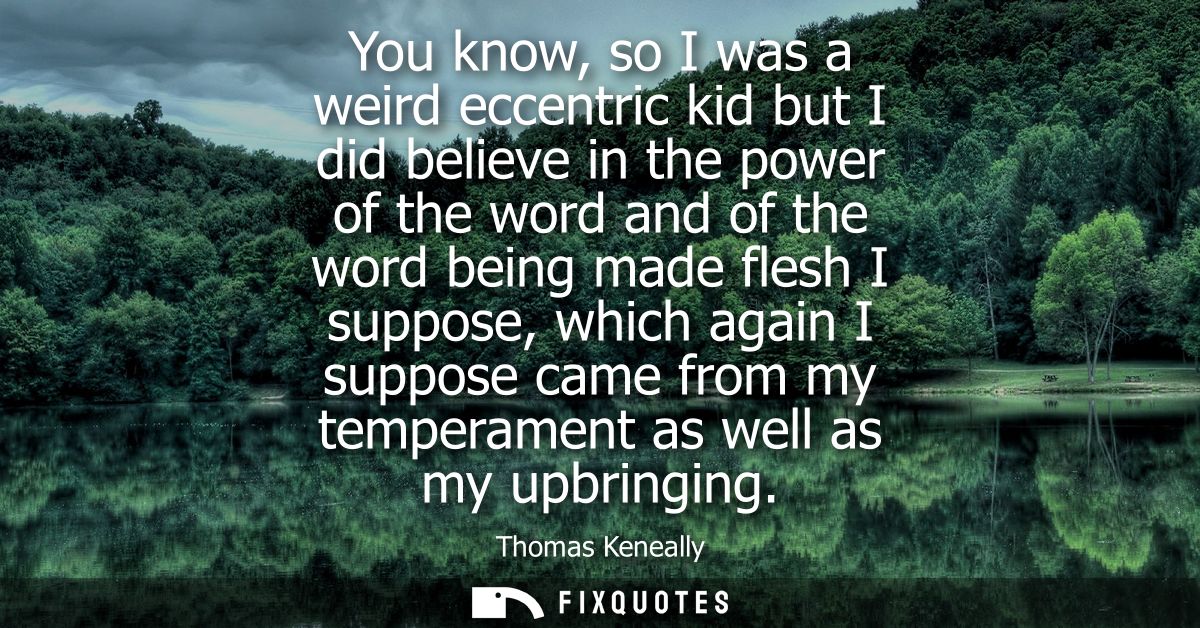
"You know, so I was a weird eccentric kid but I did believe in the power of the word and of the word being made flesh I suppose, which again I suppose came from my temperament as well as my upbringing"
About this Quote
Keneally is doing two things at once: confessing to being the kind of child who didn’t quite fit, and quietly insisting that misfit status can be an apprenticeship for literature. The phrase "weird eccentric kid" sounds self-deprecating, almost conversationally shrugging off the origin story. Then he pivots to a grander claim: "the power of the word". It’s a jolt in register that reveals the point. The odd kid wasn’t just socially out of tune; he was already oriented toward language as a force that can move bodies, histories, and moral imagination.
"Word being made flesh" is the tell. It borrows Christian theology (the Incarnation) and smuggles it into an account of artistic creation. For a novelist, it’s a precise metaphor: language doesn’t remain abstract; it becomes lived reality on the page, and sometimes beyond it. Keneally’s career, especially in historical fiction, trades on exactly that premise - that words can reanimate the past and produce ethical pressure in the present. The subtext is a defense of storytelling as more than entertainment: it’s a mode of embodiment.
The repeated "I suppose" is its own small performance of humility, but it also signals the layered causes he’s tracing: temperament and upbringing, nature and nurture, private quirks and inherited belief. He’s acknowledging that faith in language is partly personal wiring and partly cultural conditioning - a Catholic or biblically saturated background where words don’t merely describe the world; they conjure obligations. In an era suspicious of grand narratives, Keneally’s line argues for a stubbornly old-fashioned idea: that sentences can still take on flesh and consequences.
"Word being made flesh" is the tell. It borrows Christian theology (the Incarnation) and smuggles it into an account of artistic creation. For a novelist, it’s a precise metaphor: language doesn’t remain abstract; it becomes lived reality on the page, and sometimes beyond it. Keneally’s career, especially in historical fiction, trades on exactly that premise - that words can reanimate the past and produce ethical pressure in the present. The subtext is a defense of storytelling as more than entertainment: it’s a mode of embodiment.
The repeated "I suppose" is its own small performance of humility, but it also signals the layered causes he’s tracing: temperament and upbringing, nature and nurture, private quirks and inherited belief. He’s acknowledging that faith in language is partly personal wiring and partly cultural conditioning - a Catholic or biblically saturated background where words don’t merely describe the world; they conjure obligations. In an era suspicious of grand narratives, Keneally’s line argues for a stubbornly old-fashioned idea: that sentences can still take on flesh and consequences.
Quote Details
| Topic | Writing |
|---|---|
| Source | Help us find the source |
More Quotes by Thomas
Add to List