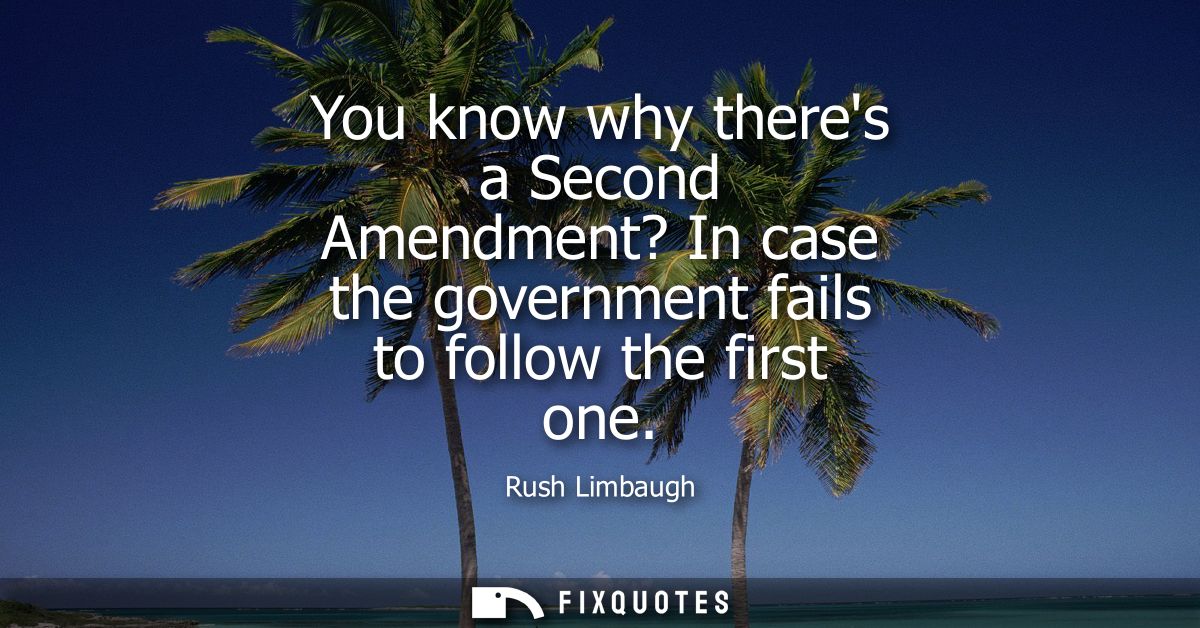
"You know why there's a Second Amendment? In case the government fails to follow the first one"
About this Quote
The specific intent is twofold: recast gun rights as a guardianship of free speech, and frame government as a likely adversary rather than a contested, democratic instrument. That move folds multiple conservative anxieties into one clean hierarchy: speech is the crown jewel, guns are the lockbox. The subtext is darker. “Fails to follow” implies betrayal, not mere disagreement. It smuggles in the idea that legal processes and elections are, at best, fragile and, at worst, decorative. The implied audience is the listener who already feels talked over by elites, regulators, and the cultural mainstream; the quote offers them a bracing sense of agency.
Context matters: Limbaugh’s power came from turning policy into identity and grievance into entertainment. This is a radio-ready syllogism, designed for repetition and moral clarity, not constitutional nuance. It flattens the messy reality that the First Amendment is enforced through courts, norms, and collective action - while the Second, invoked this way, hints at extra-legal remedy without having to say it outright. The genius, and the danger, is how effortlessly it turns suspicion into a principle.
Quote Details
| Topic | Freedom |
|---|---|
| Source | Later attribution: Quotes for Conservatives (Garry Apgar, 2020) modern compilationISBN: 9781546085898 · ID: lY2hDwAAQBAJ
Evidence:
... You know why there's a Second Amendment? In case the government fails to follow the first one. Rush Limbaugh (1951– ), radio talk show host (The Rush Limbaugh Show, August 17, 1993) The purpose of the right to bear arms is twofold; to ... |
| Cite |
Citation Formats
APA Style (7th ed.)
Limbaugh, Rush. (2026, February 17). You know why there's a Second Amendment? In case the government fails to follow the first one. FixQuotes. https://fixquotes.com/quotes/you-know-why-theres-a-second-amendment-in-case-12473/
Chicago Style
Limbaugh, Rush. "You know why there's a Second Amendment? In case the government fails to follow the first one." FixQuotes. February 17, 2026. https://fixquotes.com/quotes/you-know-why-theres-a-second-amendment-in-case-12473/.
MLA Style (9th ed.)
"You know why there's a Second Amendment? In case the government fails to follow the first one." FixQuotes, 17 Feb. 2026, https://fixquotes.com/quotes/you-know-why-theres-a-second-amendment-in-case-12473/. Accessed 25 Mar. 2026.