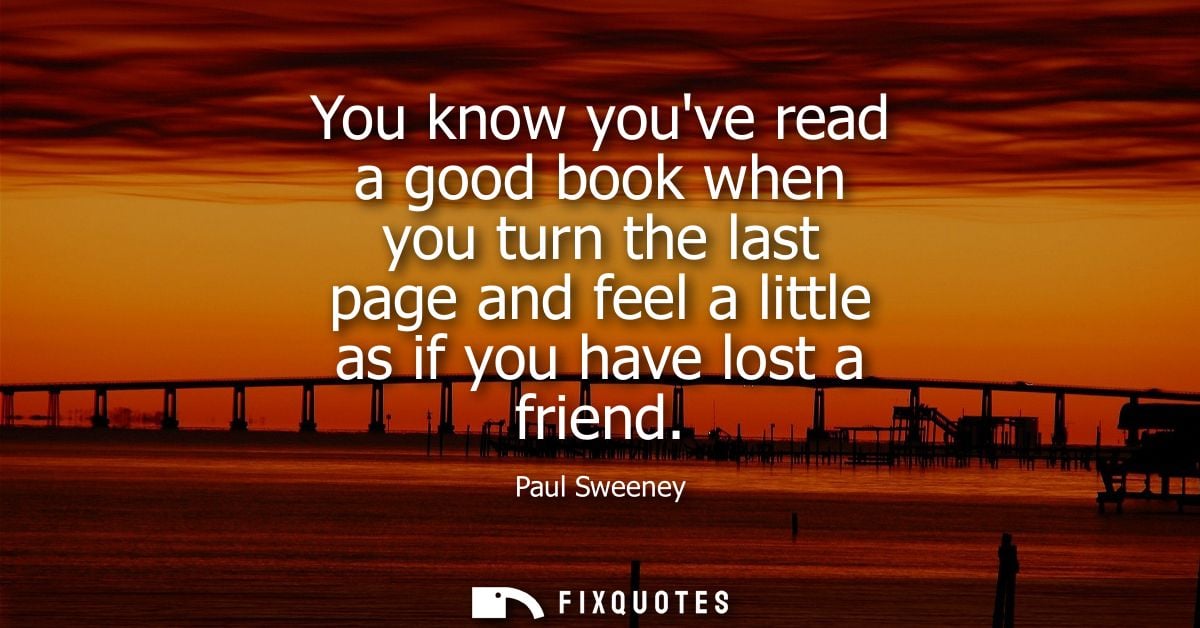
"You know you've read a good book when you turn the last page and feel a little as if you have lost a friend"
About this Quote
The intent is cultural persuasion. Politicians rarely win points by sounding like aesthetes, but they can champion literacy by framing it as emotional infrastructure. This quote makes reading feel less like self-improvement homework and more like a kind of companionship anyone deserves. It's also subtly flattering: if you've felt that loss, you're the sort of person who forms attachments to ideas and voices. That's an identity offer, not just an observation.
The subtext has a quiet anxiety embedded in it: endings hurt because immersion is real. A "good book" is defined by withdrawal symptoms, by the reader's temporary bereavement. That reframes the usual consumer logic. You didn't just "finish" something; something finished happening to you. It also implies that books can model stable, nonjudgmental intimacy - a pointed contrast to public life, where relationships are transactional and noisy.
Contextually, coming from an active politician (born 1989), it reads like a modern, media-friendly defense of attention in an age of distraction: the best stories don't just entertain; they linger, and their absence leaves a mark.
Quote Details
| Topic | Book |
|---|---|
| Source | Later attribution: Quote Unquote (A Handbook of Quotations) (M.P. Singh, 2005) modern compilationISBN: 9788183820080 · ID: WYIA-pEQTCAC
Evidence:
... You know you've read a good book when you turn the last page and feel a little as if you have lost a friend . " Paul Sweeney " To my daughter Leonora with- out whose never failing sympathy and encouragement this book would have been ... |
| Cite |
Citation Formats
APA Style (7th ed.)
Sweeney, Paul. (2026, February 21). You know you've read a good book when you turn the last page and feel a little as if you have lost a friend. FixQuotes. https://fixquotes.com/quotes/you-know-youve-read-a-good-book-when-you-turn-the-128606/
Chicago Style
Sweeney, Paul. "You know you've read a good book when you turn the last page and feel a little as if you have lost a friend." FixQuotes. February 21, 2026. https://fixquotes.com/quotes/you-know-youve-read-a-good-book-when-you-turn-the-128606/.
MLA Style (9th ed.)
"You know you've read a good book when you turn the last page and feel a little as if you have lost a friend." FixQuotes, 21 Feb. 2026, https://fixquotes.com/quotes/you-know-youve-read-a-good-book-when-you-turn-the-128606/. Accessed 6 Apr. 2026.