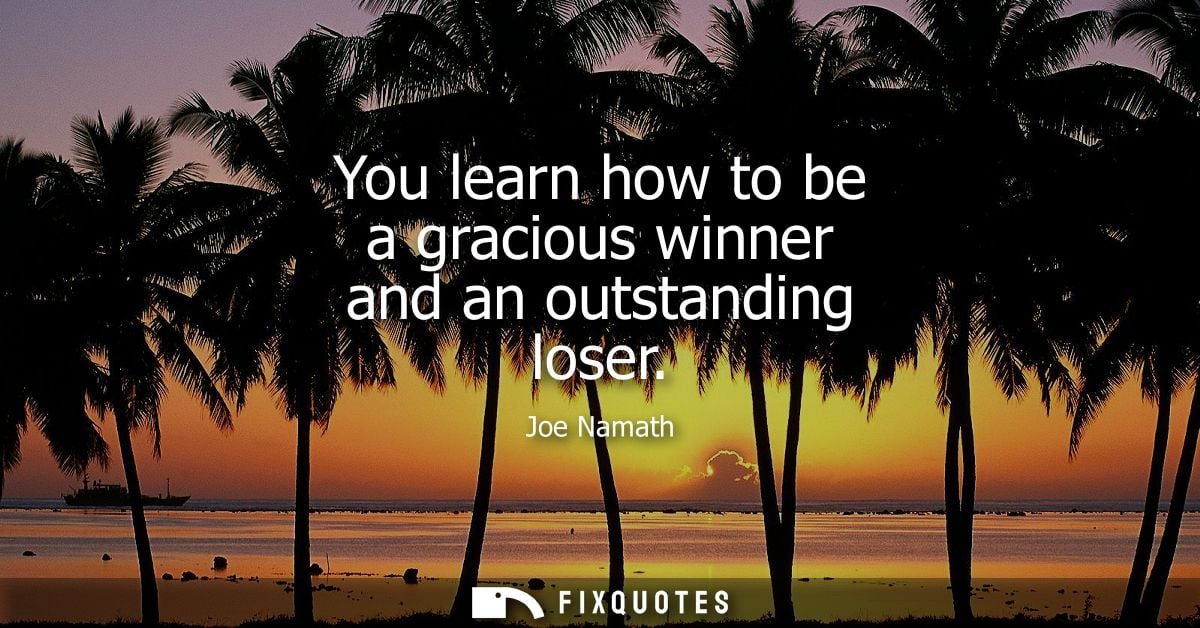
"You learn how to be a gracious winner and an outstanding loser"
About this Quote
In Joe Namath's world, swagger only works if it’s paired with self-control. "You learn how to be a gracious winner and an outstanding loser" reads like a simple sports platitude until you notice the asymmetry: winning merely asks for grace, but losing demands excellence. That’s the pressure point. Anyone can be charming with a trophy in hand; the real character test is what you do when the cameras catch you empty-handed, sweaty, and disappointed.
Namath, a quarterback built as much on celebrity as performance, understood that sports aren’t just competition - they’re public theater. The athlete is always auditioning: for teammates, for fans, for the press, for history. This line is less about etiquette and more about image under stress. "Outstanding" implies craft: you don’t just absorb defeat, you shape it. You keep the locker room intact, you don’t poison the narrative, you don’t give opponents or critics the soundbite they want. Losing becomes another kind of leadership.
The subtext is a quiet critique of American winner-worship. We love victory so much we treat defeat like moral failure, then act surprised when athletes melt down, make excuses, or lash out. Namath offers a harder standard: take the win without cruelty, take the loss without self-pity. It’s a code meant for a culture where reputation can outlast stats, and where the most revealing moments often happen after the scoreboard has already settled the argument.
Namath, a quarterback built as much on celebrity as performance, understood that sports aren’t just competition - they’re public theater. The athlete is always auditioning: for teammates, for fans, for the press, for history. This line is less about etiquette and more about image under stress. "Outstanding" implies craft: you don’t just absorb defeat, you shape it. You keep the locker room intact, you don’t poison the narrative, you don’t give opponents or critics the soundbite they want. Losing becomes another kind of leadership.
The subtext is a quiet critique of American winner-worship. We love victory so much we treat defeat like moral failure, then act surprised when athletes melt down, make excuses, or lash out. Namath offers a harder standard: take the win without cruelty, take the loss without self-pity. It’s a code meant for a culture where reputation can outlast stats, and where the most revealing moments often happen after the scoreboard has already settled the argument.
Quote Details
| Topic | Defeat |
|---|---|
| Source | Later attribution: PR for Anyone (Christina Daves, 2014) modern compilationISBN: 9781630470364 · ID: 4P9fAgAAQBAJ
Evidence:
... You learn how to be a gracious winner and an outstanding loser . -Joe Namath As heartbreaking as it is , getting bumped from a show happens . Don't take it personally . This scenario is somewhat common on live television , especially if ... |
| Cite |
Citation Formats
APA Style (7th ed.)
Namath, Joe. (2026, March 10). You learn how to be a gracious winner and an outstanding loser. FixQuotes. https://fixquotes.com/quotes/you-learn-how-to-be-a-gracious-winner-and-an-147011/
Chicago Style
Namath, Joe. "You learn how to be a gracious winner and an outstanding loser." FixQuotes. March 10, 2026. https://fixquotes.com/quotes/you-learn-how-to-be-a-gracious-winner-and-an-147011/.
MLA Style (9th ed.)
"You learn how to be a gracious winner and an outstanding loser." FixQuotes, 10 Mar. 2026, https://fixquotes.com/quotes/you-learn-how-to-be-a-gracious-winner-and-an-147011/. Accessed 6 Apr. 2026.
More Quotes by Joe
Add to List