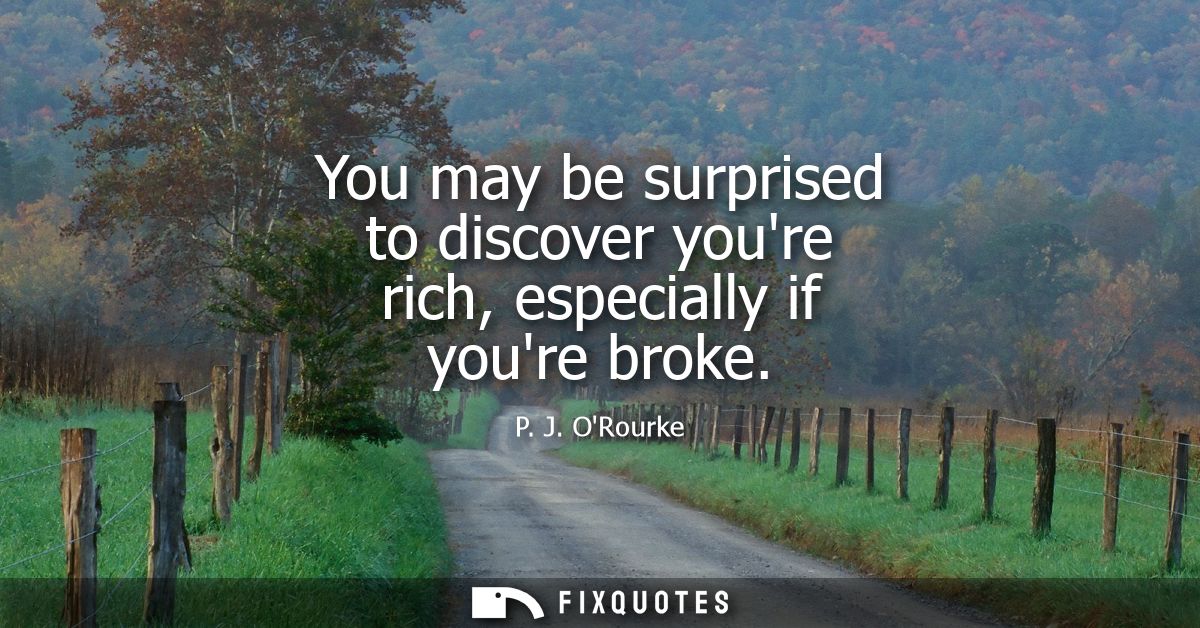
"You may be surprised to discover you're rich, especially if you're broke"
About this Quote
O'Rourke sets a trap with the breezy second person: he pulls you in as the butt of the joke, then lets you realize the joke is about the way we measure ourselves. "Surprised" is the tell. Richness, in this framing, isn't a stable fact but a revelation, something you only notice when the culture hands you the right yardstick. The punch line hinges on the deliciously ugly contrast between "rich" and "broke" - words that feel like opposites until you remember how often people with empty bank accounts still live inside an empire of conveniences, safety nets, and consumer abundance.
The intent is less self-help than political mischief. O'Rourke, a libertarian-leaning satirist disguised as a travel writer, likes to needle both the romance of victimhood and the pieties of redistribution. By suggesting that the broke might be "rich", he mocks a certain American reflex to treat hardship as proof of systemic destitution rather than relative standing. The line also jabs at the psychological economy of status: you can be materially comfortable and still feel poor if everyone around you is doing better, or if advertising has trained you to experience desire as deprivation.
Context matters: late-20th-century America, with its swelling middle-class expectations, easy credit, and constant comparison shopping, made "broke" a temporary mood as much as a condition. The subtext is cynical but useful: wealth isn't only what you have; it's what you can take for granted without noticing you've got it.
The intent is less self-help than political mischief. O'Rourke, a libertarian-leaning satirist disguised as a travel writer, likes to needle both the romance of victimhood and the pieties of redistribution. By suggesting that the broke might be "rich", he mocks a certain American reflex to treat hardship as proof of systemic destitution rather than relative standing. The line also jabs at the psychological economy of status: you can be materially comfortable and still feel poor if everyone around you is doing better, or if advertising has trained you to experience desire as deprivation.
Context matters: late-20th-century America, with its swelling middle-class expectations, easy credit, and constant comparison shopping, made "broke" a temporary mood as much as a condition. The subtext is cynical but useful: wealth isn't only what you have; it's what you can take for granted without noticing you've got it.
Quote Details
| Topic | Wealth |
|---|---|
| Source | Help us find the source |
| Cite |
Citation Formats
APA Style (7th ed.)
O'Rourke, P. J. (2026, January 18). You may be surprised to discover you're rich, especially if you're broke. FixQuotes. https://fixquotes.com/quotes/you-may-be-surprised-to-discover-youre-rich-15921/
Chicago Style
O'Rourke, P. J. "You may be surprised to discover you're rich, especially if you're broke." FixQuotes. January 18, 2026. https://fixquotes.com/quotes/you-may-be-surprised-to-discover-youre-rich-15921/.
MLA Style (9th ed.)
"You may be surprised to discover you're rich, especially if you're broke." FixQuotes, 18 Jan. 2026, https://fixquotes.com/quotes/you-may-be-surprised-to-discover-youre-rich-15921/. Accessed 10 Feb. 2026.
More Quotes by J. O'Rourke
Add to List