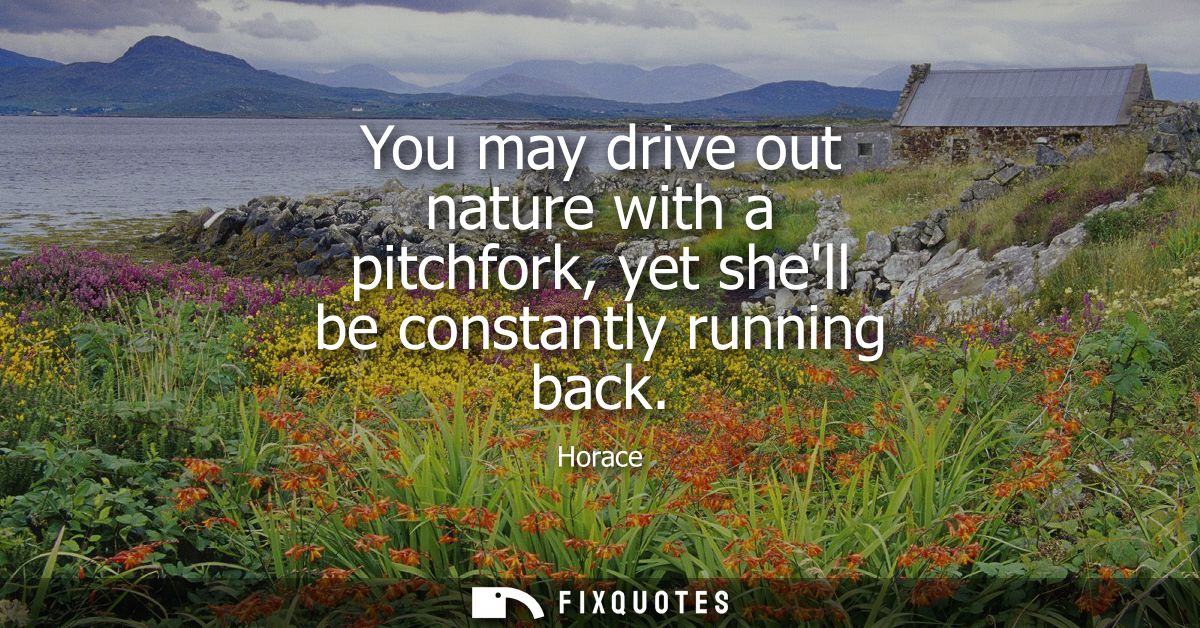
"You may drive out nature with a pitchfork, yet she'll be constantly running back"
About this Quote
The intent is less romantic than diagnostic. In Augustan Rome, moral legislation and social engineering were in vogue: shoring up family values, policing sexual behavior, staging virtue as public theater after decades of civil war. Horace, a court poet with a skeptical edge, understood the empire's obsession with order-and the private chaos that order never fully tames. The line flatters common sense against ideology: you can draft laws, practice stoic self-command, cultivate a polished persona, but the underlying drives reassert themselves in quieter, messier ways.
Subtextually, "nature" is also a jab at pretension. The pitchfork suggests the anxious elite trying to banish their own origins: rusticity, bodily needs, unrefined speech, inconvenient emotions. Horace isn't arguing for surrender to instinct so much as warning that denial is expensive and temporary. The wit lands because it turns a grand philosophical problem into a farmyard scene: metaphysics with dirt under its nails.
Quote Details
| Topic | Nature |
|---|---|
| Source | Verified source: Epistles (Epistulae), Book I (Horace, -20)
Evidence: Naturam expelles furca, tamen usque recurret et mala perrumpet furtim fastidia uictrix. (Book 1, Epistle 10, lines 24–25). This is the primary source in Horace’s own work (Latin). The commonly cited English version (“You may drive out nature with a pitchfork, yet she’ll be constantly running back”) is a paraphrase/translation of the Latin line. The epistle is addressed to Aristius Fuscus (Epistle 10) within Epistles Book 1. Many modern references date this epistle collection to around 20 BCE (often c. 20 BCE). Other candidates (1) The Oxford Dictionary of Phrase and Fable (Elizabeth Knowles, 2006)92.9% ... Horace (65–8 BC), 'Naturam expelles furca, tamen usque recurret[You may drive out nature with a pitchfork, yet sh... |
| Cite |
Citation Formats
APA Style (7th ed.)
Horace. (2026, February 17). You may drive out nature with a pitchfork, yet she'll be constantly running back. FixQuotes. https://fixquotes.com/quotes/you-may-drive-out-nature-with-a-pitchfork-yet-24579/
Chicago Style
Horace. "You may drive out nature with a pitchfork, yet she'll be constantly running back." FixQuotes. February 17, 2026. https://fixquotes.com/quotes/you-may-drive-out-nature-with-a-pitchfork-yet-24579/.
MLA Style (9th ed.)
"You may drive out nature with a pitchfork, yet she'll be constantly running back." FixQuotes, 17 Feb. 2026, https://fixquotes.com/quotes/you-may-drive-out-nature-with-a-pitchfork-yet-24579/. Accessed 7 Apr. 2026.